Dog Bites the Neighbor: What Happens Next?

Dog Bites the Neighbor: What Happens Next? (The Insurance Guide Every Dog Owner Should Read)

Dogs are part of the family. They protect us, entertain us, and make our homes feel complete. But even the friendliest dog can bite under the wrong circumstances. If your dog bites a neighbor, a delivery driver, or even a visiting friend, the situation can quickly become stressful — emotionally and financially.

Many dog owners assume, “My homeowners insurance will cover it.” Sometimes that’s true — but not always.

Here’s a complete insurance-focused guide to what happens if your dog bites someone and how to protect yourself before and after an incident.


First Things First: Make Sure Everyone Is Safe

If a dog bite occurs:

1️⃣ Help the injured person immediately

  • Clean the wound if possible

  • Apply pressure to stop bleeding

  • Seek medical attention if needed

2️⃣ Exchange information
Provide:

  • Your name and contact info

  • Insurance company name

  • Policy number (if available)

3️⃣ Document what happened
Take photos of:

  • The location

  • The dog

  • The injury (if appropriate)

  • Any gates or fences

4️⃣ Report the incident
Many cities require reporting dog bites to:

  • Animal control

  • Local health department

Staying calm and cooperative can help prevent the situation from escalating.


Does Homeowners Insurance Cover Dog Bites?

In many cases, yes — homeowners insurance covers dog bite liability claims.

Most standard homeowners policies include Personal Liability Coverage, which helps pay for:

✔ Medical bills
✔ Legal expenses ⚖️
✔ Settlements
✔ Court judgments
✔ Lost wages of the injured person

Typical liability limits include:

  • $100,000

  • $300,000

  • $500,000

But here’s the problem…

Dog bite claims can easily exceed $300,000.

That’s why insurance professionals often recommend higher liability limits or an umbrella policy. ☂️


💸 How Expensive Can a Dog Bite Claim Be?

Dog bites are one of the most common homeowners insurance claims.

Costs can include:

  • Emergency room visits

  • Surgery

  • Plastic surgery

  • Physical therapy

  • Lost wages

  • Pain and suffering

  • Legal costs

A serious bite injury can cost tens or even hundreds of thousands of dollars.

Without insurance, you would be responsible for these costs personally.


🚫 When Dog Bites Might NOT Be Covered

Not all policies automatically cover dog bites. Some insurance companies:

❌ Exclude Certain Breeds

Some insurers restrict coverage for breeds such as:

  • Pit Bulls

  • Rottweilers

  • Dobermans

  • German Shepherds

  • Akitas

  • Wolf hybrids

Even if your dog is gentle, the breed alone can affect coverage.


❌ Exclude Dogs With Bite History

If your dog has bitten before:

Your insurance company may:

  • Raise your rates

  • Exclude the dog

  • Cancel the policy

Always report prior incidents honestly when applying for insurance.


❌ Exclude Business Activities

If your dog bites someone while you run a business from home, coverage might not apply.

Examples:

  • Dog breeding

  • Dog boarding

  • Pet sitting

You may need special business liability insurance.


👥 What If the Bite Happens Away From Home?

Good news:

Most homeowners insurance policies cover dog bites anywhere, not just on your property.

This includes:

✔ Parks 
✔ Sidewalks
✔ Neighborhood walks 
✔ Friends’ homes

Your liability coverage usually follows you, not just your house.


🧾 What Happens After You File a Claim?

If your dog bites someone and you file a claim, the insurance company typically:

Step 1: Investigation

They may ask:

  • What happened?

  • Was the dog restrained?

  • Has the dog bitten before?

  • Were warning signs posted?

They may also:

  • Contact the injured person

  • Request medical records

  • Review animal control reports


Step 2: Coverage Review

The company checks:

  • Liability limits

  • Dog exclusions

  • Breed restrictions

  • Policy conditions


Step 3: Settlement or Defense

If you’re legally responsible, the insurer may:

✔ Pay medical bills
✔ Negotiate a settlement
✔ Hire a lawyer to defend you ⚖️

This legal defense is included in most policies.

Even if you’re not at fault, insurance can pay to defend you.


☂️ Why an Umbrella Policy Matters

A Personal Umbrella Policy provides extra liability protection above your homeowners policy.

Example:

Homeowners Liability Limit:

  • $300,000

Dog Bite Claim:

  • $750,000

Umbrella Policy:

  • Covers the remaining $450,000

Umbrella policies often cost $150–$300 per year — one of the best values in insurance.

For dog owners, umbrellas provide peace of mind.


🛡️ How to Reduce Dog Bite Risk

Insurance protects you financially, but prevention is even better.

Smart safety tips include:

✔ Proper training 🐾
✔ Socialization
✔ Secure fencing
✔ Leashes in public
✔ Supervision around kids
✔ Warning signs if needed

Never assume:

“My dog would never bite.”

Even good dogs can react unexpectedly.


📋 Questions Dog Owners Should Ask Their Insurance Agent

If you own a dog, ask:

  • Is my dog covered?

  • Are there breed restrictions?

  • What is my liability limit?

  • Should I get an umbrella policy?

  • Is my dog specifically excluded?

Many homeowners discover coverage gaps after a claim — not before.


🚩 Warning Signs You Might Be Underinsured

You may need more coverage if:

⚠ You have only $100,000 liability coverage
⚠ You own a large dog
⚠ You have frequent visitors
⚠ Kids play in your yard
⚠ You walk your dog in busy areas
⚠ You own a pool or trampoline

These increase liability risk.


🤝 Final Thoughts: Protecting Your Family and Your Dog

A dog bite can happen in seconds — but the financial consequences can last for years.

The good news is that the right insurance coverage can protect you from devastating costs.

The best protection plan includes:

✔ Solid homeowners insurance
✔ Higher liability limits
✔ Umbrella coverage ☂️
✔ Honest communication with your agent

If you’re not sure whether your dog is covered, it’s worth reviewing your policy.

Because when it comes to dog bites…

The best time to check your insurance is before the bite happens.


You can experience being a part of and full-serviced independent Insurance Agency today! Simply contact Briggs Agency Inc, if you are interested in an insurance review at 219-769-4840 or visit our website at www.BriggsAgency.com. We look forward to hearing from you!


Blog post written by: Zachary Pelke

Small Garage Insurance Indiana: Scalability for Growing Shops

Running a garage in Indiana means managing more than just vehicles and tools. Your insurance needs change as your business grows, and a basic commercial policy often leaves you exposed.

At Briggs Agency, Inc., we’ve helped countless shop owners find small garage insurance in Indiana that actually keeps pace with their expansion. This guide walks you through the coverage gaps most garages face and how to build protection that scales with your success.

What Coverage Your Indiana Garage Actually Needs

The Six Coverages That Protect Your Shop

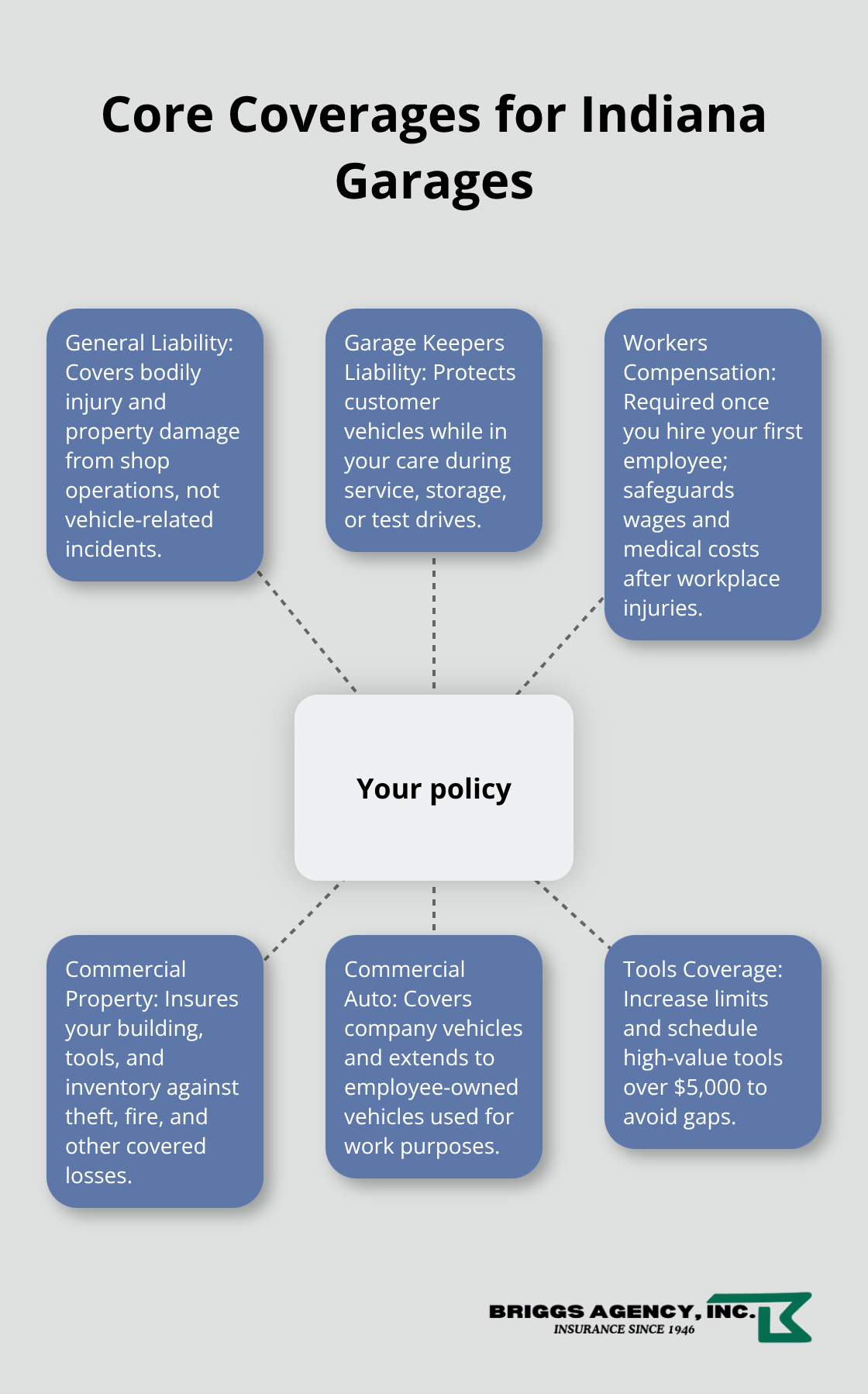
Most garage owners in Indiana start with a standard commercial policy, then discover months later that it doesn’t cover the specific risks they face daily. Workers’ compensation protects your team-the U.S. Bureau of Labor Statistics recorded over 9,900 nonfatal injuries and illnesses in 2020 across the private automotive service sector, and your technicians face real exposure to burns, cuts, and back injuries. Garage keeper’s insurance is equally vital because it covers customer vehicles in your care from damage due to fire, theft, or accidents during service. Without it, a mechanic’s test drive that ends in a fender bender or a vehicle damaged by a shop fire leaves you personally liable. General liability covers the third-party claims you might face-if a customer slips in your shop or if your work causes property damage to someone else’s vehicle. Commercial property insurance protects your physical assets, tools, and equipment from fire, storms, theft, and vandalism. Loss of income insurance keeps your business afloat if a covered event like a fire temporarily shuts you down, covering payroll, taxes, and mortgage payments while you rebuild. Commercial auto insurance is mandatory if you own or use vehicles for business purposes, since personal auto policies explicitly exclude business use. These six coverages form the foundation that keeps your shop protected, and skipping any one of them creates exposure that grows exponentially as your business expands.

Checklist of six essential insurance coverages for small auto repair shops in Indiana.

The Care, Custody, and Control Problem

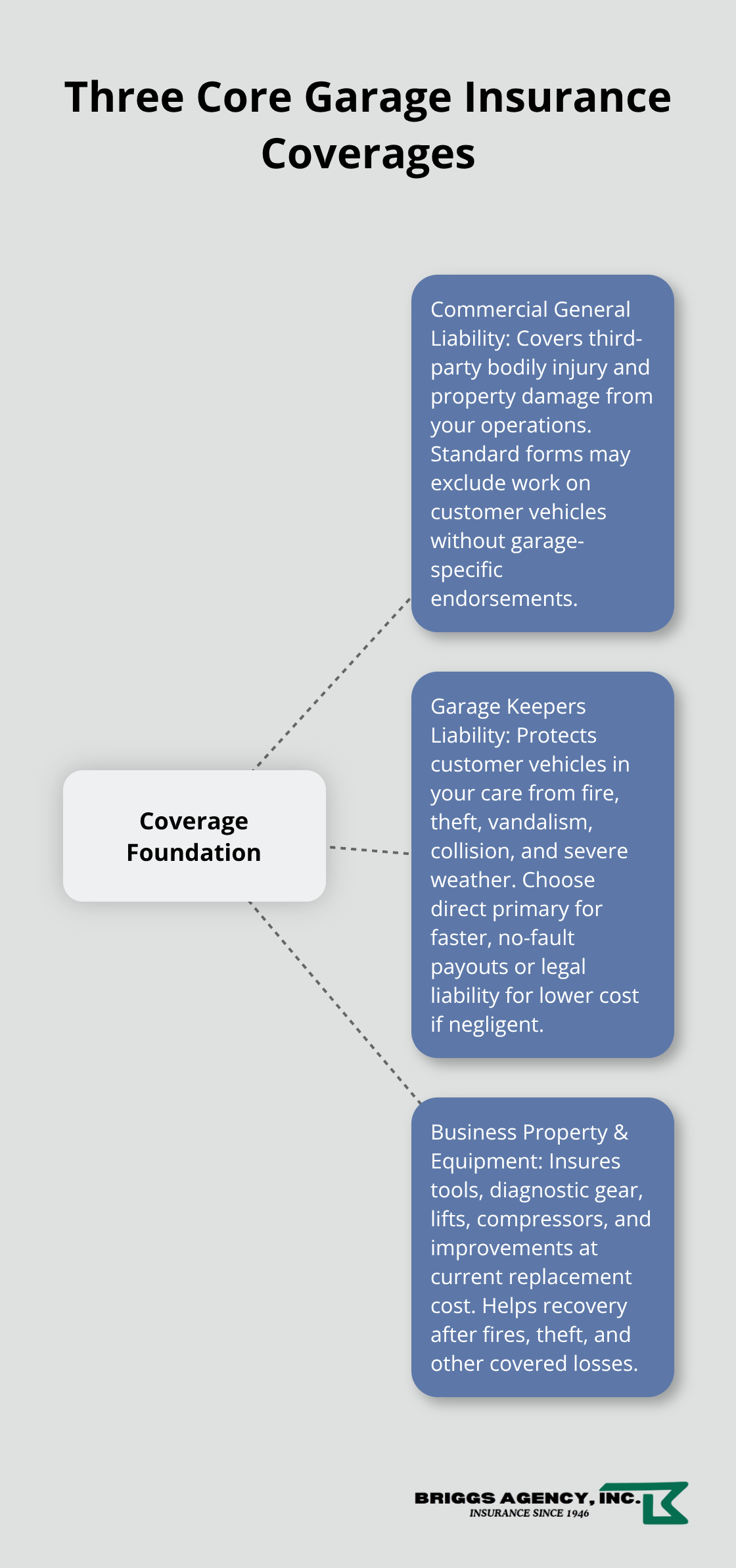
A basic commercial policy typically excludes property damage to vehicles in your care, custody, or control-exactly what you need coverage for. This exclusion exists because standard policies assume you’re not handling customer property, but garages do nothing but handle customer property. Garage keeper’s coverage fills this gap by protecting customer vehicles regardless of whether your shop was at fault, though you can choose between legal liability coverage (which only pays if you’re negligent) or direct primary coverage (which pays regardless of fault).

What Indiana Garages Actually Pay for Insurance

The monthly cost for a small auto repair shop in Indiana ranges from about $39 to $89 depending on coverage type and risk profile, according to Nationwide. Many shop owners try to save money by choosing the lowest-cost option, only to face a $15,000 claim on a customer’s vehicle that their policy doesn’t cover. Indiana doesn’t mandate specific garage insurance under consumer protection law the way California does, but that doesn’t mean you can operate without proper coverage-it means you need to be proactive about protecting yourself.

Why Your Agent Matters More Than You Think

The difference between adequate coverage and inadequate coverage often comes down to whether you work with an agent who understands automotive operations or someone who just sells generic policies. An agent familiar with garage operations knows which exclusions create real exposure and which coverage options actually fit your daily work. When you’re ready to build a plan that scales with your growth, working with someone who speaks your language makes all the difference.

How Your Insurance Needs Change as Your Garage Grows

Your Coverage Shifts With Every Business Change

Your insurance costs and coverage requirements shift dramatically as you add vehicles, hire staff, and expand services. A shop with two technicians and a basic service menu faces entirely different risks than one with eight employees offering diagnostics, transmission work, and tire services. Premiums rise based on your coverage type, past claims history, total assets insured, and the number of employees and equipment at risk, according to Nationwide. When you add a second service bay or hire your first full-time technician, your exposure to workers’ compensation claims increases immediately-that’s not theoretical risk, that’s a direct line item in your policy. More equipment means higher commercial property insurance costs. More vehicles in your care means higher garage keeper’s exposure. More employees means higher general liability exposure when someone gets hurt or your work causes damage.

The Cost of Ignoring Growth

Most shop owners keep the same policy they bought two years ago while their business has fundamentally changed. Your insurance should reflect your actual operation, not your old one. This gap between your policy and your reality creates serious exposure that compounds with each expansion.

When to Review Your Coverage

The practical approach is reviewing your coverage every time you make a significant business change: adding a location, purchasing a lift or diagnostic equipment, hiring new staff, or launching a new service line. When you add vehicles to your fleet, your commercial auto insurance needs adjustment-especially if those vehicles are used for customer drop-offs or service calls. When you hire your first employee, workers’ compensation becomes non-negotiable in Indiana, and your general liability exposure jumps because you’re now liable for their actions and safety.

Hub-and-spoke diagram showing business changes that should trigger an insurance review for Indiana garages. - Small garage insurance Indiana

When you expand into services like transmission rebuilds or electrical diagnostics, some carriers may require additional training certifications or charge higher premiums due to increased complexity and potential liability.

Getting the Right Rate for Your Expanded Shop

Getting multiple quotes when your business changes is critical because rates vary significantly between carriers and coverage tiers. Don’t settle for the first quote after an expansion-shop around to ensure you’re not overpaying for coverage you’ve outgrown or underpaying for protection you actually need. As your shop grows, more comprehensive policies become necessary to reflect your increased exposure from more vehicles, staff, and assets.

The question isn’t whether your coverage needs adjustment-it’s whether you’ll catch those gaps before they cost you thousands. Finding an insurance partner who understands automotive operations and stays proactive about your changing needs separates shops that grow safely from those that face unexpected exposure.

Finding the Right Insurance Partner for Your Garage

What to Look for in an Insurance Agent

The agent you choose matters more than the carrier you select. A good agent catches gaps in your coverage before they become expensive problems; a mediocre one sells you a policy and disappears. When you evaluate potential insurance partners, look for someone with direct experience in automotive operations, not someone who treats your garage like any other small business. An agent who understands garage operations knows that a test drive creates different liability exposure than regular shop work, knows which coverage exclusions actually matter to you, and knows that your insurance needs shift fundamentally when you add a second location or hire your tenth employee.

Ask potential agents specific questions about garage keeper’s coverage options, workers’ compensation requirements for Indiana shops, and how they handle coverage adjustments during expansion. If an agent cannot explain the difference between legal liability and direct primary garage keeper’s coverage without reading from a script, they don’t understand your business well enough to protect it effectively.

Getting Multiple Quotes and Comparing Them

Rates for garage insurance vary dramatically between carriers based on coverage type, claims history, total assets, and employee count, so accepting the first quote leaves money on the table. When you request quotes, provide identical information to each carrier so you can make accurate comparisons-don’t let one agent quote you basic coverage while another quotes comprehensive protection.

Compact checklist of steps to fairly compare garage insurance quotes from multiple carriers. - Small garage insurance Indiana

After you receive quotes, negotiate. Insurance companies build negotiating room into their initial offers, and an agent who won’t push back on pricing isn’t advocating for your business. As your shop expands into new service lines or adds locations, your coverage should expand too, which means revisiting quotes periodically rather than assuming your current rates remain competitive.

Staying Proactive as Your Business Changes

Your coverage needs shift with your operation, so your insurance partnership must shift with them. An agent who understands this reality stays in touch as your shop grows and proactively suggests coverage adjustments before you face exposure. When you add equipment, hire staff, or launch new services, your agent should flag the coverage implications and help you adjust your policy accordingly.

Working with a local agent who understands Indiana’s specific business environment and regulatory landscape ensures your coverage aligns with state requirements and local market conditions rather than generic national standards that may not apply to your operation. An independent agency that represents multiple top-rated carriers can compare your actual options and find coverage that fits both your risk profile and your budget without settling for inadequate protection.

Final Thoughts

Your garage’s insurance needs shift as you hire staff, add equipment, and expand service offerings. The shops that grow sustainably treat small garage insurance in Indiana as a living part of their business strategy, not a checkbox they completed years ago. Workers’ compensation, garage keeper’s, general liability, commercial property, loss of income, and commercial auto coverage form the baseline protection every Indiana garage needs, but baseline protection falls short once your operation expands.

An agent who understands automotive operations catches coverage gaps before they become expensive problems. They know that adding a second location changes your commercial property exposure, that hiring your first employee makes workers’ compensation non-negotiable, and that launching electrical diagnostics services may require coverage adjustments or carrier approval. They stay proactive rather than reactive, flagging coverage implications before you face exposure.

When you’re ready to review your coverage or build a plan for your expanding operation, reach out to our experienced local agents who understand what it takes to protect a growing garage.

The information provided in this blog is for general informational purposes only and does not constitute legal, financial, or insurance advice. Coverage options, terms, and availability may vary. Please consult with a licensed professional for advice specific to your situation.
Artificial intelligence may have been used to generate text and images in some blog articles.


Insurance Terms Explained in Plain English

🧠 Insurance Terms Explained in Plain English

A Simple Guide to Understanding Your Insurance Policy

Insurance policies can feel like they’re written in another language. Terms like deductible, liability, and replacement cost show up everywhere, but most people aren’t exactly sure what they mean. The truth is, understanding these terms can help you avoid expensive mistakes, choose better coverage, and feel confident about your protection.

This guide explains the most important insurance terms in plain English so you actually understand what you’re paying for. Whether you have auto, home, renters, or business insurance, these are the words you need to know.


💰 Deductible

Plain English: The amount you pay before insurance starts paying.

Your deductible is your share of the cost when you file a claim.

Example:

If your deductible is $1,000 and your repair costs are $6,000, you pay $1,000 and your insurance pays $5,000.

Important Tips:

  • Higher deductibles usually mean lower monthly premiums

  • Lower deductibles mean higher monthly premiums

  • Choose a deductible you could afford in an emergency

👉 Many homeowners choose deductibles between $1,000–$2,500.


🛡️ Liability Coverage

Plain English: Protection if you hurt someone or damage their property.

Liability coverage pays for:

  • Medical bills for other people

  • Property damage

  • Legal fees

  • Lawsuits

Example:

If you cause a car accident and damage another vehicle, liability insurance pays for their repairs — not yours.

Why It Matters:

Liability coverage protects your:

  • Savings

  • Future income

  • Assets

Low liability limits are one of the biggest risks people take without realizing it.

Many experts recommend at least:

  • $100,000 per person

  • $300,000 per accident

  • Or higher if possible.


🚗 Full Coverage

Plain English: Not an official type of insurance — just a nickname.

“Full coverage” usually means you have:

  • Liability

  • Collision

  • Comprehensive

But it does NOT mean everything is covered.

It Often Does NOT Include:

  • Rental car reimbursement

  • Gap coverage

  • Roadside assistance

  • New car replacement

Always ask what “full coverage” actually includes.


🔧 Collision Coverage

Plain English: Pays to fix your car if you crash.

Collision covers damage to your vehicle from:

  • Hitting another car

  • Hitting a pole

  • Hitting a guardrail

  • Single-car accidents

Example:

You slide on ice and hit a mailbox. Collision coverage pays for your repairs.


🌧️ Comprehensive Coverage

Plain English: Covers damage that isn’t a crash.

Comprehensive covers things like:

  • Theft

  • Vandalism

  • Fire

  • Storm damage

  • Falling trees

  • Hitting a deer

  • Broken windshield

Example:

A tree branch falls on your parked car during a storm — comprehensive coverage pays for repairs.


🏠 Replacement Cost

Plain English: Insurance pays to replace items with new ones.

Replacement cost means insurance pays what it costs today to replace your property with new items.

Example:

Your TV cost $800 five years ago. A similar new TV costs $1,100 today.

Replacement cost pays $1,100, not $800.

Why It Matters:

Replacement cost helps you fully recover after a loss.


📉 Actual Cash Value (ACV)

Plain English: Replacement cost minus depreciation.

Actual Cash Value means insurance pays what your item is worth today, not what it costs new.

Example:

Your couch cost $2,000 five years ago.

Insurance might value it at $700 today.

You would receive $700, not $2,000.

This is why replacement cost coverage is usually better.


📊 Policy Limit

Plain English: The maximum amount insurance will pay.

Every policy has limits.

Example:

Home policy limits:

  • Dwelling: $350,000

  • Personal Property: $175,000

  • Liability: $300,000

Insurance will not pay more than these amounts.

If damages exceed limits, you pay the difference.


📄 Endorsement (Rider)

Plain English: Extra coverage added to a policy.

An endorsement modifies your policy.

Examples:

  • Jewelry coverage

  • Sewer backup coverage

  • Home business coverage

  • Equipment coverage

Endorsements help customize your protection.


🌊 Exclusions

Plain English: Things your policy does NOT cover.

Every policy has exclusions.

Common Exclusions:

Home insurance usually excludes:

  • Flood damage

  • Earthquakes

  • Wear and tear

  • Mold (sometimes)

Auto insurance usually excludes:

  • Intentional damage

  • Commercial use (sometimes)

Reading exclusions helps avoid surprises.


🚙 Permissive Use

Plain English: Insurance usually follows the car, not the driver.

If you let someone borrow your car occasionally, your insurance usually applies.

Example:

Your friend borrows your car and causes an accident.

Your insurance typically pays first.

Important:

Regular drivers should be listed on the policy.


💵 Premium

Plain English: The price you pay for insurance.

Premiums can be paid:

  • Monthly

  • Quarterly

  • Annually

Premiums are based on:

  • Driving history

  • Credit (in many states)

  • Claims history

  • Location

  • Coverage levels


🧾 Claim

Plain English: A request for insurance to pay for a loss.

You file a claim when something happens like:

  • Accident

  • Storm damage

  • Theft

Typical Claim Steps:

1️⃣ Report the loss
2️⃣ Provide information
3️⃣ Adjuster reviews
4️⃣ Damage is estimated
5️⃣ Payment issued


☂️ Umbrella Policy

Plain English: Extra liability protection above your normal policies.

Umbrella insurance adds extra protection on top of:

  • Auto insurance

  • Home insurance

Example:

Auto liability limit:
$300,000

Umbrella policy:
$1,000,000

Total protection:
$1.3 million

Umbrella policies are usually surprisingly affordable.

Many cost $150–$300 per year.


🧠 Why Understanding Insurance Terms Matters

Understanding your insurance helps you:

✔ Avoid coverage gaps
✔ Choose the right limits
✔ Save money
✔ Avoid claim surprises
✔ Protect your assets
✔ Make smarter decisions

Most insurance problems happen because people didn’t understand what their policy covered.


⭐ Quick Cheat Sheet

Deductible = What you pay first
Premium = What you pay monthly
Liability = Protects you from lawsuits
Collision = Crash damage
Comprehensive = Non-crash damage
Replacement Cost = New item value
Actual Cash Value = Used item value
Policy Limit = Maximum payout
Endorsement = Extra coverage
Exclusion = Not covered


📞 Final Thoughts

Insurance doesn’t have to be confusing. Once you understand the basics, it’s much easier to choose the right coverage and avoid costly mistakes.

If you’re ever unsure what your policy means, it’s always a good idea to talk with a local independent agent who can explain your coverage in plain English.

Because the best insurance policy isn’t just affordable — it’s one you actually understand.


You can experience being a part of and full-serviced independent Insurance Agency today! Simply contact Briggs Agency Inc, if you are interested in an insurance review at 219-769-4840 or visit our website at www.BriggsAgency.com. We look forward to hearing from you!


Blog post written by: Zachary Pelke

Best Contractor Insurance Indiana: How to Choose the Right Partner

Running a contracting business in Indiana means protecting yourself from real financial risk. Without the right coverage, one accident or injury claim can threaten everything you’ve built.

We at Briggs Agency, Inc. help contractors find the best contractor insurance Indiana has to offer. This guide walks you through what coverage you actually need and how to pick a partner who understands your business.

What Coverage Does Indiana Actually Require for Contractors

Local Requirements Vary-But Client Demands Don’t

Indiana doesn’t impose a statewide contractor licensing mandate, which means requirements vary by city and county. However, this decentralized approach creates a real problem: many contractors assume they need less insurance than they actually do. That’s backwards. Even if your local jurisdiction doesn’t mandate specific coverage, your clients almost certainly will.

Chart showing 99% of Indiana general liability policies are written at market-standard limits - Best contractor insurance Indiana

General liability insurance with limits of $2 million per occurrence and $4 million aggregate has become the market standard, and about 99% of Indiana general liability policies sold fall into this tier. If you bid on projects without this coverage, you won’t win the work.

Workers’ Compensation: Non-Negotiable for Employers

Indiana law requires workers’ compensation insurance if you have employees-there’s no way around it. A sole proprietor operating alone might technically avoid the requirement, but that’s genuinely risky. One injury could bankrupt you. Most contractors with employees should carry coverage at the standard $500,000 per occurrence level, though the policy’s overall protection extends beyond that single-incident limit. MoneyGeek data shows workers’ comp in Indiana averages around $162 per month, making it one of your most important monthly expenses.

Beyond the Basics: Specialized Coverage for Contractor Risks

Indiana contractors face specific risks that demand targeted coverage. Commercial auto insurance protects company vehicles and covers bodily injury, property damage, theft, and weather-related incidents-carriers typically recommend a combined single limit of at least $1,000,000.

Hub-and-spoke diagram of specialized insurance coverages for Indiana contractors - Best contractor insurance Indiana

Builder’s risk insurance becomes essential on active job sites, covering structures in progress and on-site materials against fire, vandalism, and weather damage. If you transport tools regularly, inland marine insurance protects saws, nail guns, and equipment under five years old valued under roughly $10,000. Professional liability insurance shields you from claims alleging negligence or mistakes, covering legal fees and damages if a client sues over incorrect materials or faulty workmanship. Contractor surety bonds-including bid, performance, and payment bonds-may be required for certain projects and serve as a guarantee that you’ll complete work and pay subcontractors. Pollution liability coverage addresses environmental risks like silica exposure or chemical spills during transport.

What This Actually Costs

Most Indiana contractors bundle general liability with property coverage into a business owner’s policy, which costs roughly $367 per month and saves money compared to buying policies separately. The total for a typical small contractor profile combining a BOP, workers’ compensation, and professional liability runs approximately $607 monthly or about $7,280 annually.

Compact list summarizing typical monthly and annual insurance costs for Indiana contractors

These costs vary significantly based on your specific trade, years of experience, and claims history-but understanding what you’ll pay helps you budget properly and avoid coverage gaps that could prove far more expensive down the road.

The Three Core Coverages Indiana Contractors Can’t Afford to Skip

General Liability: Your Foundation Coverage

General liability forms the foundation of any contractor’s insurance strategy, and Indiana’s market standard of $1,000,000 per occurrence with $2,000,000 aggregate isn’t arbitrary. This coverage protects you when a client claims you caused bodily injury or property damage-scenarios that happen more often than contractors expect. MoneyGeek data shows Indiana contractors with two employees pay approximately $250 per month for general liability, slightly below the national average of $256 per month. The real decision isn’t whether to buy it; it’s whether to bundle it with property coverage into a business owner’s policy, which costs around $367 monthly and delivers roughly 19 to 28 percent savings compared to purchasing policies separately. Many contractors treat general liability as a checkbox item, but this coverage directly impacts your ability to win bids. Clients won’t sign contracts without proof of it, and the $250 monthly investment becomes non-negotiable when you realize one lawsuit could eliminate years of profit.

Workers’ Compensation and Commercial Auto: Protecting Your Team and Fleet

Workers’ compensation operates differently than other coverages because Indiana law mandates it once you hire your first employee. The standard coverage level of $500,000 per occurrence protects your employees’ medical costs and disability benefits if they’re injured on the job, and Indiana’s average monthly cost of $162 makes it significantly cheaper than most contractors anticipate. Apply for coverage before you bring anyone aboard rather than waiting until you’ve already hired someone. Commercial auto insurance must cover your company vehicles and typically requires a combined single limit of at least $1,000,000 for bodily injury and property damage, with comprehensive and collision coverage protecting against theft, vandalism, and weather events. At roughly $180 per month in Indiana, commercial auto becomes essential the moment you transport crews or equipment.

Tools, Equipment, and Specialized Protection

Inland marine insurance handles your tools and equipment separately, paying to repair or replace items like saws and nail guns if they’re lost, stolen, or damaged. This coverage typically applies to tools under five years old valued under approximately $10,000 and operates as all-risk rather than limited to specific hazards. When you combine general liability, workers’ compensation, and commercial auto, you’re looking at roughly $592 monthly before adding specialized coverages like builder’s risk for active job sites or professional liability for design-related work. The contractors who manage costs effectively don’t skip coverages; they shop quotes from multiple carriers and ask about contractor-specific package discounts that often reduce the total price. These three core policies create a solid foundation, but your specific trade and project types may demand additional layers of protection that we’ll explore next.

Who Should Handle Your Contractor Insurance

Avoid the Cheapest Quote Trap

Shopping for contractor insurance requires you to ignore the temptation to select the lowest price. The cheapest quote often signals an agent who doesn’t understand Indiana contractor risks or won’t advocate for you when claims happen. Instead, focus on finding a partner with genuine contractor experience, the ability to compare multiple carriers, and real knowledge of your local market. Start by requesting quotes from at least three providers and comparing them side by side, but don’t stop at price alone. Check whether each carrier specializes in contractor coverage and ask specifically about their experience with your trade. A roofing contractor’s risks differ significantly from a plumbing contractor’s, and an agent unfamiliar with your specialty won’t catch coverage gaps that could prove catastrophic.

Prepare Your Information and Verify Endorsements

When you request quotes, have your workforce details, annual revenue, and years of experience ready to speed the process. Verify that each quote includes the contractor-specific endorsements you need, such as additional insured status and waiver of subrogation. These endorsements matter more than most contractors realize because they directly impact whether clients will accept your insurance certificate.

Choose an Agent Who Understands Indiana’s Landscape

The agent you choose should understand Indiana’s decentralized licensing landscape and how it affects your insurance requirements across different jurisdictions. Ask whether they’ve worked with contractors in your specific county or city and whether they understand the local permit and bonding requirements that often accompany project contracts. A local agent representing multiple carriers can show you how bundling general liability with property coverage into a business owner’s policy saves roughly 19 to 28 percent compared to separate policies. They’ll also explain how raising your deductible from $2,500 to $10,000 can cut premiums by 23 to 32 percent while helping you understand the cash reserves you’ll need to cover that higher out-of-pocket cost.

Obtain Your Certificate Quickly and Plan for Growth

Request a certificate of insurance from your chosen provider and verify you can obtain it quickly once you’ve applied for quotes and paid for coverage, since clients typically demand proof before signing contracts. After you’ve selected your partner, commit to an annual policy review whenever you hire new employees or expand your services, because your coverage needs will shift as your business grows. An experienced local agent representing multiple top-rated carriers can tailor your coverage to match both Indiana requirements and your specific project demands.

Final Thoughts

Protecting your contracting business in Indiana requires three non-negotiable decisions: securing general liability coverage at the market standard of $1,000,000 per occurrence, carrying workers’ compensation if you have employees, and protecting your vehicles with commercial auto insurance. These three coverages form the foundation that keeps your business solvent when accidents happen. Depending on your specific trade, you’ll likely need builder’s risk for active job sites, inland marine for tools and equipment, and professional liability if your work involves design or specification decisions.

Finding the best contractor insurance Indiana offers requires more than comparing prices online-you need a partner who understands contractor-specific risks and knows how Indiana’s decentralized licensing landscape affects your coverage requirements across different jurisdictions. An experienced local agent representing multiple carriers will explain how raising your deductible cuts premiums by 23 to 32 percent, verify your endorsements match client contract demands, and help you obtain certificates of insurance quickly when you need them for bids. Bundling policies saves 19 to 28 percent compared to buying separately, and a knowledgeable agent will show you exactly where those savings appear.

We at Briggs Agency, Inc. represent multiple top-rated carriers and compare options to tailor policies that deliver competitive pricing and the right protection for your specific business. Contact us to request quotes from multiple carriers, discuss your coverage gaps, and schedule an annual policy review as your business grows. Your next step is simple: reach out today and let us show you how proper coverage protects what you’ve built.

The information provided in this blog is for general informational purposes only and does not constitute legal, financial, or insurance advice. Coverage options, terms, and availability may vary. Please consult with a licensed professional for advice specific to your situation.
Artificial intelligence may have been used to generate text and images in some blog articles.

Indiana Weather Is Unpredictable. Is Your Policy?

Indiana Weather Is Unpredictable. Is Your Policy?

If you live in Northwest Indiana, you already know one thing:
The weather does whatever it wants.

Sunny in the morning. Hail by dinner. Snowstorm tomorrow. Tornado sirens next week.

From Merrillville to Crown Point to Valparaiso, homeowners see it all — windstorms, hail damage, frozen pipes, flooding rains, and heavy snow loads. But here’s the real question:

👉 If a storm hit tonight… would your homeowners’ policy actually protect you the way you think it does?

Let’s break it down.


Wind & Hail Deductibles: The Fine Print No One Talks About

Many Indiana homeowners don’t realize their policy may have:

  • A separate wind/hail deductible

  • A percentage-based deductible

  • Or a higher deductible just for storm-related damage

What does that mean?

Instead of a flat $1,000 deductible, you might have:

  • 1%–2% of your home’s dwelling coverage

If your home is insured for $300,000:

  • 1% deductible = $3,000

  • 2% deductible = $6,000

That’s a big difference 😬

After a major hailstorm (which are common here), homeowners are shocked when they find out their “deductible” isn’t what they thought it was.

Pro Tip: Review your declarations page and confirm:

  • Is your wind/hail deductible flat or percentage-based?

  • Can it be adjusted?

  • Are you financially prepared for it?

Roof Coverage: Replacement Cost vs. Actual Cash Value

This is HUGE in Indiana because roof claims are extremely common.

There are two major types of roof coverage:

1️⃣ Replacement Cost (RC)

Pays what it costs to replace your roof today, minus deductible.

2️⃣ Actual Cash Value (ACV)

Pays the value of your roof after depreciation.

Here’s an example:

  • Your 15-year-old roof gets damaged.

  • Replacement cost = $15,000

  • Depreciation = $7,000

If you have ACV coverage:
You might only receive $8,000 minus deductible.

That leaves thousands out of pocket 💸

Many carriers now switch older roofs to ACV automatically without homeowners realizing it.

Ask yourself:

  • Is my roof covered at replacement cost?

  • Is there a roof schedule that reduces payout based on age?


🌊 Flooding: The Most Common Uncovered Claim

Here’s the hard truth:

🚫 Standard homeowners’ insurance does NOT cover flood damage.

Flood damage includes:

  • Water entering from outside

  • Heavy rain overwhelming drainage systems

  • River or lake overflow

  • Flash flooding

In Northwest Indiana, heavy rain and snowmelt cause basement flooding more often than people think.

To be covered, you typically need:

  • A separate flood policy (often through FEMA’s National Flood Insurance Program or private markets)

Even homes not in high-risk flood zones can flood.

And here’s the kicker:
There’s usually a 30-day waiting period before flood coverage takes effect.

You can’t wait until the storm is on the radar 🌧


💧 Sewer Backup & Sump Pump Failure

This one is EXTREMELY common locally.

Standard policies typically do NOT include sewer backup coverage automatically.

Without an endorsement:
If your sump pump fails and your basement floods…
You could be responsible for cleanup, flooring, drywall, and furniture replacement.

Adding water backup coverage is usually inexpensive — but only if you add it before the loss.

Check your policy for:

  • Water backup endorsement

  • Coverage limits (many are only $5,000 or $10,000 unless increased)

Finished basements need higher limits 🏡


Ordinance or Law Coverage: The Upgrade Gap

After storm damage, your home must be rebuilt to current building codes.

If your home is older, new codes may require:

  • Electrical updates

  • Structural changes

  • Material upgrades

  • Insulation improvements

Basic policies often limit ordinance or law coverage to 10%.

That might not be enough.

For example:
If your home is insured for $250,000, 10% gives you $25,000 for code upgrades.

Depending on the rebuild, that may fall short.


Ice Dams & Frozen Pipes

Indiana winters are unpredictable too.

Ice dams can:

  • Push water under shingles

  • Cause ceiling leaks

  • Lead to mold issues

Frozen pipes can:

  • Burst

  • Flood entire rooms

  • Cause tens of thousands in damage

Most policies cover sudden pipe bursts — but not neglect.

If heat was turned off or home was vacant improperly, coverage could be denied.

Always:

  • Maintain heat

  • Shut off water if leaving long-term

  • Properly winterize vacant properties


Tornado Damage

Indiana averages dozens of tornadoes each year.

Good news:
Wind damage from tornadoes is generally covered.

But:

  • Detached structures may have separate limits.

  • Personal property may have limits.

  • Temporary living expenses (Loss of Use coverage) vary by policy.

If your home becomes unlivable:
Your policy may cover:

  • Hotel stays

  • Rental housing

  • Food over normal expenses

Check your “Loss of Use” limit.


What You Should Review Today

Pull out your declarations page and check:

✅ Dwelling coverage amount
✅ Wind/hail deductible
✅ Roof settlement type
✅ Water backup endorsement
✅ Flood policy status
✅ Ordinance or law percentage
✅ Loss of Use limit

If you don’t understand something — that’s normal. Policies are written in insurance language, not human language.


💡 The Real Question

Storms aren’t predictable.

But your protection can be.

The difference between being financially protected and financially devastated after a storm usually comes down to small details in your policy — not whether you “have insurance.”

In Indiana, weather isn’t the gamble.

Being underinsured is.


You can experience being a part of and full-serviced independent Insurance Agency today! Simply contact Briggs Agency Inc, if you are interested in an insurance review at 219-769-4840 or visit our website at www.BriggsAgency.com. We look forward to hearing from you!


Blog post written by: Zachary Pelke

Garage Owners Policy Indiana: Simplifying Your Small-Business Protections

Running an auto repair shop in Indiana means managing risks that standard commercial policies simply don’t cover. A garage owners policy Indiana is built specifically for your business, protecting everything from customer vehicles on your lot to your team during test drives.

At Briggs Agency, Inc., we’ve helped countless shop owners discover the gaps in their coverage and fill them before problems arise. This guide walks you through what you actually need to protect your business.

What Garage Owners Really Need to Know About Coverage

How Garage Liability and Garagekeepers Coverage Work Together

A garage owners policy in Indiana covers the specific risks that come with running an auto repair shop, body shop, car wash, tire shop, or oil change station. According to Indiana Code Title 27, § 27-8-9-6, garage liability policies protect businesses engaged in selling, leasing, repairing, servicing, delivering, testing, road testing, parking, or storing motor vehicles. This means your policy covers liability when a mechanic test-drives a customer’s vehicle and causes an accident, damage to customer cars while they sit on your lot, and injuries that occur during shop operations. Garagekeepers liability, a separate but complementary coverage, protects customer vehicles in your care from theft, weather damage, or accidents that happen while the car is stored or serviced at your facility.

Diagram showing how a Garage Owners Policy connects to Garage Liability and Garagekeepers Liability with real-world examples. - Garage owners policy Indiana

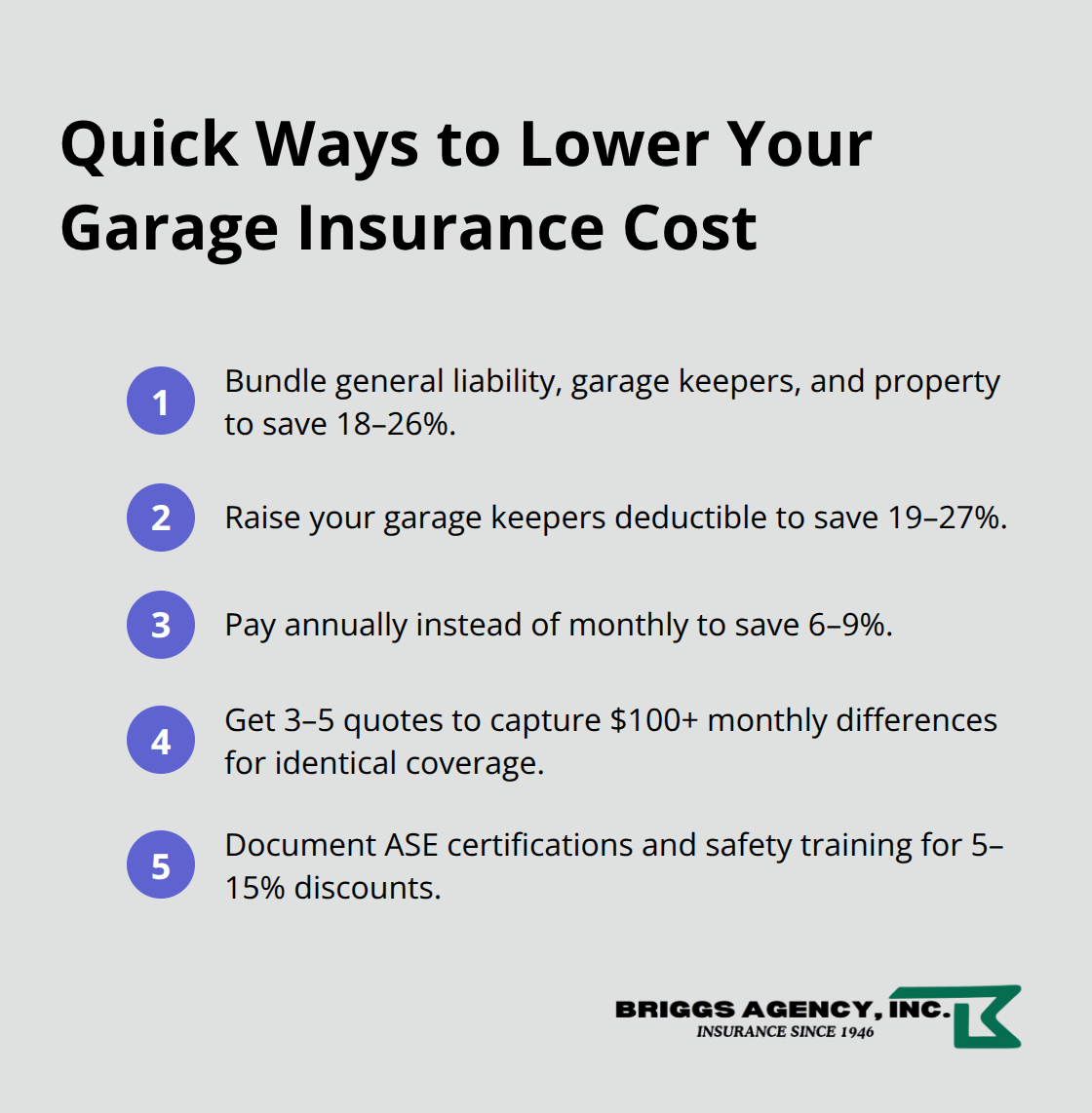
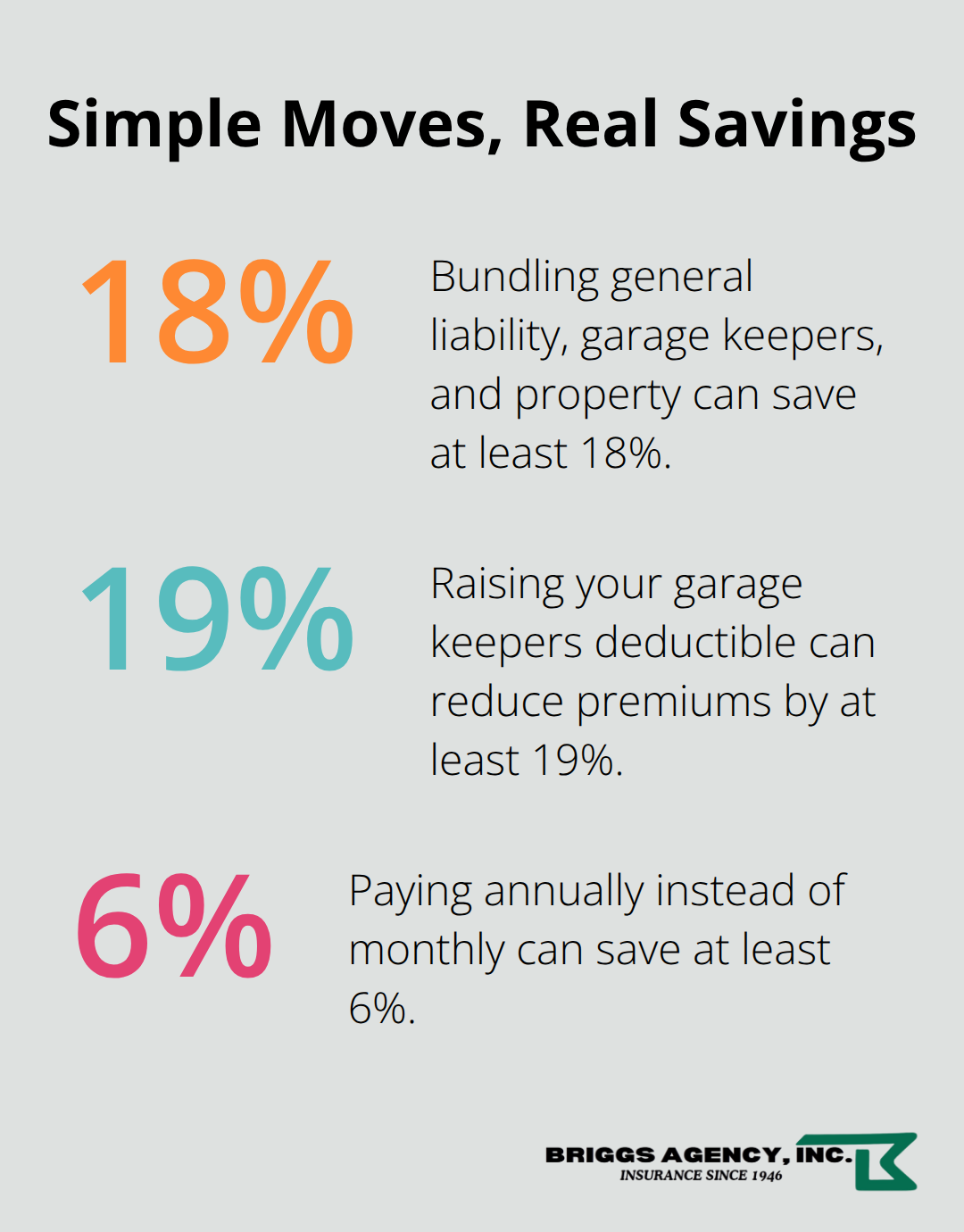
The difference between these two coverages matters significantly. Garage liability responds when your operations cause damage to someone else’s vehicle, while garagekeepers liability covers damage to vehicles your customers leave with you. In Indiana, auto repair shops typically pay around $149 per month for general liability coverage and can bundle garage liability with garagekeepers liability to reduce total premiums by roughly 18% to 26% compared to buying policies separately.

Why Standard Commercial Policies Leave You Exposed

Standard commercial general liability policies have significant gaps for auto service businesses. A typical commercial policy excludes motor vehicle liability because insurers view garage operations as specialized, high-risk work. If a customer’s car is damaged while stored at your shop or if an employee causes an accident during a test drive, your general liability policy will likely deny the claim. This is why Indiana garages cannot rely on off-the-shelf business coverage.

Garage owners policies are tailored specifically to address these scenarios, with limits commonly ranging from $250,000 to $500,000 for garagekeepers coverage depending on your operation size and vehicle types you service. For shops handling high-value vehicles like classic cars or luxury models, higher limits become critical.

Tailoring Coverage to Your Specific Operations

When you evaluate coverage, discuss with your insurance professional how the policy responds to your specific activities-whether you offer delivery service, road testing, collision repair, or paint booth work. Each service line carries different risk levels and may require endorsements or higher coverage limits. The cost varies by location, operation scope, and claims history, but bundling coverages and paying annually instead of monthly typically saves 6% to 9% on premiums.

Understanding what your policy actually covers for each activity you perform protects your business from unexpected claim denials. The next section explores the specific coverage options available and what protection each one provides for your shop’s daily operations.

What Your Garage Policy Actually Covers

Liability Protection for Customer Vehicles

Liability protection for customer vehicles sits at the heart of your garage owners policy, and this is where most shop owners discover how inadequate their previous coverage truly was. When a customer’s car sustains damage while in your care-whether during a test drive, while parked on your lot, or during servicing-garagekeepers liability covers that loss up to your policy limits, typically $250,000 to $500,000 depending on your operation size and the vehicles you handle. This protection applies to theft, weather damage, accidents, and incidents that occur during storage or service work. If you service high-value vehicles like luxury cars or classics, higher limits become essential because a single incident could exceed standard coverage amounts. The cost difference between $250,000 and $500,000 in garagekeepers coverage is modest-often just $20 to $40 monthly-so underinsuring this protection creates unnecessary risk when the premium adjustment is so small.

Protecting Your Tools and Equipment

Tools, equipment, and inventory require separate consideration within your garage policy structure. Your diagnostic equipment, lifts, paint booths, compressors, and shop tools represent significant capital investment, and a standard garage policy may not automatically protect them. Commercial property coverage within a garage owners policy protects these assets against fire, theft, and weather damage while they sit in your facility. Indiana auto repair shops report equipment values ranging from $50,000 to well over $200,000 depending on service offerings, making this protection non-negotiable.

Bundling Coverage for Maximum Savings

When you bundle commercial property with garage liability and garagekeepers coverage, shops typically save 18% to 26% on total premiums compared to purchasing policies separately, which means protecting your equipment becomes more affordable when combined with other coverages. This bundling strategy allows you to maintain robust protection across all critical areas of your operation without stretching your budget.

Percentage savings from bundling coverages and paying annually for Indiana garage policies.

Workers Compensation and Safety Investment

Workers compensation insurance protects your employees and your business from injury claims, with Indiana rates averaging around $147 monthly for auto repair shops. This coverage becomes legally required once you hire your first employee in Indiana, and the cost is tax-deductible. Shops that invest in ASE certifications and documented safety training often qualify for premium discounts of 5% to 15%, so formalizing your safety practices directly reduces insurance costs while improving your operation’s risk profile.

Your coverage decisions today shape how well your business handles tomorrow’s unexpected incidents. The next section examines the specific gaps that many Indiana garage owners overlook-and how to address them before they become costly problems.

What Coverage Gaps Actually Cost Indiana Garage Owners

Most Indiana shop owners face claim denials only after a loss occurs. The problem isn’t that garage policies lack options-it’s that many shops purchase minimum coverage and skip the endorsements that actually protect daily operations. Uninsured customer vehicles sitting on your lot represent genuine exposure that standard garagekeepers liability often fails to cover completely. If a customer’s vehicle has a lapsed insurance policy and sustains damage while parked at your facility, your garagekeepers coverage applies, but the customer may have no way to recover losses beyond your policy limits. This creates tension because customers expect your facility to protect their cars, yet your coverage caps out at $250,000 to $500,000 depending on your policy. High-value vehicles or multiple cars on your lot simultaneously could exceed these limits in a single incident. Shops handling luxury vehicles, classics, or fleet work frequently underestimate this risk and face situations where a major loss remains partially uncompensated.

Test Drives and Road Service Exposures

Test drives and road service create a different coverage challenge that catches many shop owners off guard. When your mechanic test-drives a customer’s vehicle after repair and causes an accident, garage liability coverage applies-but only if the policy explicitly covers road testing activities. Indiana Code Title 27, § 27-8-9-6 specifically defines road testing as a covered activity, yet many shops fail to confirm this protection exists in their actual policy documents. The distinction matters because some insurers restrict road testing to post-repair verification only, while others exclude it entirely unless an endorsement is added. A mechanic who causes $75,000 in damage to another vehicle during an unauthorized or inadequately covered test drive exposes your shop to direct liability that your policy might not cover.

Hired and Non-Owned Vehicle Liability Gaps

Hired and non-owned vehicle liability gaps emerge when you use rental vehicles for business purposes or when employees operate their personal vehicles for shop-related tasks. Standard garage policies do not automatically cover these scenarios, yet many shops regularly use rental trucks for parts delivery or employee vehicles for customer pick-up services. The cost to add hired and non-owned vehicle coverage typically runs $15 to $30 monthly, yet most shops never request it because they do not recognize the exposure. This gap represents a significant blind spot for shops that depend on vehicle mobility for daily operations.

Verification Steps That Prevent Costly Denials

Shops operating in Indiana should verify with their agent whether their current policy covers road testing without limitation, includes hired vehicle liability for rental equipment, and addresses non-owned vehicle use by employees. These three gaps represent the most common reasons claims get denied after incidents occur.

Checklist of three coverage verifications for Indiana garage owners. - Garage owners policy Indiana

Taking time to confirm coverage specifics before a loss happens protects your operation from unexpected financial exposure and ensures your policy actually matches your business activities.

Final Thoughts

A garage owners policy in Indiana protects your business from the specific risks that standard commercial coverage ignores. Throughout this guide, we’ve shown how liability gaps during test drives, uninsured customer vehicles on your lot, and hired vehicle exposures create financial exposure that catches shop owners unprepared. Bundling garage liability with garagekeepers coverage saves you 18% to 26% on premiums while filling the protection gaps that matter most.

Confirming that road testing, hired vehicles, and non-owned vehicle liability appear explicitly in your policy prevents costly claim denials after incidents occur. Many shop owners discover their existing policies lack critical endorsements or carry limits too low for their operation size. Contact an agent who understands Indiana garage operations and can review your current coverage against your actual business activities.

At Briggs Agency, Inc., we’ve served Crown Point and surrounding Indiana communities since 1946, helping business owners like you compare coverage options from multiple carriers and build policies that match your specific needs. Our independent agency represents top-rated insurers, which means we find competitive pricing without locking you into one company’s limited options. Reach out to us today to discuss your garage owners policy and confirm you’re protected for every activity your shop performs.

The information provided in this blog is for general informational purposes only and does not constitute legal, financial, or insurance advice. Coverage options, terms, and availability may vary. Please consult with a licensed professional for advice specific to your situation.
Artificial intelligence may have been used to generate text and images in some blog articles.
What Happens If Your Friend Crashes Your Car? (And Other Awkward Insurance Questions)

What Happens If Your Friend Crashes Your Car? (And Other Awkward Insurance Questions)

Let’s be honest — insurance gets awkward fast.

You let your friend borrow your car. They get into an accident.
Now everyone’s staring at each other like:

“Wait… whose insurance pays for this?”

If you’ve ever wondered about this (or avoided asking because it feels uncomfortable), this guide is for you. We’re breaking down what actually happens — with real-world explanations, not insurance jargon.


🚘 First Things First: Insurance Follows the Car (Usually)

In most states, auto insurance follows the vehicle — not the driver.

That means:

If your friend crashes your car, your auto insurance policy is typically primary.

So yes… your insurance would likely be the first one to respond

Here’s how it usually works:

  • Your liability coverage pays for damage or injuries to the other party.

  • Your collision coverage (if you have it) pays to fix your vehicle.

  • Your deductible applies.

  • The accident may affect your rates at renewal.

Even if you weren’t driving.

Uncomfortable? A little.
Important to know? Absolutely.


🛑 What If It Wasn’t Their Fault?

If your friend was hit by another driver and they were not at fault:

  • The at-fault driver’s liability insurance should pay.

  • Your insurance may step in temporarily (through collision coverage).

  • Your carrier may subrogate (seek reimbursement).

In that case, rate impact is less likely — but still possible depending on the carrier and state.


⚠️ What If Your Friend Wasn’t Listed on Your Policy?

This is where things get tricky.

Most policies allow “permissive use” — meaning someone who occasionally drives your car with permission is covered.

However:

  • If they live in your household and are not listed → 🚨 problem.

  • If they regularly drive your car and aren’t listed → 🚨 problem.

  • If they were specifically excluded from your policy → ❌ no coverage.

Insurance companies expect household members and regular drivers to be disclosed.

If someone living with you crashes your car and isn’t listed, a claim could be:

  • Denied

  • Partially covered

  • Or paid but followed by a policy non-renewal

Not ideal.


💸 What If Damages Exceed Your Limits?

Let’s say your friend causes a serious accident.

You carry:

  • $50,000 per person bodily injury

  • $100,000 per accident

  • $50,000 property damage

But the damages total $180,000.

Now what?

Your policy only pays up to your limits.

You could be personally responsible for the difference.

This is why higher liability limits (and sometimes an umbrella policy) matter more than people realize.


🚨 Does Your Friend’s Insurance Ever Help?

Sometimes — but usually secondarily.

If damages exceed your policy limits, your friend’s policy may step in as excess coverage.

But that depends on:

  • Their coverage limits

  • State laws

  • Policy wording

Never assume their insurance will protect you first.


Other Awkward Insurance Questions (That Everyone Has)

Let’s tackle a few more.


❓ “What If Someone Borrows My Car and Doesn’t Have Insurance?”

If you gave them permission, your policy is still primary.

Their lack of insurance doesn’t remove your responsibility as the vehicle owner.

This is why lending your car should be treated like lending money — carefully.


❓ “What If My Friend Was Drinking?”

If your friend was driving under the influence:

  • Your policy may still pay for damages.

  • You could still face liability exposure.

  • Your rates could increase significantly.

  • In extreme cases, legal consequences could escalate.

Insurance does not excuse criminal behavior.


❓ “What If My Teen Driver Lets Their Friend Drive?”

This one causes major claim issues.

If your teen (a listed driver) gives permission to their friend:

  • Coverage may apply.

  • Some carriers restrict this.

  • It can increase risk classification.

  • Future underwriting could be impacted.

This is a great time for a family driving conversation

❓ “What If I Don’t Have Collision Coverage?”

If your friend crashes your car and you don’t carry collision:

  • Your policy pays only for the other party’s damages (liability).

  • You pay out-of-pocket to fix your own vehicle.

A lot of people learn this the hard way.


❓ “Will My Rates Go Up?”

Possibly.

Insurance pricing considers:

  • Fault determination

  • Claims history

  • Driver history

  • Policy risk factors

Even if you weren’t driving, it was your vehicle.


🛡️ How to Protect Yourself Before This Happens

Here are smart preventative steps:

✔️ 1. Carry Higher Liability Limits

Minimum limits protect the state.
Higher limits protect you.

✔️ 2. Consider an Umbrella Policy

If you have:

  • A home

  • Savings

  • Future income to protect

Umbrella coverage adds an extra liability layer.

✔️ 3. Only Lend to Responsible Drivers

If you wouldn’t trust them with your credit card, don’t hand them your keys 🔑

✔️ 4. List All Household Drivers

Avoid claim denial headaches.

✔️ 5. Review Your Policy Annually

Life changes. Drivers change. Risk changes.


🚦 The Bottom Line

Letting a friend borrow your car feels harmless.

But if something goes wrong, you — as the vehicle owner — are usually financially responsible first.

Insurance isn’t just about checking a box.

It’s about understanding how risk transfers — especially when other people are involved.


You can experience being a part of and full-serviced independent Insurance Agency today! Simply contact Briggs Agency Inc, if you are interested in an insurance review at 219-769-4840 or visit our website at www.BriggsAgency.com. We look forward to hearing from you!


Blog post written by: Zachary Pelke

Truckers Liability Insurance Indiana: What It Covers for Drivers

Running a trucking operation in Indiana means understanding your legal obligations and protecting your business from financial risk. Truckers liability insurance Indiana is more than a legal requirement-it’s your safeguard against costly claims that could shut down your operation.

At Briggs Agency, Inc., we help drivers and fleet owners navigate the coverage options that actually matter for their routes and cargo. This guide breaks down what you need to know to make informed decisions about your protection.

What Truckers Liability Insurance Actually Covers

The Foundation of Your Legal Protection

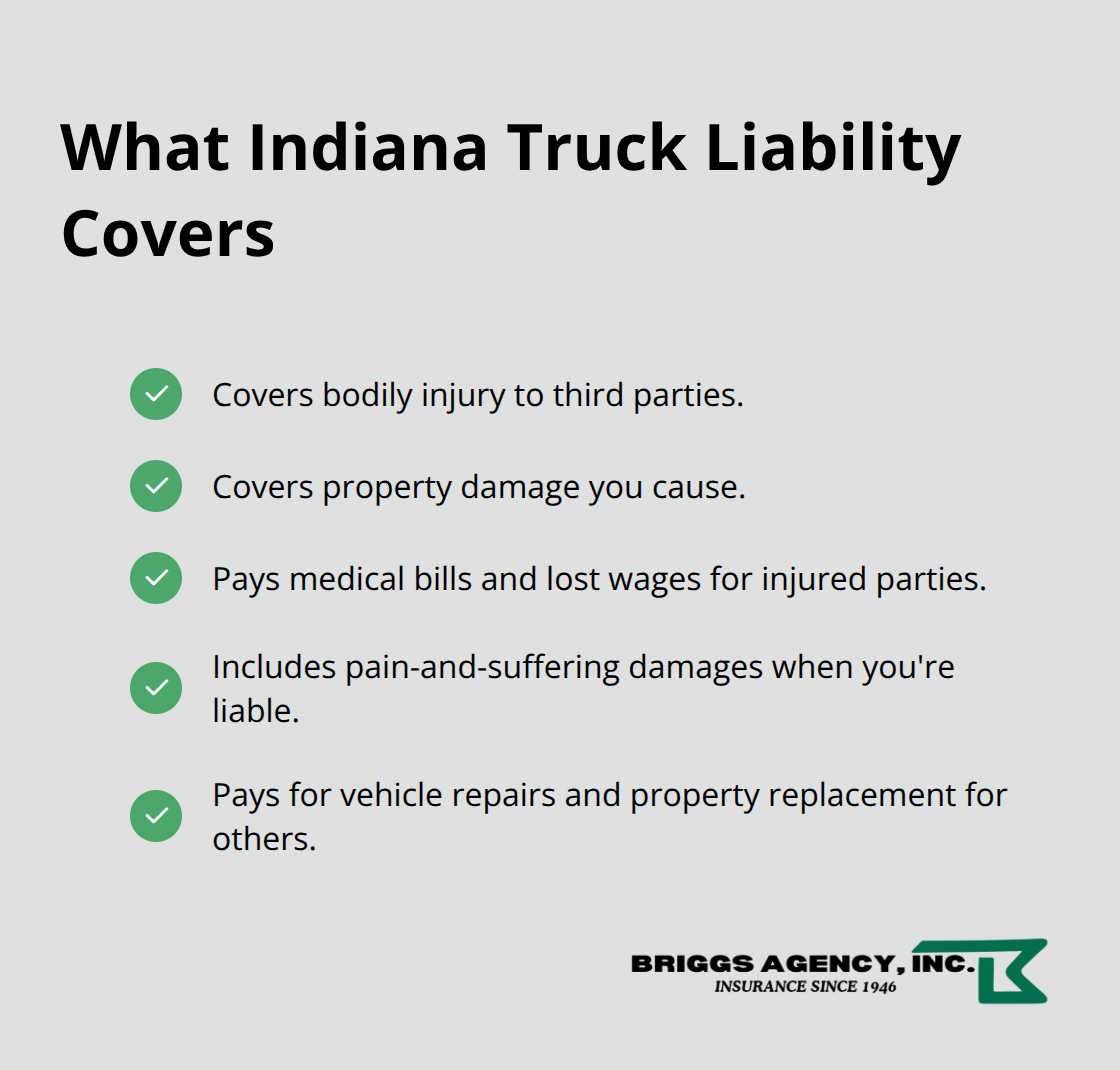
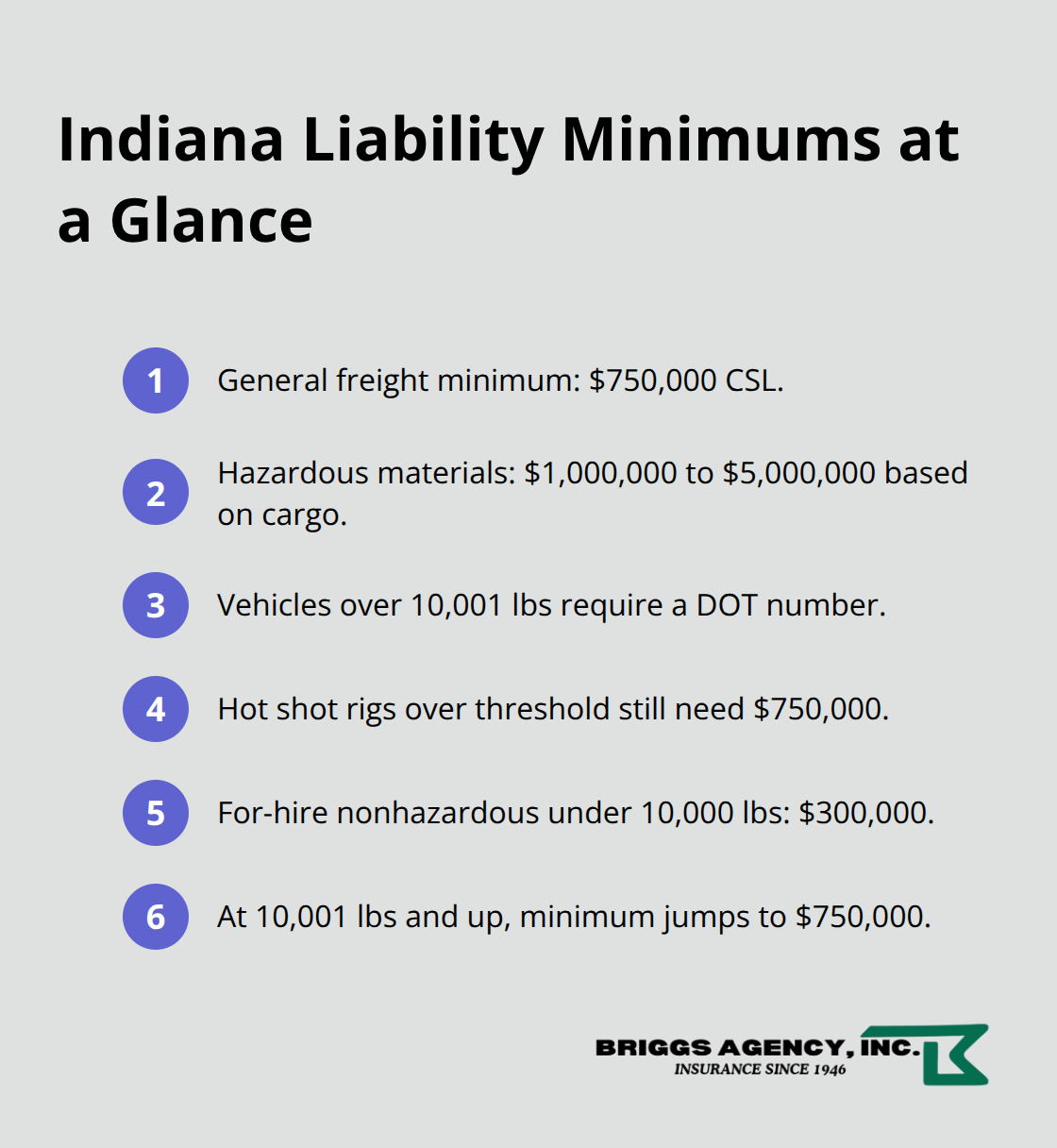
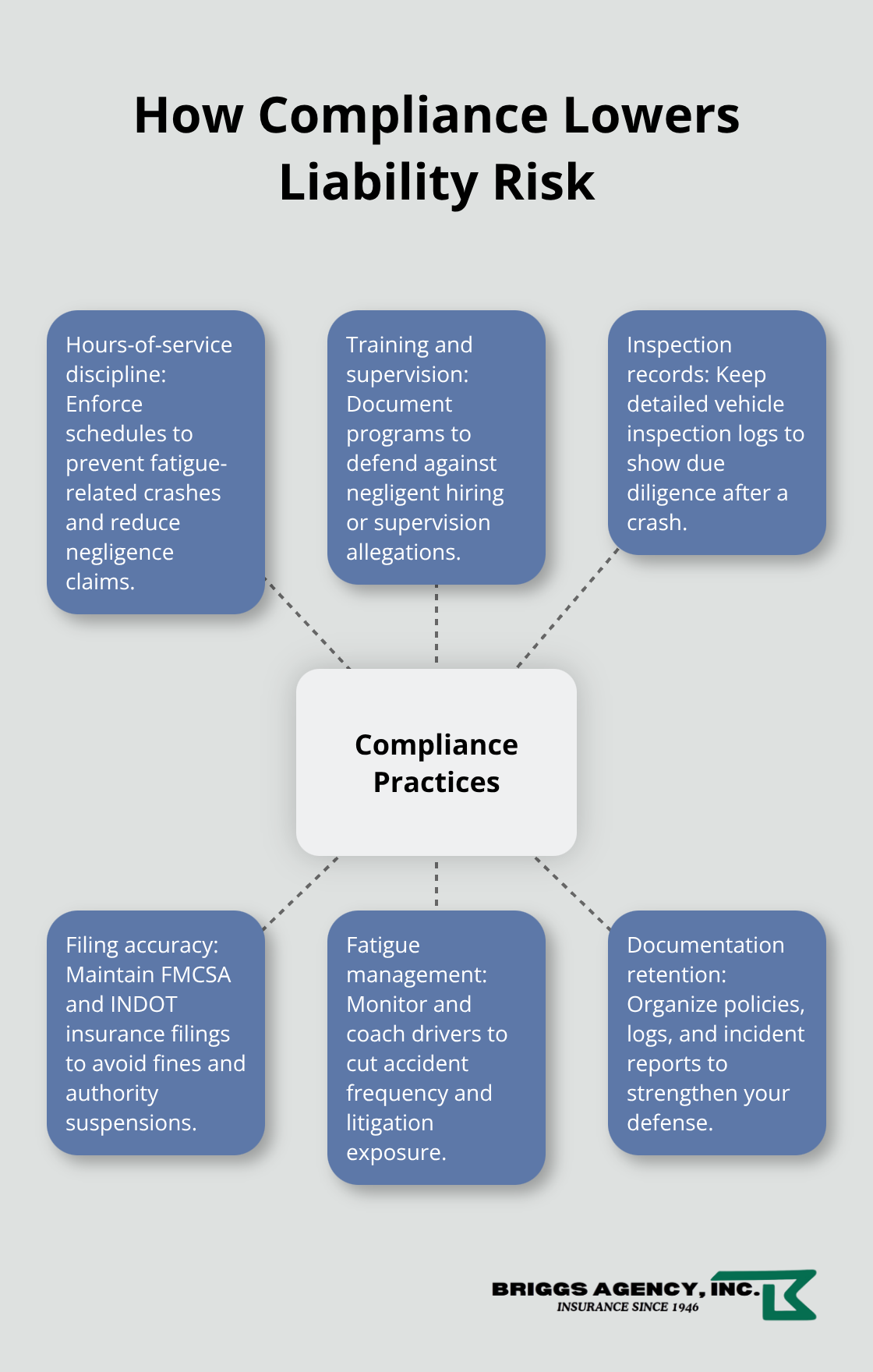
Truckers liability insurance protects you when you cause bodily injury or property damage to someone else while operating your truck. This coverage activates when you’re at fault in an accident-it pays for the other person’s medical bills, lost wages, pain and suffering, and repairs to their vehicle or property. Indiana law requires all commercial truck operators to carry minimum primary liability coverage of $750,000 for non-hazardous freight. If you haul hazardous materials, that requirement jumps to $1,000,000 to $5,000,000 depending on your cargo type. Without this coverage, you cannot legally operate, and the FMCSA will suspend or revoke your operating authority if you fail to maintain proof of insurance through the required BMC-91 or BMC-91X filings.

Summary of Indiana trucking liability insurance requirements and common practice - Truckers liability insurance Indiana

Why Minimum Coverage Often Falls Short

The real question isn’t whether you need liability insurance-it’s whether the minimum coverage is enough for your actual operation. Many Indiana truckers operate with $1,000,000 per occurrence and $2,000,000 aggregate limits, which provides substantially more protection than the state minimum and often satisfies broker and shipper requirements. Your cargo type, routes, and vehicle size all affect your risk exposure. A hazmat hauler operating interstate faces far greater liability exposure than a local delivery driver, and your insurance should reflect that reality.

Tailoring Coverage to Your Operation

Your specific routes, cargo, and business model determine what coverage actually protects you. A family-owned, independent agency like Briggs Agency, Inc. (serving Crown Point and the surrounding area since 1946) represents multiple top-rated carriers, which means their experienced local agents can compare options and tailor policies to your needs rather than settling for the bare legal minimum that leaves you exposed. The difference between minimum coverage and adequate coverage often comes down to understanding your actual liability exposure-something a local agent who knows Indiana trucking operations can help you identify.

What Bodily Injury and Property Damage Liability Actually Covers

How These Two Components Protect You

Bodily injury and property damage liability coverage pays for costs when you cause an accident that injures someone or damages their property. Bodily injury liability covers the other driver’s medical expenses, rehabilitation costs, lost wages, and pain and suffering claims. Property damage liability covers repairs or replacement of the other person’s vehicle, guardrails, buildings, or any other property your truck damaged. Indiana requires you to carry both components as the foundation of your legal protection.

Hub and spoke chart showing bodily injury, property damage, medical payments, and legal defense elements

Why Minimum Coverage Leaves You Exposed

The state minimum of $750,000 for non-hazardous freight sounds substantial until you face a serious accident involving multiple vehicles or injuries. A single multi-vehicle crash easily exceeds $2 million in damages when you factor in medical treatment, lost income, and long-term care for seriously injured parties. Many Indiana truckers choose $1,000,000 per occurrence with $2,000,000 aggregate limits instead of the minimum, which provides meaningful cushion against catastrophic claims that could otherwise wipe out your business.

How Your Cargo and Routes Affect Your Liability Exposure

Your actual liability exposure depends on what you haul and where you drive. Hazmat carriers operating interstate face significantly higher risk and must carry $1,000,000 to $5,000,000 in coverage depending on cargo classification. Even within general freight, your routes matter: a driver regularly traveling I-94 through dense Chicago traffic faces different exposure than someone making local deliveries in rural areas.

Additional Protections That Work Alongside Liability

Medical payments coverage, separate from liability, covers reasonable medical expenses for injured parties regardless of fault in some cases, which helps settle minor claims faster and keeps your rates stable. Some policies also include coverage for legal fees and court costs if you’re sued, protecting your business from the expense of defending yourself even in frivolous claims. An experienced local agent who understands Indiana trucking operations will assess your specific cargo types, annual mileage, interstate movements, and growth plans to recommend coverage that matches your actual risk rather than leaving you underprotected or overpaying for unnecessary limits.

Matching Your Coverage to Your Actual Risk

Start With Your Cargo and Routes

Your cargo and routes determine whether the state minimum protects you or leaves you exposed. If you haul hazardous materials, your decision is straightforward: Indiana and federal law require $1,000,000 to $5,000,000 depending on your cargo classification, so you need coverage that meets those mandates. For general freight, the calculation becomes more specific. A local delivery driver making short runs in rural areas faces different exposure than someone regularly driving I-94 through congested Chicago traffic or crossing state lines frequently.

Document your typical routes, the weight and type of cargo you carry, and your annual mileage. This information directly affects your liability risk and the coverage limits you actually need. Many Indiana truckers operating general freight settle on $1,000,000 per occurrence with $2,000,000 aggregate limits rather than the $750,000 state minimum, which gives them real cushion without overextending costs.

Check Your Client Contracts

Some brokers and shippers now require higher limits as a condition of business, so checking your client contracts matters. If you work with multiple brokers or shippers, you might find they request different coverage amounts. Understanding those requirements upfront prevents delays when you need to activate loads.

Request Quotes From Multiple Carriers

Different carriers price trucking risk differently based on their loss history, underwriting approach, and appetite for specific cargo types or routes. One carrier might offer aggressive pricing on general freight but charge significantly more for hazmat operations, while another does the opposite. Request quotes from at least three carriers and ask them to evaluate the same coverage limits so you can compare actual prices rather than different protection levels.

Compact checklist of steps to align trucking liability coverage with real-world risk - Truckers liability insurance Indiana

When you contact insurers, provide your driving record, driver certifications and training, specific areas where you operate, materials you haul, annual miles, and any interstate movements. This detail allows them to give accurate quotes instead of rough estimates that shift later. Carriers also evaluate your growth plans, so mentioning expansion helps them structure policies that scale with your business rather than forcing you to renegotiate annually.

Work With an Agency That Represents Multiple Carriers

A local agency represents multiple top-rated carriers and handles the comparison work for you, pulling quotes and evaluating options based on your specific operation rather than steering you toward one solution. They also manage your FMCSA filings and financial proof of responsibility documentation, which saves you time navigating regulatory requirements.

Final Thoughts

Truckers liability insurance in Indiana protects your operation from financial devastation when accidents happen. The state minimum of $750,000 for non-hazardous freight meets legal requirements, but your actual coverage should match your cargo type, routes, and business model. Hazmat carriers need $1,000,000 to $5,000,000 depending on cargo classification, while general freight operators often find that $1,000,000 per occurrence with $2,000,000 aggregate limits provides meaningful protection without unnecessary expense.

Finding adequate protection starts with documenting your operation-write down your typical routes, cargo types, annual mileage, and any interstate movements. Request quotes from multiple carriers and ask them to evaluate identical coverage limits so you can compare actual prices, since different carriers price trucking risk differently based on their underwriting approach and loss history. Your brokers and shippers may also require specific coverage amounts, so reviewing client contracts prevents delays when you need to activate loads.

A local agency that represents multiple top-rated carriers saves time and delivers better results than handling this work alone. Briggs Agency, Inc. handles the comparison work, pulls quotes based on your specific operation, and manages your FMCSA filings and financial proof of responsibility documentation. Contact us to discuss your truckers liability insurance Indiana requirements and get quotes from carriers that match your operation.

The information provided in this blog is for general informational purposes only and does not constitute legal, financial, or insurance advice. Coverage options, terms, and availability may vary. Please consult with a licensed professional for advice specific to your situation.
Artificial intelligence may have been used to generate text and images in some blog articles.
Indiana Contractor Liability Insurance: Risks, Rules, and Remedies

Running a contracting business in Indiana means facing real liability exposure every single day. Property damage claims, job site injuries, and third-party lawsuits can drain your finances fast-which is why Indiana contractor liability insurance isn’t optional, it’s essential.

At Briggs Agency, Inc., we’ve helped countless contractors understand their coverage gaps and build protection strategies that actually work. This guide walks you through the risks you face, what Indiana requires, and how to choose coverage that fits your operation.

What Liability Risks Hit Indiana Contractors Hardest

Property Damage Claims Cost More Than You Think

Property damage on job sites happens faster than most contractors expect. A dropped tool through a client’s roof, equipment damage during transport, or accidental structural harm during renovation work costs thousands in repairs and legal fees. Indiana contractors face these claims regularly, and without proper coverage, a single incident wipes out months of profit. General liability insurance covers these scenarios, but many contractors underestimate the actual dollar exposure. A roofing mistake that damages underlying structure, improper demolition that harms adjacent property, or equipment that causes fire damage easily exceeds $50,000 in claims. The cost isn’t just the repair bill-it includes investigation expenses, legal defense, and settlements that drag on for months.

Bodily Injury Claims Create Overlapping Liability Exposure

Bodily injury claims on job sites present even steeper financial risk. Construction accidents involving your workers, subcontractors, or third parties create multiple layers of liability. If a worker from your subcontractor gets injured on your project and their employer’s workers’ compensation coverage proves insufficient, they may pursue a third-party claim against you. Indiana’s workers’ compensation system is designed to provide medical benefits and partial wage replacement without requiring the injured worker to prove fault. However, third-party liability claims allow them to sue for additional damages when another party shares fault. A serious injury claim-permanent disability, lost wages, ongoing medical care-routinely exceeds $100,000 and can reach into the millions. Your general liability policy covers defense costs and damages, but inadequate limits leave you personally liable for anything beyond your policy cap.

Professional Liability and Third-Party Claims Add Separate Exposure

Professional liability claims add another layer of risk. If you provide design input, consult on building methods, or oversee safety protocols, errors or negligence in those services create separate exposure. A faulty design recommendation or failure to catch a safety violation that causes injury opens you to claims that standard general liability doesn’t fully cover. Third-party claims also arise when property owners, neighboring businesses, or other contractors sue you for damages caused by your work. These lawsuits demand legal defense even before determining fault, and defense costs alone reach $10,000 to $25,000 depending on complexity. Your insurer covers these expenses, but only if you maintain adequate professional liability or general liability limits. Delayed notification to your insurer can void coverage, so reporting incidents immediately becomes non-negotiable.

Diagram showing key liability exposures for Indiana contractors: property damage, bodily injury, professional liability, and third-party claims.

Understanding these three liability categories-property damage, bodily injury, and third-party claims-shows why Indiana contractors cannot afford to underinsure. Each risk category carries its own financial exposure, and they often overlap on the same project. The next section examines what Indiana law actually requires contractors to carry and how state regulations shape your coverage obligations.

Indiana Contractor Insurance Requirements and Regulations

Local Licensing Rules Vary Across Indiana Cities

Indiana has no statewide general contractor license requirement, but that doesn’t mean you operate without regulations. Local jurisdictions set their own rules, and they differ significantly across the state. In Indianapolis, the Department of Business and Neighborhood Services issues general contractor licenses and requires a $10,000 surety bond, proof of business registration, general liability insurance, workers’ compensation coverage, and a $247 license fee. Fort Wayne contractors pay $90 for a general contractor license through the Allen County Building Department, while Evansville requires a $25,000 surety bond, three letters of recommendation, and notarized criminal history forms through the Vanderburgh County Building Commission. Your licensing obligations depend entirely on where you operate.

Compact list of licensing requirements for Indianapolis, Fort Wayne, and Evansville. - Indiana contractor liability insurance

If you work across multiple Indiana cities, you manage different fees, different bond amounts, and different renewal cycles. Indianapolis licenses expire every two years; Fort Wayne renews annually; Evansville offers one-year or two-year options. Skipping compliance costs you fines, lost bids, and potential license suspension.

Workers’ Compensation Coverage Is Non-Negotiable

Workers’ compensation insurance is mandatory in Indiana if you have employees, and this requirement has no gray area. Your insurer covers medical expenses, wage replacement, and vocational rehabilitation for job site injuries without your employees proving fault. This no-fault system protects workers and shields you from direct employee lawsuits over workplace injuries, but only if you maintain active coverage. The moment you hire your first employee, you must carry workers’ compensation or face penalties that exceed the cost of the policy itself.

General Liability Forms Your Foundation

General liability insurance forms the foundation of contractor protection and is often required by local licensing authorities or client contracts. It covers bodily injury, property damage, and legal defense costs when third parties claim harm from your operations. Many contractors assume general liability handles everything, but it doesn’t cover professional liability claims if you provide design services or safety consulting. Your actual coverage limits matter enormously. A $1 million general liability policy sounds solid until a serious injury claim hits $1.5 million, leaving you personally liable for the gap. Contractors in Indiana typically carry $1 million to $2 million in general liability limits depending on project size and risk.

Additional Coverage Types Protect Specific Exposures

Commercial auto insurance is mandatory for business-owned vehicles and covers work-related accidents. Tools and equipment insurance protects your job site gear from theft or damage. Professional liability becomes essential if you oversee safety programs or provide construction consulting. A Business Owner’s Policy bundles general liability with commercial property insurance to reduce costs while covering both liability and on-site equipment or materials.

Understanding Your Premium Costs

Insurance costs vary based on business size, claims history, and services offered. General liability averages around $100 per month, workers’ compensation around $168 per month, and commercial auto around $180 per month for Indiana contractors according to industry data. Your specific premiums depend on your operation’s details, so obtaining actual quotes from carriers beats guessing. Check with your specific city or county government before taking on projects, because assuming you know the rules across all your service areas will hurt you eventually. Once you understand what Indiana requires and what coverage costs, the real challenge becomes selecting limits and deductibles that actually protect your business without overpaying for unnecessary coverage.

How to Choose the Right Contractor Liability Coverage

Map Your Actual Job Site Exposure

Start by mapping your actual job site exposure instead of copying another contractor’s policy limits. A residential kitchen remodel carries vastly different risk than commercial office construction or demolition work. Your property damage exposure depends on what you touch-a drywall contractor working inside existing homes faces lower structural damage risk than a foundation specialist or roofer whose mistakes affect building integrity. Bodily injury exposure scales with project complexity and crew size. A solo painter has minimal workers’ compensation claims risk; a general contractor managing fifteen subcontractors on a commercial site faces exponential injury exposure.

Review your past three years of projects and identify which ones created the most significant liability concerns. Did you work near occupied buildings where property damage could harm neighboring businesses? Did you handle heavy equipment or work at heights where serious injuries become likely? Did you provide any design input or safety oversight that extends beyond standard execution? These specifics determine whether $1 million in general liability suffices or whether $2 million makes sense.

Set Coverage Limits That Protect Your Business

Indiana contractors need liability insurance to protect their business-most client contracts and municipal requirements demand $1 million minimum. For larger commercial projects or high-risk work like demolition or excavation, $2 million becomes standard. Professional liability becomes non-negotiable if you design safety systems, specify materials, or consult on construction methods. A $1 million professional liability policy costs roughly $40 to $60 monthly but protects you when design recommendations cause injury or property damage.

Deductibles represent your out-of-pocket responsibility before insurance kicks in. A $500 deductible means you pay the first $500 of any claim; a $2,500 deductible cuts your premium but increases your risk. Most Indiana contractors choose $1,000 deductibles as the practical middle ground-low enough to absorb without destroying cash flow, high enough to reduce premiums meaningfully. Higher deductibles make sense only if you maintain substantial emergency reserves.

Get Quotes and Compare Carrier Options

Actual quotes from multiple carriers reveal how your specific operation affects pricing far better than industry averages. A roofing contractor with fifteen employees and five years of claims history pays dramatically different premiums than a residential painter with no employees and a clean record. When you contact an agent, have your business revenue, number of employees, types of projects, claims history, and service areas ready. Agents ask these questions not to be intrusive but because they directly impact your premium and coverage suitability.

A contractor claiming $500,000 annual revenue but carrying $2 million in general liability with a $500 deductible is likely overpaying; another contractor with $2 million revenue and only $1 million coverage is gambling. Your agent can identify these misalignments and adjust limits and deductibles to match both your risk profile and budget. Compare quotes from multiple top-rated carriers to find competitive pricing without sacrificing coverage.

Bundle Policies and Add Specialized Coverage

Bundling general liability with commercial property insurance through a Business Owner’s Policy typically saves 10 to 15 percent compared to purchasing policies separately. If you own equipment, tools, or materials stored on job sites, inland marine coverage protects against theft and damage-an essential add-on for contractors whose equipment represents significant capital investment. Request certificates of insurance from your agent once policies activate; many client contracts require proof of coverage before work begins, and delays in obtaining certificates cost you project start dates and client relationships.

Chart showing typical premium savings when bundling general liability and property into a BOP. - Indiana contractor liability insurance

Final Thoughts

Protecting your contracting business starts with honest assessment of your actual risks and ends with coverage that matches those risks without gaps or waste. Indiana contractor liability insurance isn’t a checkbox item or a cost to minimize-it’s the financial foundation that keeps your business standing after accidents happen. Property damage, bodily injury, and third-party claims overlap constantly on real job sites, which means underestimating any one of them puts your entire operation at risk.

Your licensing obligations vary by city, your workers’ compensation requirement is absolute if you have employees, and your general liability limits must reflect the scale and complexity of your projects. A $1 million policy works for smaller residential work; larger commercial projects demand $2 million or more. Professional liability becomes essential the moment you provide design input or safety oversight, and deductibles should balance premium savings against your ability to absorb out-of-pocket costs without disrupting operations.

The practical next step is gathering quotes from multiple carriers rather than accepting industry averages as your reality. Your specific business-your revenue, employee count, claims history, and project types-determines your actual premium and appropriate coverage limits. We at Briggs Agency, Inc. have guided Indiana contractors through these decisions since 1946, and we compare options to tailor policies that deliver competitive pricing and the right protection for your operation.

The information provided in this blog is for general informational purposes only and does not constitute legal, financial, or insurance advice. Coverage options, terms, and availability may vary. Please consult with a licensed professional for advice specific to your situation.
Artificial intelligence may have been used to generate text and images in some blog articles.
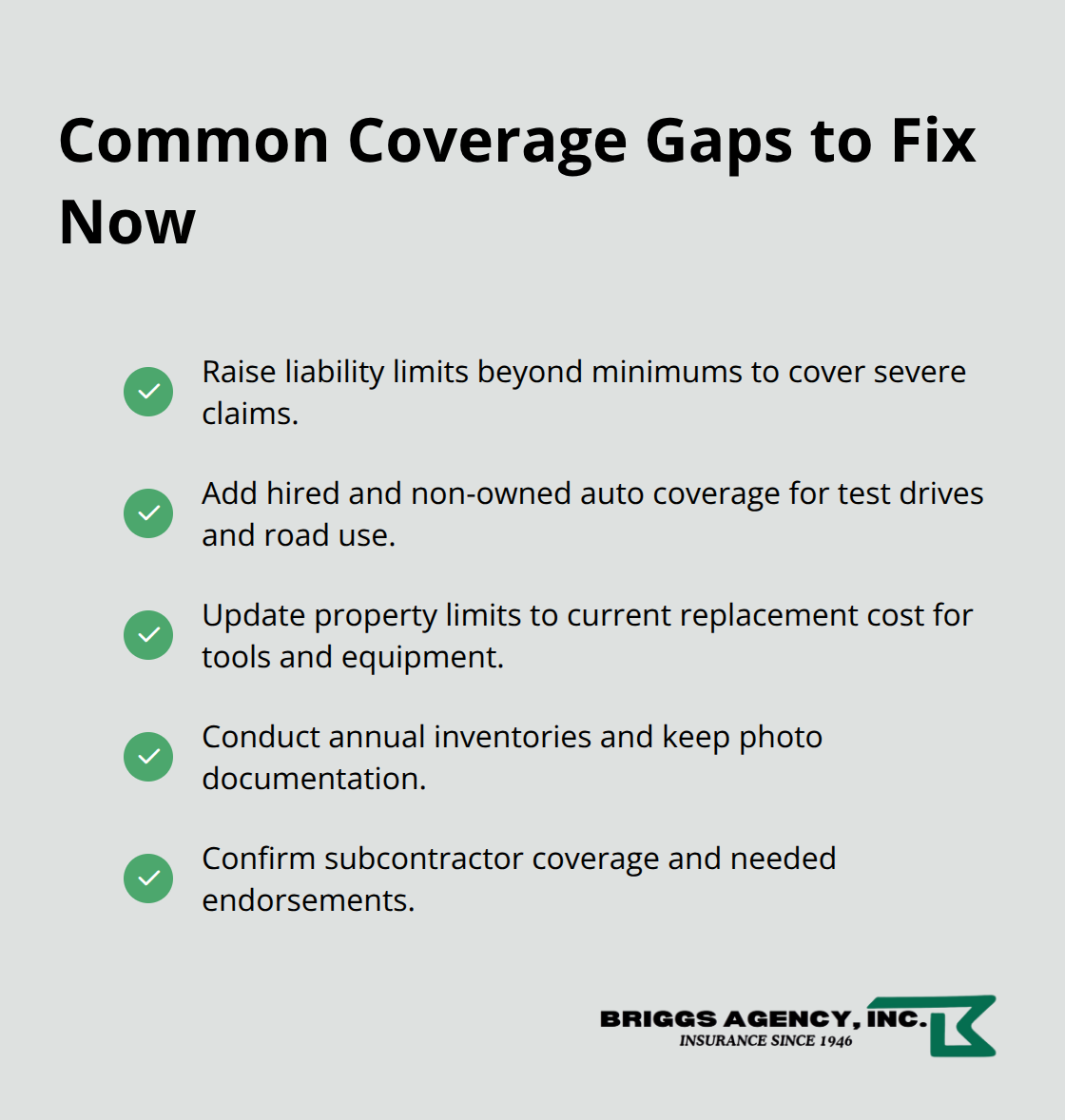
Love What You Protect: A Valentine’s Day Insurance Reminder ❤️

Valentine’s Day is a time to celebrate the people who matter most — spouses, partners, families, and the life you’re building together. While flowers and dinner reservations are thoughtful gestures, one of the most meaningful ways to show love is by protecting what matters most.

This Valentine’s Day, here are a few important insurance reminders to keep your heart (and finances) safe.


💍 New Jewelry? Don’t Let It Go Unprotected

Valentine’s Day is one of the most popular times of year for jewelry purchases — especially engagement rings.

What many homeowners don’t realize is that standard homeowners and renters policies often have limited coverage for jewelry, particularly in cases of theft or mysterious disappearance.

If you or your partner recently received:

  • An engagement ring

  • Diamond earrings

  • A luxury watch

  • A special anniversary necklace

It may be wise to schedule the item separately on your policy for full protection.

A quick coverage review today can prevent a major financial loss tomorrow.


🏡 Big Life Changes Call for Coverage Updates

Love often brings exciting milestones:

  • Moving in together

  • Getting married

  • Buying a home

  • Renovating or upgrading

Each of these changes can impact your insurance needs. If you’ve recently experienced a life change, ask yourself:

  • Is my home insured for its current replacement value?

  • Have I updated my policy to reflect renovations or upgrades?

  • Do we have adequate liability protection now that our household has grown?

Insurance should evolve as your life does.


🚗 Date Nights & Road Trips

Weekend getaways and frequent outings can mean more time on the road. If you’ve:

  • Added a vehicle

  • Combined auto policies

  • Changed commuting habits

It’s a smart time to review liability limits, deductibles, and coverage options to ensure you’re fully protected.


❤️ Protecting Your Future Together

Valentine’s Day is about love — and love is about planning for the future.

Life insurance is one of the most powerful ways to protect your partner and family. It can help cover:

  • Mortgage payments

  • Daily living expenses

  • Education costs

  • Long-term financial goals

For young families and newlyweds, coverage is often more affordable than many expect — and the peace of mind it provides is priceless.


The Best Gift Is Peace of Mind

Flowers fade. Chocolates disappear. But proper insurance protection lasts all year long.

This Valentine’s Day, consider giving the gift of security. A simple policy review can ensure the people and possessions you cherish most are protected.

At Briggs Agency, we’re here to help you review your coverage and make sure your policies reflect your life today — and the future you’re building together.

If you’d like a complimentary coverage review, contact our team today. ❤️