💡 Deductibles Explained: How They Actually Work (And Why They Matter More Than You Think)

When it comes to insurance, “deductible” is one of those terms everyone has heard… but not everyone truly understands. 
And the truth is—your deductible can make a HUGE difference in how much you pay both monthly and when something goes wrong.

Let’s break it all down in a simple, real-world way so you actually feel confident about your coverage


🧾 What Is a Deductible?

A deductible is the amount of money you pay out of pocket before your insurance kicks in.

👉 Think of it like your “share” of the risk.

Example:

  • You have a $1,000 deductible
  • Your claim is $5,000
  • You pay $1,000
  • Insurance pays the remaining $4,000

Simple, right?


🔍 How Deductibles Actually Work (Real-Life Scenarios)

Car Accident Example

Let’s say you rear-end someone (it happens):

  • Damage to your car: $3,500
  • Your deductible: $500

👉 You pay: $500
👉 Insurance pays: $3,000


🏡 Home Insurance Example

A storm rolls through Northwest Indiana and damages your roof:

  • Repair cost: $12,000
  • Deductible: $2,000

👉 You pay: $2,000
👉 Insurance pays: $10,000


⚠️ Important Note:

You only pay a deductible when:

  • You file a claim on your own policy
  • The loss is covered

If someone else is 100% at fault?  Their insurance should pay (no deductible for you)


📊 Types of Deductibles You Should Know

Not all deductibles are created equal

1. 💵 Fixed Dollar Deductible

  • Most common (ex: $500, $1,000, $2,500)
  • Easy to understand and predictable

2. 📈 Percentage Deductible (Common for Home Insurance)

  • Based on your home’s insured value

Example:

  • Home insured for $300,000
  • 2% deductible = $6,000 out of pocket 

👉 This is HUGE and often surprises people


3. 🌪️ Special Deductibles (Storm/Wind/Hail)

  • Separate deductibles for specific risks
  • Very common in Indiana due to weather

👉 You might have:

  • $1,000 standard deductible
  • BUT $5,000 wind/hail deductible

💰 Deductible vs Premium: The Trade-Off

Here’s where strategy comes in

Deductible Monthly Premium Out-of-Pocket Risk
LOW ($250–$500) Higher Lower risk
HIGH ($1,000–$5,000+) Lower Higher risk

👉 The Rule:

  • Higher deductible = lower monthly payment
  • Lower deductible = higher monthly payment

🤔 So… Which Deductible Should You Choose?

It depends on YOU

Choose a HIGHER deductible if:

✔️ You want to save money monthly
✔️ You have emergency savings
✔️ You don’t file small claims often


Choose a LOWER deductible if:

✔️ You prefer predictable costs
✔️ You don’t want big out-of-pocket surprises
✔️ You want peace of mind


🚨 Common Deductible Mistakes (Avoid These!)

❌ 1. Choosing the cheapest policy without checking the deductible

That low price might come with a $5,000+ deductible


❌ 2. Not knowing you have a percentage deductible

This is one of the BIGGEST homeowner surprises


❌ 3. Filing small claims

If your deductible is $1,000 and damage is $1,200…
👉 You’re only getting $200—and risking higher premiums later


❌ 4. Having a deductible you can’t afford

If you can’t comfortably pay it, it’s too high. Period.


🧠 Pro Tips from an Independent Agent

As an independent agency, we see this all the time

Bundle policies (home + auto) to offset a lower deductible cost
Review your deductible yearly—your situation changes
Match your deductible to your savings
Ask about claim-free discounts before filing small claims


📍 Why This Matters (Especially in Northwest Indiana)

Living in the 219 region means dealing with:

  • Strong storms
  • Snow/ice damage
  • Wind & hail claims

👉 Which means your deductible isn’t just a number—it’s what you’ll actually pay when things go wrong


🏁 Final Takeaway

Your deductible is one of the most important parts of your policy—not just a small detail.

👉 It affects:

  • Your monthly payment
  • Your financial risk
  • Your overall coverage strategy

The goal isn’t just “cheap insurance” … it’s smart protection.


You can experience being a part of and full-serviced independent Insurance Agency today! Simply contact Briggs Agency Inc, if you are interested in an insurance review at 219-769-4840 or visit our website at www.BriggsAgency.com. We look forward to hearing from you!


Blog post written by: Zachary Pelke

Contractor Insurance Coverage Indiana: Policy Keys for Builders

Running a contracting business in Indiana means navigating specific insurance requirements that protect both your operation and your team. Contractor insurance coverage in Indiana isn’t one-size-fits-all, and missing the right policies can expose you to serious financial and legal risks.

We at Briggs Agency, Inc. have helped countless builders understand exactly what coverage they need and how to avoid overpaying for it. This guide walks you through Indiana’s requirements, the essential policies every contractor should carry, and practical ways to reduce your premiums.

What Indiana Actually Requires From Contractors

State-Mandated Coverage You Cannot Ignore

Indiana doesn’t mandate general liability insurance for all contractors, which surprises many builders who assume it’s a legal requirement. However, the state does require workers’ compensation insurance if you have even one employee-and that includes yourself if you operate as a sole proprietor with employees. The Indiana Department of Labor enforces this strictly, with penalties reaching $10,000 per violation for non-compliance.

If you bid on public construction projects, Indiana’s prevailing wage law applies, and many government entities require proof of workers’ compensation before awarding contracts. Additionally, if your contracting work involves driving commercial vehicles, Indiana requires minimum liability coverage of $25,000 for bodily injury per person and $50,000 per accident, plus $25,000 for property damage-these are among the lowest thresholds in the Midwest, but they’re non-negotiable.

The General Liability Gap That Costs Contractors

The real protection gap appears when contractors operate without general liability coverage. Indiana courts have consistently upheld homeowner lawsuits against contractors for property damage and bodily injury, with jury awards averaging $150,000 to $400,000 for serious incidents according to Indiana Trial Lawyers Association data. Most commercial contracts and bonding requirements demand general liability as a condition of doing business, making it practically mandatory even where state law doesn’t require it.

How Indiana Differs From Neighboring States

Indiana’s regulatory environment differs significantly from neighboring states like Ohio and Illinois-Indiana has no state licensing board for general contractors, which means less oversight but also less consumer protection for your clients. Your insurance credentials become even more important to build trust with property owners and project managers.

Equipment Theft and Workers’ Compensation Costs

Tools and equipment theft is particularly common in Indiana’s construction sector, especially in the Indianapolis and Gary regions where theft rates exceed the national average by 18 percent, according to the National Equipment Register. Workers’ compensation rates in Indiana average 1.5 to 2.2 percent of payroll depending on your trade classification, making it essential to accurately report your crew size and job types to avoid audit surprises later.

Two key Indiana contractor insurance percentages visualized for quick reference - Contractor insurance coverage Indiana

Understanding these state-specific requirements sets the foundation for protecting your business, but knowing what coverage exists is only half the battle. The next section covers the essential policies that actually shield your operation from the financial damage that state minimums alone cannot prevent.

Essential Coverage Types for Contractors

General Liability Insurance Protects Against Common Claims

General liability insurance covers property damage and bodily injury claims that arise from your work, and Indiana courts award damages aggressively when contractors fall short. A roofing contractor who damages a homeowner’s gutters, a concrete finisher whose equipment injures a bystander, or a carpenter whose negligence causes water damage to adjacent properties all face claims that easily exceed $50,000. Your policy limit should match your project scope-contractors handling residential work typically need $1 million per occurrence and $2 million aggregate, while commercial projects often demand $2 million or higher. Many Indiana general contractors carry only $300,000 limits thinking it’s sufficient, then face uninsured exposure when actual damages run higher. Verify your limits against your signed contracts; clients increasingly require proof of specific coverage amounts before work begins.

Workers’ Compensation Covers Employee Injuries

Workers’ compensation becomes your largest controllable insurance expense once you hire employees. Indiana’s classification system assigns rates based on your specific trade and work type, meaning a framing contractor pays substantially more than a general superintendent because framers face higher injury risk. The state’s Workers’ Compensation Board publishes rates ranging from 0.8 percent of payroll for office staff to 4.5 percent or higher for heavy demolition work, and misclassifying your crew as lower-risk trades triggers audits that cost far more than the premium difference. If you run a crew of five carpenters, your annual premium runs roughly $35,000 to $55,000 depending on your safety record and experience modification rate. Your claims history directly affects this rate-two serious injuries in three years can increase your premium by 30 percent or more, making workplace safety programs financially mandatory, not optional.

Commercial Auto Insurance for Vehicle-Related Incidents

Commercial auto insurance differs sharply from personal auto policies and many Indiana contractors mistakenly use personal coverage for work vehicles, which voids claims. Indiana’s minimum requirement of $25,000 bodily injury per person provides almost no real protection-a single serious injury claim from a pedestrian struck by your work truck easily exceeds that limit. Try maintaining at least $100,000 per person and $300,000 per accident as standard practice, particularly if you operate multiple vehicles or transport employees. If your work involves hauling equipment or materials, add hired and non-owned auto coverage to protect yourself when employees drive their personal vehicles for business purposes or when you rent equipment trailers.

Tools and Equipment Coverage Prevents Financial Loss

Tools and equipment theft in Indiana costs contractors an average of $2,500 to $8,000 per incident according to National Equipment Register data, with Indianapolis and northwest Indiana experiencing particularly high theft rates. Standard commercial property policies exclude tools and equipment left at job sites, meaning a stolen $15,000 compressor or stolen power tools leave you absorbing the full loss unless you carry specialized coverage. Equipment floaters and contractors’ tools coverage run approximately 3 to 5 percent of the equipment value annually and typically include theft, vandalism, and accidental damage. Contractors who maintain detailed equipment inventories with serial numbers and photos reduce claim processing time from weeks to days when theft occurs. Understanding what each policy covers sets the stage for the next critical step: calculating what these policies actually cost and identifying where you can reduce premiums without sacrificing protection.

Checklist of must-have insurance coverages for Indiana contractors

Cost Factors and How to Get Competitive Rates

What Affects Your Contractor Insurance Premium

Your contractor insurance premium hinges on five concrete factors that you can measure and control. Experience modification rate, or EMR, sits at the top of this list-Indiana’s Workers’ Compensation Board calculates your EMR based on your actual claims history compared to contractors in your classification, and a single serious claim can spike your rate by 15 to 40 percent for three years running. A clean safety record maintained over five years drops your EMR below 1.0, meaning you pay less than the standard rate for your trade. Revenue and payroll size matter directly because workers’ compensation premiums scale with total payroll dollars, so misreporting your crew size or deliberately underclassifying workers to reduce premiums triggers audits that cost thousands in back premiums plus penalties. Payroll audits for Indiana contractors frequently uncover thousands in owed premiums when crews were underreported.

Your specific trade classification determines your base rate-a masonry contractor pays roughly double what a general superintendent pays per payroll dollar because masons face higher injury risk. Loss history for general liability matters equally; two property damage claims in three years signals elevated risk to underwriters, and your next quote jumps 20 to 35 percent even if claims were minor. Finally, the amount of coverage you request affects pricing-requesting $5 million in aggregate limits costs substantially more than $2 million, but many contractors request inadequate limits then face uninsured exposure.

Common Mistakes That Drive Up Your Costs

Contractors frequently sabotage their own premiums through avoidable mistakes that inflate costs unnecessarily. Failing to report all employees and misclassifying workers stands as the costliest error-classifying a carpenter as a laborer saves perhaps $3,000 annually but triggers audit penalties exceeding $15,000 when discovered, and Indiana’s Department of Labor actively pursues these cases. Carrying duplicate coverage creates waste; many contractors maintain both a commercial general liability policy and a contractors’ liability policy simultaneously, paying for overlapping protection when one policy suffices.

Requesting inflated coverage limits you’ll never use adds 10 to 20 percent to your premium-a small residential remodeler requesting $5 million aggregate limits pays substantially more than one requesting $1 million when the actual risk profile demands the lower amount. Ignoring safety program investments means missing premium discounts of 5 to 15 percent that carriers offer for documented safety training, incident-free years, and written safety protocols. Comparing quotes from only two carriers leaves you blind to rate variations that commonly exceed 40 percent for identical coverage across different insurers.

How to Compare Quotes from Multiple Carriers

Indiana contractors often pay 30 to 50 percent more than necessary simply because they accepted the first quote without shopping competitively. Accurate quotes require consistent information across all carriers-different answers about crew size, job types, or revenue between quotes invalidates comparisons and produces misleading pricing. Request quotes using identical specifications: same revenue figure, same crew classifications, same coverage limits, same deductibles. This approach reveals true rate differences and exposes which carriers view your risk profile favorably versus those that price aggressively for your trade.

Compact step-by-step list to compare contractor insurance quotes consistently - Contractor insurance coverage Indiana

Final Thoughts

Contractor insurance coverage in Indiana protects your team, your clients, and your ability to secure future projects. Verify that your current policies meet Indiana’s legal minimums for workers’ compensation and commercial auto coverage, then confirm your general liability limits match your actual project scope and contract requirements. Audit your crew classifications and payroll reporting to eliminate the audit risk that catches many contractors off guard.

The contractors who pay the least for insurance maintain clean safety records, accurately report their operations, and compare rates systematically across multiple carriers. Request quotes from at least three insurers using identical specifications for revenue, crew size, and coverage limits-this step commonly reveals 30 to 50 percent pricing differences for identical protection. A documented safety program and incident-free years qualify you for discounts that reduce your annual premium by thousands of dollars while lowering your actual risk profile.

We at Briggs Agency, Inc. help Indiana contractors identify coverage gaps, eliminate waste, and secure competitive rates from top-rated carriers. Contact us to review your current contractor insurance coverage Indiana and explore where you might be overpaying or underprotected.

The information provided in this blog is for general informational purposes only and does not constitute legal, financial, or insurance advice. Coverage options, terms, and availability may vary. Please consult with a licensed professional for advice specific to your situation.
Artificial intelligence may have been used to generate text and images in some blog articles.

Restaurant Property Damage Insurance: Safeguarding Your Dining Spot

Your restaurant faces real risks every day-from kitchen fires to burst pipes to severe weather. These incidents can shut down operations, destroy equipment, and threaten your business’s survival.

Restaurant property damage insurance protects your building, equipment, and inventory when disaster strikes. At Briggs Agency, Inc., we help restaurant owners understand what coverage actually means for their specific situation and assets.

Common Causes of Property Damage in Restaurants

Kitchen Fires: Prevention Stops Catastrophe

Kitchen fires rank as the leading threat to restaurant operations, and proper maintenance prevents most of them. The National Fire Protection Association reports that unattended cooking causes the primary incidents, while grease buildup in hoods and ducts creates a secondary risk that compounds rapidly. A single grease fire spreads to your ventilation system in minutes, forcing complete shutdown and potentially destroying thousands of dollars in equipment. Regular hood cleaning following NFPA 96 standards isn’t optional-it’s the difference between a minor incident and catastrophic loss. Many restaurant owners skip this maintenance to save money, then face six-figure property damage claims and weeks of closure.

Three key actions to reduce restaurant kitchen fire risk and protect property

Your suppression system requires annual inspection and certification; a failed system during a fire means your property damage claim faces denial if negligence is found.

Water Damage: Pipes, Flooding, and Hidden Costs

Burst pipes and flooding create hidden costs that most restaurant owners underestimate. A single burst water line in your building structure destroys drywall, flooring, and electrical systems before you notice it, especially in older establishments with aging infrastructure. Flooding from heavy rain or sewer backups poses an even greater threat-standard property policies often exclude water damage from external sources, leaving you exposed. Temperature control failures in refrigeration units cause inventory spoilage that wipes out thousands of dollars in perishable food within hours, yet many policies require separate spoilage coverage or endorsements to cover this loss.

Weather and Seasonal Threats

Weather-related damage follows predictable seasonal patterns in your region and demands specific coverage. Wind tears off roofs, hail destroys HVAC units, and power outages trigger equipment breakdown that spoils inventory and halts operations. Northern Indiana restaurants face particular risk from severe winter storms that damage roofs and burst pipes simultaneously, yet many owners treat weather coverage as optional. Standard property policies contain gaps that cost money when disaster strikes. Your coverage limits must reflect your actual replacement costs, not what you think you might spend. Understanding what your policy actually covers-and what it excludes-determines whether you recover fully or face unexpected out-of-pocket expenses when property damage occurs.

What Restaurant Property Damage Insurance Covers

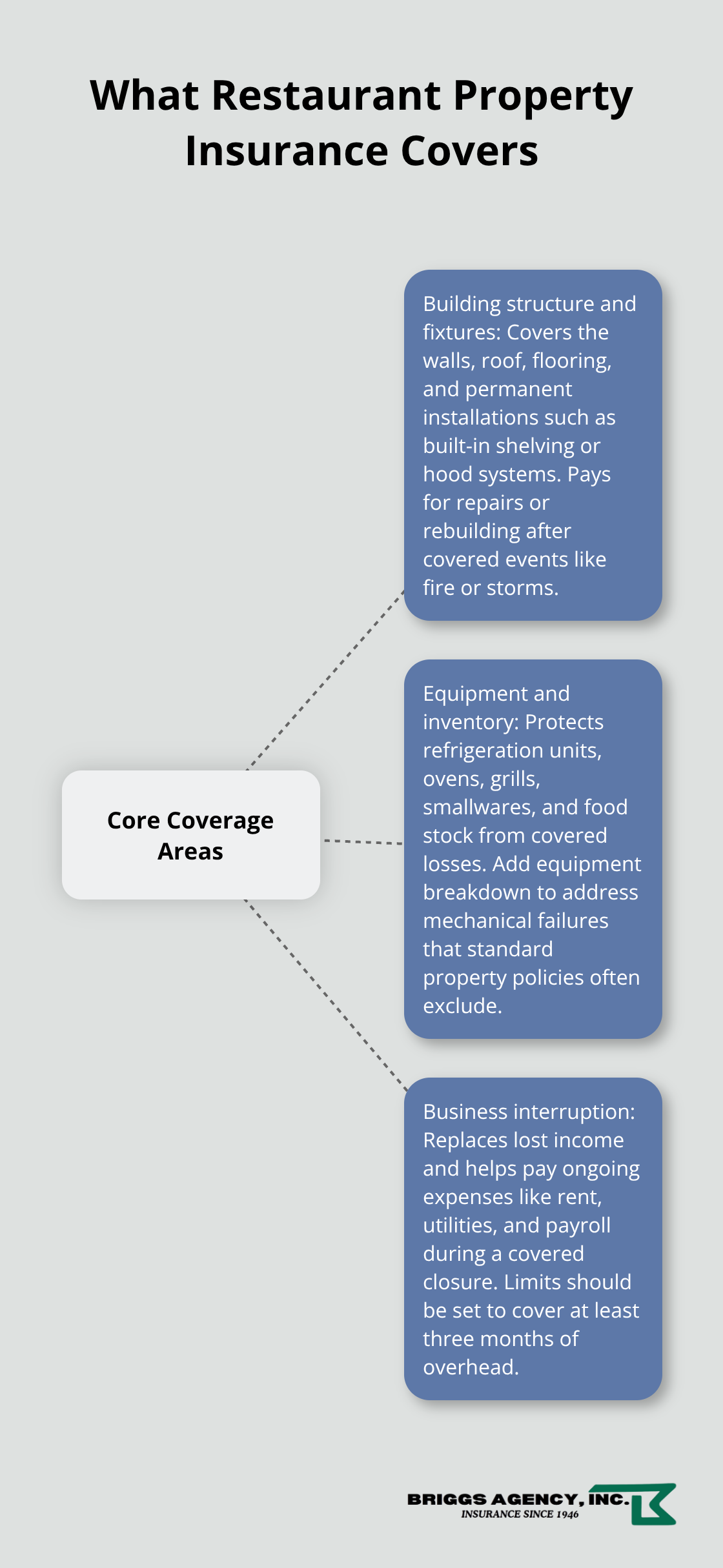
Restaurant property damage insurance protects three critical areas of your operation, but understanding exactly what falls under each category prevents costly coverage gaps when you file a claim.

Building Structure and Permanent Fixtures

Your building structure includes the walls, roof, flooring, electrical systems, plumbing, and permanent fixtures like built-in counters or walk-in coolers that you cannot remove without structural damage. Most policies cover damage from fire, wind, hail, theft, and vandalism to these components, though water damage from external sources like flooding or sewer backup often requires separate endorsements.

Hub-and-spoke diagram showing core property coverage areas for restaurants - Restaurant property damage insurance

If you occupy a leased space, your landlord’s policy covers the building shell, but you need your own coverage for tenant improvements and built-in equipment you installed. Your replacement cost should reflect current construction prices in your area, not what you originally paid five or ten years ago. Underinsuring your building means you absorb the difference when reconstruction costs exceed your policy limit, a painful reality many owners face after major damage.

Equipment and Appliances

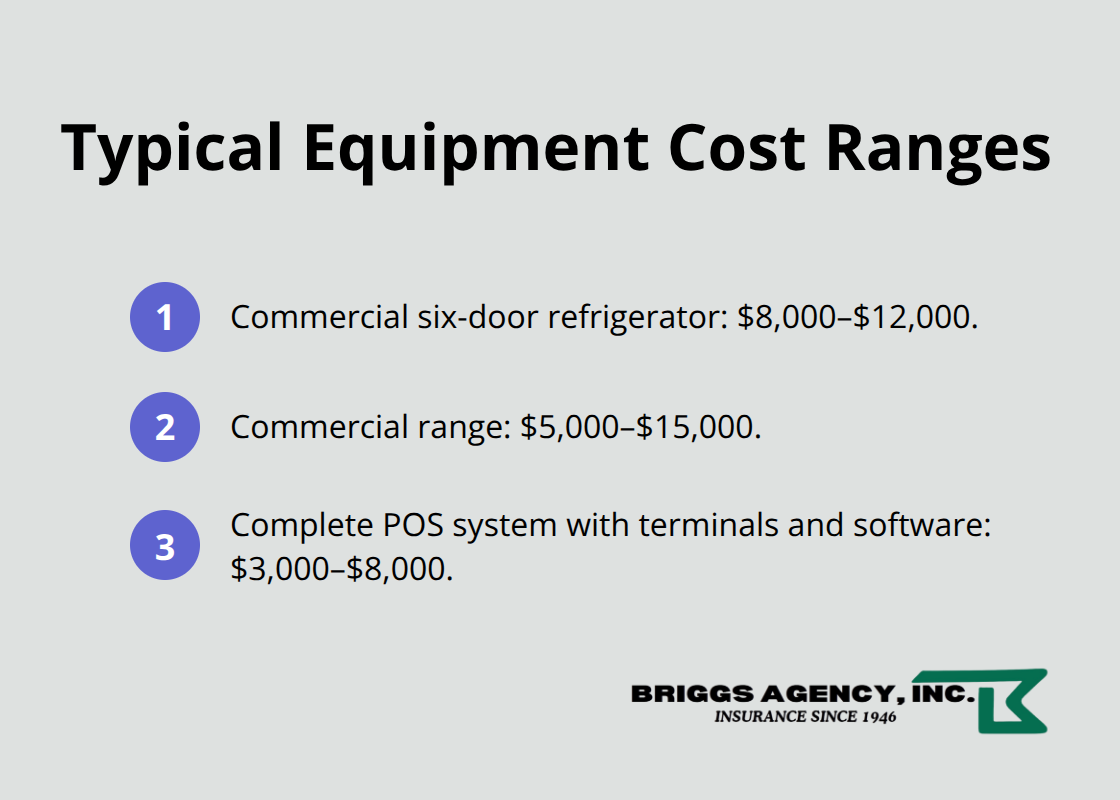
Equipment and appliances demand separate attention because standard property coverage sometimes limits what it pays for commercial kitchen gear. Your refrigeration units, ovens, fryers, grills, and HVAC systems need explicit coverage with limits matching their replacement value. Equipment breakdown coverage protects against mechanical failure and spoilage from power outages, which standard property policies exclude entirely. A commercial refrigerator costs between $3,000 and $8,000 to replace, and spoilage from a single cooling failure destroys $5,000 to $15,000 in perishable inventory within hours. Your policy should specify coverage for both stored equipment and units actively operating during service hours.

Inventory and Stock

Inventory and stock coverage protects food, beverages, and supplies at their replacement cost, not what you paid wholesale. Many restaurant owners carry inventory limits far below their actual stock value, then face partial recovery when fire or water destroys their supplies. Your policy covers inventory both in storage areas and actively on hand during service hours, provided your limits match your actual stock levels.

How Location Shapes Your Coverage and Costs

Location matters significantly for your coverage costs and available options. Urban restaurants with higher property values and greater foot traffic face higher premiums than rural establishments, while areas prone to severe weather or flooding see rate increases of 15 to 25 percent depending on historical loss data. Northern Indiana restaurants face particular exposure to winter storms and seasonal flooding that demand specific endorsements beyond standard policies. Your actual replacement costs for building components, equipment, and inventory determine whether your policy limits provide adequate protection or leave you exposed. Calculating these numbers accurately before disaster strikes separates full recovery from unexpected out-of-pocket expenses.

How to Choose the Right Coverage for Your Restaurant

Assess Your Property Value and Assets

Start with a detailed inventory of everything your restaurant owns, because guessing at property values guarantees underinsurance. Walk through your building with a calculator and list every item: the cost to replace your roof, HVAC system, flooring, walk-in coolers, POS terminals, furniture, and smallwares. Contact three local contractors and obtain actual quotes for roof replacement, not estimates from five years ago. A 2,000-square-foot restaurant building in Northern Indiana costs between $150 and $250 per square foot to rebuild after total loss, meaning your structure alone requires $300,000 to $500,000 in coverage.

Equipment replacement costs vary dramatically. A commercial six-burner range runs $4,000 to $7,000, a walk-in cooler costs $8,000 to $15,000, and a complete hood system with suppression reaches $12,000 to $25,000. Your inventory value fluctuates seasonally, but calculate your peak stock level and use that figure for your insurance limit. Most restaurant owners underestimate their inventory by 30 to 40 percent because they forget about beverages, dry goods in storage, and prepared food in coolers.

Document everything with photos and receipts, then add 10 to 15 percent to your calculations to account for inflation and the reality that replacement costs exceed original purchase prices. Many restaurants carry limits 20 to 30 percent below their actual replacement costs, a mistake that costs thousands when disaster strikes.

Evaluate Your Location and Risk Factors

Your location directly determines both your coverage needs and your costs, making regional risk assessment non-negotiable. Properties in flood-prone areas or communities with aging infrastructure face 15 to 25 percent higher premiums for property coverage, and standard policies exclude water damage from external sources entirely.

Compact checklist of location-driven property insurance considerations for restaurants - Restaurant property damage insurance

Northern Indiana restaurants need specific endorsements for sewer backup coverage, off-premises power outage spoilage protection, and winter storm damage that standard policies limit or exclude. Ask your insurance agent for your specific property’s loss history and the historical frequency of claims in your ZIP code for fire, water, wind, and weather events. Restaurants in high-traffic urban areas pay more for property coverage due to higher replacement costs and increased exposure, while those in lower-density areas typically see more favorable rates.

Review Policy Limits and Deductibles

Your deductible choice directly impacts your premium and your out-of-pocket exposure. A $1,000 deductible costs significantly less than a $500 deductible, but you absorb that $1,000 in losses when claims occur. Try a deductible you can afford to pay without straining your cash flow, because underfunding this decision forces you to skip claims on smaller losses.

Review your replacement cost calculations annually and adjust your limits whenever you renovate, purchase new equipment, or expand your operation. Coverage that protected you adequately last year may leave you exposed today. Your insurance agent can help you identify gaps in your current policy and recommend endorsements that match your specific operation and location.

Final Thoughts

Restaurant property damage insurance protects your building, equipment, and inventory from the real threats that force closure and drain your finances. Walk through your restaurant, document what you own, obtain current quotes from local contractors, and calculate your peak inventory value-this work takes a few hours but prevents the painful discovery after a fire or flood that your coverage falls $50,000 or $100,000 short of what you need to rebuild. Your location in Northern Indiana shapes both your risks and your coverage needs, with winter storms, seasonal flooding, and aging infrastructure demanding specific endorsements that standard policies exclude.

Review your policy annually, especially after renovations or equipment purchases, because coverage that worked last year may leave gaps today. Choose a deductible you can actually afford to pay without straining cash flow, and verify that your limits match current replacement costs, not what you paid five years ago. Your restaurant deserves protection from someone who understands local risks and your business.

We at Briggs Agency, Inc. have served Northern Indiana restaurants and businesses since 1946, helping owners understand what protection actually means for their specific operation. As an independent agency representing multiple top-rated carriers, we compare options and tailor restaurant property damage insurance to deliver competitive pricing and the right coverage for your situation. Contact Briggs Agency, Inc. to review your current coverage, identify gaps, and build a property damage insurance program that matches your actual needs.

The information provided in this blog is for general informational purposes only and does not constitute legal, financial, or insurance advice. Coverage options, terms, and availability may vary. Please consult with a licensed professional for advice specific to your situation.
Artificial intelligence may have been used to generate text and images in some blog articles.
Contractor General Liability Insurance: Why It Matters for Indiana Pros

Running a contracting business in Indiana means managing real risks every single day. One accident on a job site or property damage claim can threaten everything you’ve built.

Contractor general liability insurance protects you from these financial disasters. At Briggs Agency, Inc., we’ve helped countless Indiana contractors understand why this coverage isn’t optional-it’s essential.

What Your Coverage Actually Protects

Three Core Coverage Categories

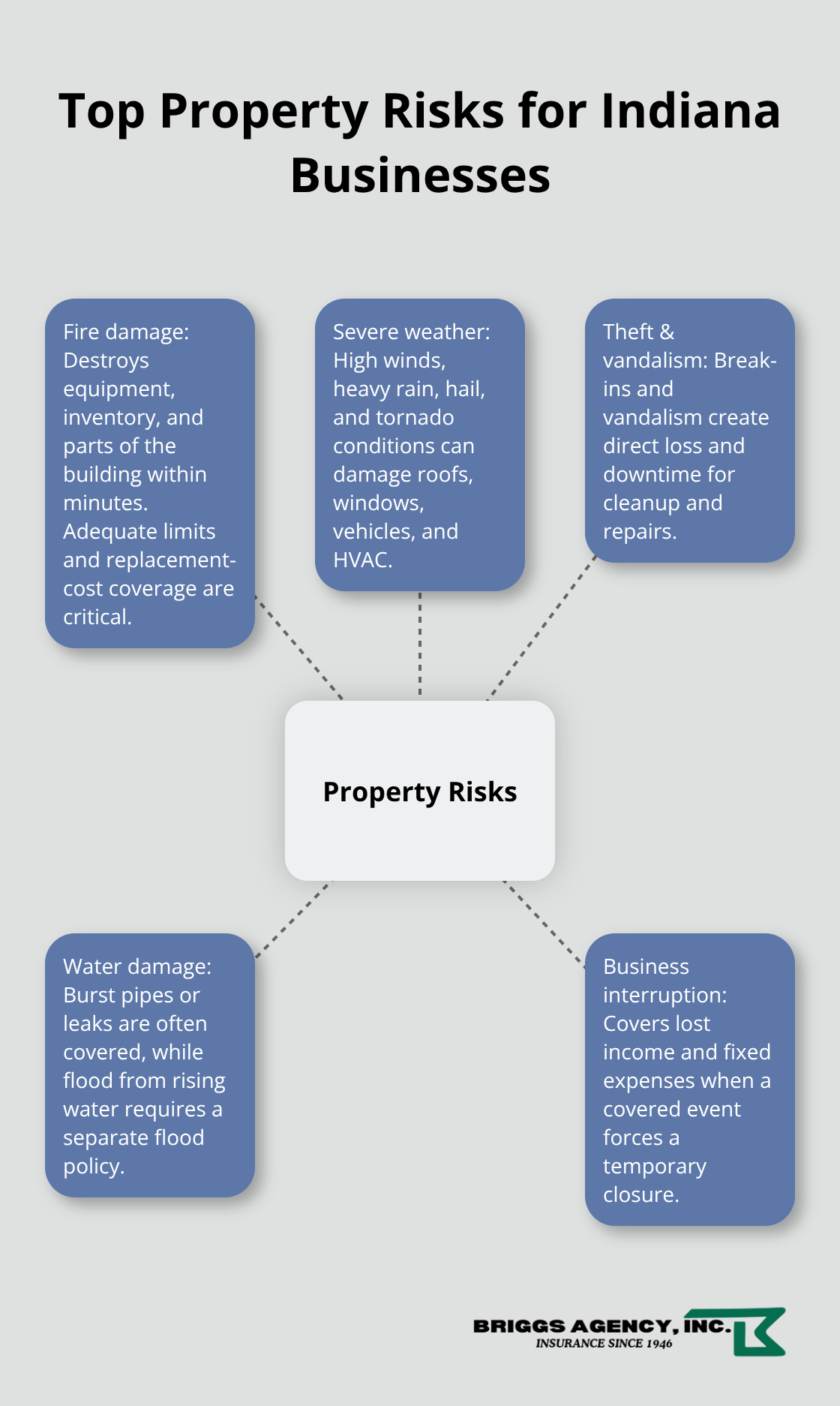
General liability insurance for contractors covers three categories of expenses that can sink your business if left uninsured. First, bodily injury claims arise when someone gets hurt on your job site-a worker steps on a nail, a client trips over your equipment, or a passerby is struck by debris. Property damage claims happen when your work damages something that isn’t yours-you accidentally drill through a water line, your crew damages a neighbor’s fence, or materials from your project damage a parked car. Second, your policy pays for legal defense costs the moment a claim is filed, regardless of whether you’re found liable. A serious injury lawsuit can cost $10,000 to $25,000 just in defense expenses, and that’s before any settlement or judgment. Third, medical payments coverage steps in quickly to cover immediate medical bills for injured parties, even if fault hasn’t been determined.

Hub-and-spoke infographic showing the core protections in contractor general liability insurance: bodily injury/property damage, legal defense, and medical payments.

This small gesture often prevents minor incidents from becoming lawsuits.

Understanding Your Policy Limits

The limits you carry directly determine your financial exposure. Indiana public works projects mandate a minimum of $1,000,000 per occurrence and $2,000,000 in general aggregate coverage for all contractors on the job. For private projects, you’ll typically find that $1 million per occurrence is the baseline, though many commercial clients and larger projects require $2 million per occurrence with $4 million aggregate. A roofing mistake or improper demolition can easily exceed $50,000 in property damage repair costs, and serious bodily injury claims regularly reach six figures or more. Your policy covers both the damages awarded and the defense costs, but only up to your limits-exceeding them means paying out of pocket.

Adjusting Your Deductible and Coverage

Increasing your deductible from $500 to $2,500 can reduce your monthly premium by 15 to 25 percent, but only take that step if you have adequate reserves to cover the higher out-of-pocket expense after a claim. For Indiana contractors, try starting with $1 million per occurrence and $2 million aggregate-this provides reasonable protection for most residential and light commercial work. Larger or more complex projects demand higher limits, and tailoring coverage to your specific exposure will shape what makes sense for your operation. Understanding these three coverage pillars helps you see why the right limits matter when a claim actually happens.

Why Indiana Contractors Must Carry This Coverage

Public Works Projects Demand Specific Minimums

Indiana public works projects require specific minimum coverage limits for every contractor on the job. If you bid on public work, you must provide written proof of these minimums before you can start. The state enforces these requirements uniformly across all contractor tiers, so there’s no negotiating around them. Private projects add their own demands: commercial clients commonly require $1 million per occurrence at minimum, and larger projects often demand $2 million per occurrence with $4 million aggregate. These aren’t arbitrary numbers-they reflect the real cost of serious incidents on job sites.

Local Licensing Authorities Set Their Own Rules

Each Indiana city controls its own contractor licensing process, and general liability insurance plays a central role in all of them. Indianapolis requires general liability insurance as part of your contractor license application, along with a $10,000 surety bond and workers’ compensation proof. Fort Wayne mandates a written exam and GL coverage verification before you receive your license. Evansville demands three letters of recommendation, a $25,000 surety bond, and GL certificates before you get licensed. These aren’t suggestions-they’re gatekeepers to legal work in your city.

Checkmark list summarizing general liability requirements for Indianapolis, Fort Wayne, and Evansville contractor licenses. - Contractor general liability insurance

You cannot operate without satisfying your local authority’s specific requirements.

Claims and Liability Exposure in Indiana

A serious bodily injury claim can easily exceed $100,000, and property damage from a single mistake routinely hits $50,000 or more. Without adequate limits, you pay personally for anything above your policy cap. Construction defect lawsuits in Indiana have a 10-year exposure window due to how state courts interpret faulty workmanship claims, meaning liability can follow you years after a project closes. That extended timeline makes higher limits essential-they cap your financial exposure at a specific number instead of leaving you vulnerable to six-figure judgments that arrive long after the work is done.

What Clients and Contracts Require

Your clients won’t hire you without proof of coverage. Most commercial leases, client contracts, and permit applications require a Certificate of Insurance listing your GL coverage before work starts. General contractors in Indiana typically carry $1 million per occurrence for residential and light commercial work, jumping to $2 million or higher for complex projects. If you provide design input, safety oversight, or construction consulting, you need professional liability coverage on top of general liability-defense costs alone for those claims run $10,000 to $25,000. Your coverage limits must match what your clients expect and what your actual work demands.

Pricing and Coverage Strategy

Monthly premiums for construction contractors in Indiana average around $281 according to MoneyGeek, though your actual rate depends on business size, claims history, and the specific services you offer. A solopreneur pays roughly $58 per month, but adding a fifth employee can boost premiums by 166 percent. Bundling general liability with property coverage into a Business Owner’s Policy can reduce costs by 10 to 15 percent and simplify management. The practical move: map your actual job-site exposure over the past three years, distinguish between residential and commercial work, note heavy equipment use and any design or safety responsibilities, then obtain quotes from at least three carriers familiar with Indiana’s statutes and local licensing rules.

Percentage chart showing premium reductions from higher deductibles and bundling coverage for Indiana contractors.

The right coverage protects your business, satisfies your clients, and meets your city’s legal requirements-all at a price that fits your operation.

What Actually Happens When Claims Hit Your Job Sites

Immediate Job-Site Incidents and Medical Costs

The moment a serious incident occurs on your job site, your general liability policy becomes your financial lifeline. Slip-and-fall accidents happen constantly in Indiana construction-a worker steps into an unmarked hole, a subcontractor’s crew leaves equipment blocking a walkway, or a client visits the site and trips on exposed wiring. Medical bills pile up immediately: an ambulance call runs $500 to $2,000, emergency room treatment easily exceeds $5,000, and if surgery is needed, costs climb into the tens of thousands. Your medical payments coverage handles these bills without waiting for fault determination, which prevents minor incidents from escalating into lawsuits.

Property Damage Claims and Repair Costs

Property damage claims arrive just as fast and often cause more financial damage than bodily injury. A roofing crew accidentally punctures a water line during installation, causing $15,000 in foundation water damage to the home below. An improper demolition method damages the structural support of an adjacent building, triggering $75,000 in repairs and a third-party lawsuit. Your general liability policy covers the full cost of repairs, plus legal defense, but only up to your policy limits-which is why Indiana contractors carrying just $1 million per occurrence face serious exposure on larger commercial projects where a single mistake can cost $100,000 or more to fix.

Construction Defect Claims and Long-Tail Exposure

The real danger emerges years after a project closes. Indiana law gives property owners a 10-year window to file construction defect claims, meaning a faulty roof installation you completed in 2026 can result in a lawsuit hitting your door in 2036. These long-tail claims are expensive to defend because courts have expanded what counts as unintentional faulty workmanship, making it harder to avoid liability even when you followed standard practices. A completed operations claim for water intrusion or structural settling can cost $20,000 to $50,000 just to investigate and defend, and if the property owner wins, damages can exceed $200,000 for a residential project or $500,000 for commercial work. This extended exposure is precisely why higher limits matter-they protect you from personal liability for incidents that surface years later.

Professional Liability and Design Exposure

If you provide design input, safety consulting, or construction oversight, professional liability claims add another layer of risk that general liability alone does not cover. A contractor who recommends a structural approach that later causes settlement or cracking faces defense costs of $10,000 to $25,000 and potential damages far exceeding general liability limits. The combination of immediate job-site exposure and delayed construction defect risk makes adequate coverage non-negotiable for Indiana contractors serious about protecting their business.

Final Thoughts

Contractor general liability insurance stands as the foundation that protects your business when accidents strike. The incidents covered in this post-job-site injuries, property damage claims, and construction defect lawsuits-happen to Indiana contractors every year, and they cost real money. Without adequate coverage, a single serious claim wipes out years of profit or forces you to close your doors.

The financial stakes demand your attention. A $50,000 property damage claim, a $100,000 bodily injury lawsuit, or a $200,000 construction defect suit arriving years after project completion represents the claims that hit Indiana contractors regularly. Your general liability policy caps your personal exposure at a specific number instead of leaving you vulnerable to judgments that exceed your ability to pay. That protection matters far more than the monthly premium you’ll spend.

Review your current coverage limits against the actual exposure on your job sites, map your past three years of projects, and identify any design or safety responsibilities that might require professional liability coverage. Contact a local agent who understands Indiana’s specific requirements and can compare quotes from multiple carriers. We at Briggs Agency, Inc. have guided Indiana contractors since 1946, and our experienced local agents can help you find the right contractor general liability insurance at a competitive price.

The information provided in this blog is for general informational purposes only and does not constitute legal, financial, or insurance advice. Coverage options, terms, and availability may vary. Please consult with a licensed professional for advice specific to your situation.
Artificial intelligence may have been used to generate text and images in some blog articles.
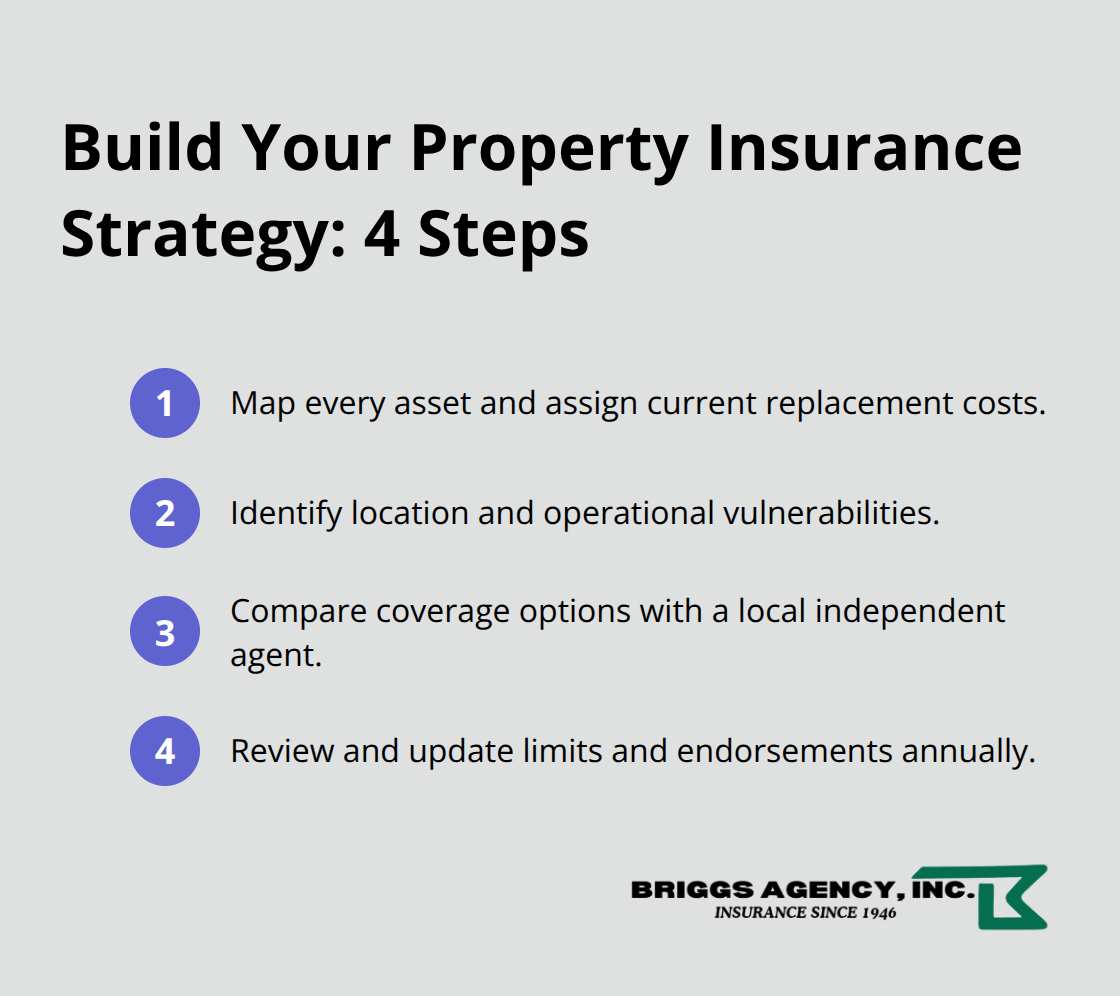
Northwest Indiana Trucking Insurance: Protecting Your Business and Assets

Running a trucking operation in Northwest Indiana means managing real risks every day. One accident, one liability claim, or one equipment loss can threaten everything you’ve built.

At Briggs Agency, Inc., we’ve helped countless trucking businesses in our region find the right coverage to protect their assets and stay compliant. This guide walks you through the insurance types you actually need and the gaps that could cost you.

Why Trucking Insurance Protects Your Bottom Line

Federal and State Requirements Drive Coverage Decisions

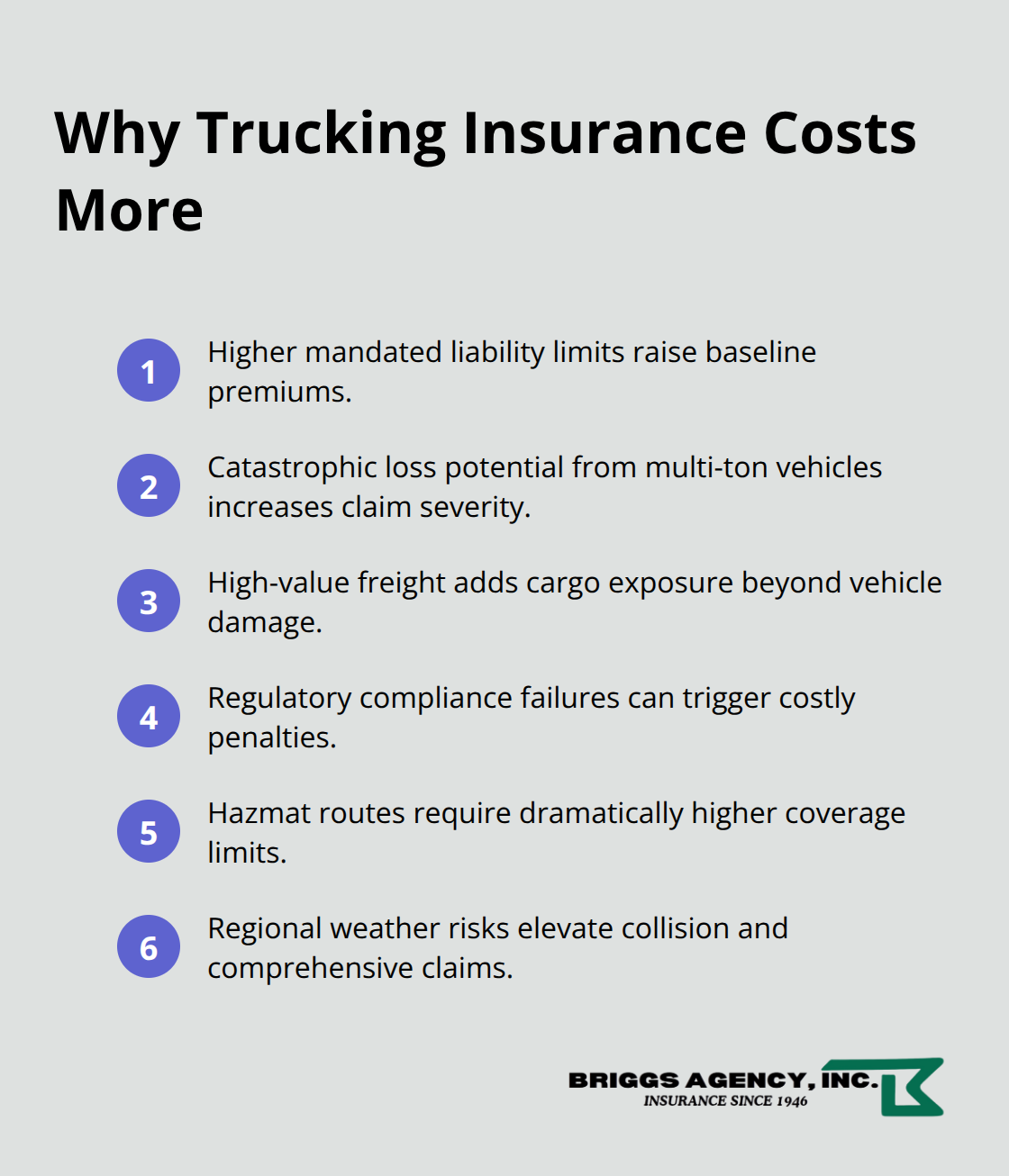
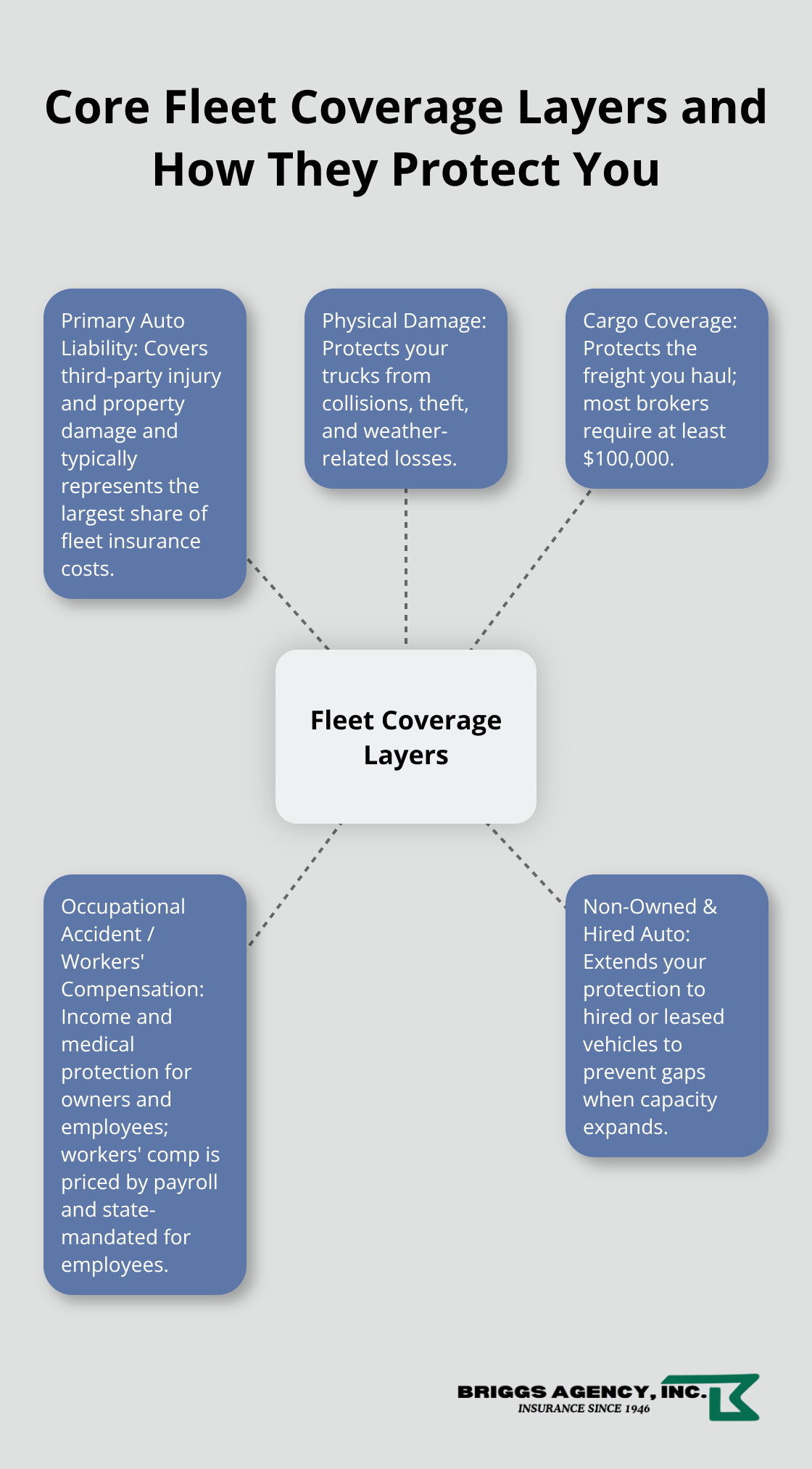
Federal law mandates commercial truck insurance for interstate operations, and Northwest Indiana state regulations impose additional requirements for intrastate work. Operators who ignore these mandates face fines, license suspension, and personal liability that extends beyond the business itself. Primary Liability coverage stands as the foundation-it covers bodily injury and property damage to third parties when your truck causes an accident. Without it, you absorb settlements and medical bills personally, and serious crashes routinely generate claims exceeding $100,000. One accident can eliminate years of profit if your coverage contains gaps.

The Real Cost of Accidents and Equipment Failures

Road conditions create constant exposure to loss. Brake system failures represent a significant mechanical risk in large truck crashes. Driver error, weather conditions, cargo shifts, and equipment malfunctions compound the risk. A single liability claim involving injuries or property damage reaches $500,000 to $2 million depending on severity.

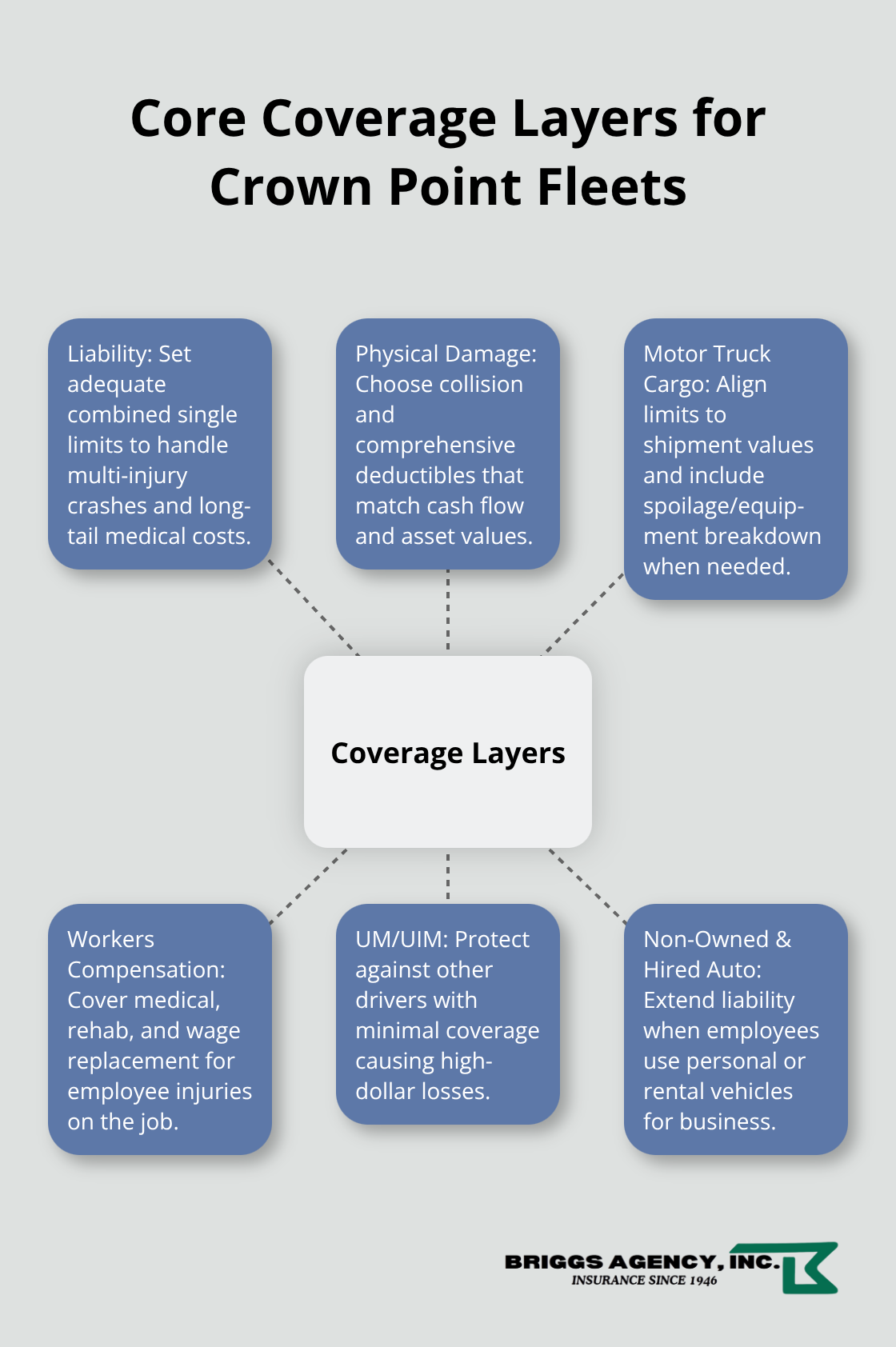
Physical Damage coverage protects your tractor and trailer from collision, theft, vandalism, fire, and weather events, but only when your deductible and limits align with your asset value. Motor Truck Cargo coverage proves equally important if you transport freight-loads like hazardous materials, jewelry, or live animals carry exclusions or require specific riders that most operators overlook.

The Owner-Operator Coverage Gap

Owner-operators face a critical blind spot: Non-Trucking Liability coverage (bobtail coverage) protects you when you drive without a load or between dispatch jobs. Standard policies leave this scenario unprotected, and the financial consequences run deep. In Northwest Indiana, operators with clean safety records and comprehensive coverage achieve premium reductions of 15-25% compared to those with claims history or coverage gaps. That advantage reflects both compliance and competitive positioning in a market where reputation matters.

Coverage Your Trucking Operation Actually Needs

Primary Liability: The Foundation That Protects Your Assets

Primary Liability coverage is non-negotiable and federally mandated, yet most Northwest Indiana operators underestimate the limits they truly require. A single serious accident involving multiple vehicles or severe injuries generates substantial claims, while many operators carry bare-minimum limits that expose personal assets to risk.

Infographic showing that 29% of semi-truck accidents involve brake-related failures - Northwest Indiana trucking insurance

The FMCSA reports that brake-related failures account for 29% of semi-truck accidents, and when those failures cause injury, settlements climb fast. You need limits that match your actual exposure, not just the legal minimum.

Physical Damage and Deductible Strategy

Physical Damage coverage protects your tractor and trailer against collision, theft, fire, hail, windstorm, flood, and vandalism-the events that threaten your equipment investment directly. The critical mistake we see repeatedly is operators choosing deductibles without analyzing their cash flow impact. Increasing your deductible from $1,000 to $5,000 can reduce premiums by 20-30%, but only if you maintain emergency reserves to cover that deductible when a claim hits. Set aside the deductible amount in a dedicated fund before you raise it, then compare expected annual savings to your increased out-of-pocket risk.

Cargo Coverage and Hidden Exclusions

Motor Truck Cargo coverage protects the freight you haul, but standard cargo policies exclude high-value or hazardous loads like jewelry, explosives, tobacco, and live animals unless you purchase specific riders upfront. Most operators get blindsided by these gaps during claims. Define your typical loads and cargo values before renewal, then request riders for any exclusions that apply to your actual business. This step takes minutes but prevents thousands in uncovered losses.

Non-Trucking Liability and Owner-Operator Protection

Non-Trucking Liability coverage, often called bobtail coverage, protects owner-operators when driving without a load or between dispatch jobs-a gap that leaves you personally liable if an accident occurs during those unloaded miles. In Northwest Indiana, operators with clean safety records and comprehensive coverage including bobtail protection see premium reductions of 15-25% compared to those with claims history or gaps. That advantage reflects how insurers view your risk management maturity, not just compliance.

Technology and Broker Partnerships Drive Real Savings

Specialized trucking insurance brokers typically deliver 10-25% savings by classifying your operation correctly and identifying discounts you’d miss working alone. Combining strategies produces the best results: implement safety technology like telematics, dash cameras, and backup sensors for immediate 5-15% discounts, then work with a broker who understands Northwest Indiana trucking to optimize rates further. Telematics and GPS tracking reward your operation with lower premiums because they provide insurers with proof that you monitor driver behavior and route efficiency, reducing both accident risk and theft exposure. These investments in safety technology and professional guidance set the stage for identifying coverage gaps that could derail your operation-which brings us to the specific blind spots most trucking businesses overlook.

Coverage Gaps That Cost Northwest Indiana Truckers Money

Liability Limits That Fall Short of Real Exposure

Most Northwest Indiana trucking operators carry insurance, but they carry the wrong amounts or forget entire coverage categories until a claim exposes the mistake. Liability limits matter more than premium cost when a serious accident happens. A single crash involving multiple vehicles or severe injuries generates claims exceeding $500,000 to $2 million depending on injury severity and property damage, yet many operators maintain bare-minimum limits that leave personal assets unprotected. Federal law sets minimum liability requirements, but those minimums exist for legal compliance, not financial protection. You need limits that match your actual exposure. The state mandates a minimum of $750,000 in liability coverage for non-hazardous freight, jumping to $1,000,000 to $5,000,000 depending on your cargo type and routes. If you haul hazardous materials or operate near populated areas, your exposure runs higher than an operator moving pallets on rural routes. Calculate your worst-case scenario based on your cargo type, routes, and vehicle weight, then set limits above that number.

The Owner-Operator Bobtail Coverage Blind Spot

Owner-operators face a second critical gap that surprises them during claims. When you lease to an ICC-regulated carrier, your coverage responsibilities shift depending on lease terms. Some lease agreements require the carrier to cover your truck while dispatched, but they don’t cover you when you drive without a load or between jobs. Non-Trucking Liability coverage, also called bobtail coverage, fills that gap by protecting you during unloaded miles or when operating independently. Without it, an accident during those unloaded miles leaves you personally liable for settlements and medical bills. In Northwest Indiana, operators with comprehensive coverage including bobtail protection see premium reductions of 15-25% compared to those with gaps, because insurers recognize that thorough coverage reflects mature risk management.

Cargo Exclusions That Derail Claims

The third gap involves cargo exclusions that operators discover too late. Standard Motor Truck Cargo policies automatically exclude high-value or hazardous loads like jewelry, explosives, tobacco, and live animals unless you purchase specific riders upfront. Most operators face claim denials when the insurer determines that the load fell into an excluded category. Define your typical loads and cargo values before renewal, request riders for any exclusions that apply to your actual business, and verify those riders appear in your policy documents before you operate. This step takes minutes but prevents thousands in uncovered losses.

Final Thoughts

Finding the right Northwest Indiana trucking insurance requires more than comparing quotes online. Your operation has specific risks that generic policies miss, and the agent you choose shapes whether you receive adequate protection or discover gaps during a claim. Local agents who understand your regional hazards ask the right questions about your loads, drivers, equipment, and growth plans-conversations that reveal gaps a distant broker would overlook.

Rates and underwriting standards vary significantly across carriers, so request quotes from at least two or three insurers and have an experienced agent help you evaluate them. One carrier may offer better pricing for owner-operators with clean records, while another specializes in fleets with hazardous cargo. A broker who works with multiple carriers positions your operation in front of the right underwriter, not just the cheapest option. At Briggs Agency, Inc., we represent multiple top-rated carriers to compare options across different insurers rather than pushing you toward one company’s limited offerings.

As your business grows, your coverage must grow with it. Adding trucks, expanding routes, or shifting to higher-value cargo changes your risk profile and your insurance requirements, so notify your agent immediately when those changes occur. Work with an experienced local agent who takes time to understand your operation, implement safety technology that reduces your risk, and review your coverage annually as your business evolves.

The information provided in this blog is for general informational purposes only and does not constitute legal, financial, or insurance advice. Coverage options, terms, and availability may vary. Please consult with a licensed professional for advice specific to your situation.
Artificial intelligence may have been used to generate text and images in some blog articles.

Restaurant Insurance Indiana: Tailored Protection for Restaurants

Running a restaurant in Indiana means managing countless moving parts-from food safety to staffing to equipment maintenance. One critical element many owners overlook is having the right insurance coverage in place.

At Briggs Agency, Inc., we work with restaurant owners across Indiana who face unique risks that standard business policies simply don’t address. Restaurant insurance Indiana protects your business, your employees, and your customers when accidents or unexpected events happen.

What Coverage Do Indiana Restaurant Owners Actually Need?

Restaurant owners in Indiana face five major claim categories that shape coverage decisions: equipment breakdown, employee injuries, slip-and-falls, theft, and vandalism. General liability insurance covers customer-facing risks-medical costs when someone gets hurt on your premises, plus advertising injuries like copyright claims. This protection typically includes limits of $1 million per occurrence and $2 million aggregate, which costs Indiana restaurant owners around $107 per month on average according to MoneyGeek data from 2026. Property insurance protects your building, equipment, and inventory from fires, natural disasters, and theft, and most landlords require it whether you own or lease your space.

Visual list of the top claim categories Indiana restaurants face

Vehicle Coverage for Delivery Operations

If you deliver food or operate vehicles for business purposes, your personal auto policy won’t cover those activities, so commercial auto insurance becomes mandatory. You need coverage for hired and non-owned vehicles if you rely on third-party delivery services. This gap catches many restaurant owners off guard when a delivery driver causes an accident-your business faces liability exposure that standard policies explicitly exclude.

Three key points on commercial auto and delivery risk for restaurants - Restaurant insurance Indiana

Workers’ Compensation and Incident Documentation

Workers’ compensation is required for any Indiana restaurant with employees and covers medical expenses, lost wages, and death benefits for dependents. Indiana law gives you two years from the injury date to file a claim, so accurate incident documentation matters immediately after an accident occurs. This window is tighter than many owners realize, making prompt reporting and detailed records essential for protecting both your employees and your business.

Equipment Breakdown and Business Interruption Protection

Equipment breakdown coverage specifically protects expensive kitchen appliances from costly repairs or replacements when refrigeration fails or power outages ruin perishable inventory. This isn’t included in basic property policies, yet it ranks among the top five claim drivers for restaurants. Business interruption coverage reimburses lost revenue when a covered event forces temporary closure-critical protection when a fire or equipment failure shuts down operations for days or weeks.

Liquor Liability and Additional Coverages

If your restaurant serves alcohol, liquor liability insurance is essential and now mandatory in Indiana with a $500,000 minimum requirement that took effect July 1, 2024. This coverage protects against claims from intoxicated patrons and covers legal defense costs, which matters because Indiana operates under Dram Shop laws that increase lawsuit likelihood. A Business Owners Policy (BOP) bundles property, general liability, and business interruption into one cost-effective package, often saving money compared to purchasing policies separately. Many Indiana restaurants also benefit from cyber liability coverage to protect customer payment data and online ordering systems, plus signage coverage for damaged exterior or interior signs after covered events.

With these core coverages in place, you’ve addressed the major risks that threaten restaurant operations. The next step involves identifying which provider can deliver the right combination of protection and local expertise for your specific situation.

What Puts Your Indiana Restaurant at Real Financial Risk

Slip-and-Fall Accidents: Your Most Preventable Threat

Slip-and-fall accidents represent the most preventable yet expensive threat to Indiana restaurants, and they happen far more often than owners expect. A wet floor in your dining room, grease near the kitchen line, or unsecured equipment creates immediate liability exposure-and customers pursue claims aggressively when they’re injured. General liability claims from slip-and-fall accidents typically fall within a $10,000 to $50,000+ range, which is why maintaining clear walkways, dry floors, and visible warning signage protects your bottom line. Kitchen hazards compound this risk because your staff faces constant exposure to burns, cuts, and slip hazards in tight spaces with high-pressure operations. Keeping walkways clear, floors dry, and signage visible prevents most incidents before they start, but general liability coverage catches what prevention misses.

Equipment Breakdown and Spoilage: Hidden Financial Drains

Equipment breakdown sits alongside slip-and-falls as a top-five claim driver for Indiana restaurants, and the financial impact strikes immediately and severely. When a refrigerator fails during summer heat or a power outage strikes, spoiled inventory and lost revenue total thousands of dollars within hours. Standard property policies exclude perishable inventory losses-a gap that catches owners off guard when they’re already scrambling to reopen. Equipment breakdown claims often cost more than the repair itself because you lose business income while equipment sits idle, making business interruption coverage equally important for restaurants that depend on continuous operations to stay profitable. Spoilage coverage protects against losses from refrigeration failures or power outages that ruin perishable inventory, addressing a risk that most basic policies ignore.

Food Contamination: Regulatory and Legal Exposure

Food contamination and foodborne illness claims carry different but equally serious financial exposure because they involve regulatory investigation, potential customer litigation, and reputational damage that extends beyond insurance payouts. A single outbreak traced to your kitchen triggers health department action, mandatory closure, and lawsuits from affected customers that take months or years to resolve. Your general liability policy covers some of this exposure, but the real protection comes from maintaining strict food safety protocols, training staff on proper handling and storage temperatures, and keeping detailed records of ingredient sourcing and preparation times. These practices reduce incident likelihood and demonstrate due diligence to regulators and insurers alike.

Fire Risk in Commercial Kitchens

Indiana tourism brought 83 million visitors to the state in 2024 with $16.9 billion in spending, which means your restaurant likely serves travelers and locals unfamiliar with your operations-increasing slip-and-fall risk from visitors who don’t know your layout. Fire risk in commercial kitchens demands serious attention because grease buildup, open flames, and high-heat cooking create conditions where fires spread rapidly and cause total loss of both building and equipment. Regular hood cleaning, functional fire suppression systems, and staff training on fire response reduce incident likelihood, but property insurance with adequate building and equipment limits remains your financial backstop when prevention fails. Understanding these specific risks shapes the coverage decisions you need to make next.

Selecting an Insurance Partner Who Gets Your Restaurant

Indiana’s insurance market includes 1,753 domestic and licensed foreign insurers, but most lack restaurant-specific expertise and underwriting knowledge. This abundance of options creates a practical problem: comparing quotes from generic business insurers wastes time because they misclassify your operation, miss industry-specific risks, and often decline coverage altogether when they realize you operate a kitchen with liquor service and delivery operations. You need an agency that understands the difference between dine-in revenue, takeout margins, and delivery risk exposure-distinctions that directly affect your premium and coverage adequacy.

Why Restaurant-Specific Expertise Matters

When you contact three insurers for quotes, insist on speaking with someone who has placed restaurant policies within the past twelve months, not a generalist who handles all small business types equally. Briggs Agency, Inc., a family-owned independent agency in Crown Point serving businesses since 1946, represents multiple top-rated carriers and compares options to tailor policies for Indiana restaurants. An agent with restaurant experience knows exactly which carriers specialize in food service, how underwriters evaluate spoilage risk, and which coverage gaps show up repeatedly in claims.

Comparing Quotes Across Multiple Carriers

The comparison process itself matters more than the initial quote price. Expect 30 to 50 percent price variation for identical coverage among different carriers according to MoneyGeek data, which means comparing only two quotes leaves you overpaying or underinsured. Request detailed quotes that specify coverage limits, deductibles, exclusions, and what’s included in any bundled Business Owners Policy versus standalone policies. Ask each carrier whether they cover spoilage, signage, lost business income, and equipment breakdown-the four coverages that separate adequate protection from inadequate policies.

Hub-and-spoke visualization of must-have coverages for Indiana restaurant insurance quotes - Restaurant insurance Indiana

Providing Accurate Information Upfront

Provide accurate information upfront: precise square footage, exact employee count broken down by role, annual revenue, whether you own or lease, specific cuisine type, delivery methods used, and alcohol service details. Misclassification kills deals during underwriting and delays coverage when you need it most. Clean underwriting information with precise details avoids the 30 to 50 percent price variation that results from carriers making different assumptions about your operation.

Calculating True Cost and Coverage Trade-Offs

Once you receive quotes, calculate the true cost per month including any monthly billing fees, because paying annually upfront saves 5 to 10 percent according to MoneyGeek, and raising your deductible from $500 to $2,500 cuts premiums by 15 to 25 percent if your business reserves can absorb a larger claim. The lowest price rarely delivers the best protection, so prioritize coverage that matches your actual risk profile over premium savings that leave you exposed. A policy that costs $20 less per month but excludes spoilage coverage exposes you to thousands in losses when equipment fails during peak season.

Final Thoughts

Restaurant insurance Indiana protects your business, your employees, and your customers when accidents or unexpected events disrupt operations. The coverage decisions you make today determine whether a slip-and-fall accident, equipment breakdown, or food contamination claim becomes a manageable loss or a financial catastrophe that threatens your restaurant’s survival. You now understand the five major claim categories that shape coverage decisions, the specific risks that hit Indiana restaurants hardest, and how to evaluate insurance providers who actually understand your operation.

We at Briggs Agency, Inc. have served Indiana businesses since 1946, and we specialize in restaurant insurance because we understand the unique risks you face. As a family-owned independent agency in Crown Point, we represent multiple top-rated carriers and compare options to deliver competitive pricing and the right protection tailored to your specific operation. Our experienced local agents know which carriers specialize in food service, how underwriters evaluate spoilage risk, and which coverage gaps show up repeatedly in claims.

Contact Briggs Agency, Inc. today to discuss your restaurant’s insurance needs with an agent who has placed restaurant policies within the past twelve months. Bring your square footage, employee count, annual revenue, and details about your service model-dine-in, takeout, delivery, or alcohol service-so we can request quotes from multiple carriers and compare coverage limits and deductibles. Three years of clean claims can yield meaningful reductions in renewal rates, potentially up to 20 percent, so the investment you make in proper coverage today pays dividends through lower premiums as your loss profile improves.

The information provided in this blog is for general informational purposes only and does not constitute legal, financial, or insurance advice. Coverage options, terms, and availability may vary. Please consult with a licensed professional for advice specific to your situation.
Artificial intelligence may have been used to generate text and images in some blog articles.
What Insurance Do Contractors Need? A Simple Guide for Builders, Remodelers, and Trades

What Insurance Do Contractors Need? A Simple Guide for Builders, Remodelers, and Trades 🛠️

Contractors build the homes we live in, repair the businesses we rely on, and keep our communities running. But whether you’re a general contractor, electrician, plumber, roofer, landscaper, or carpenter, every job site carries risk. One accident, lawsuit, or unexpected loss could cost thousands—or even shut down your business.

That’s why having the right insurance coverage is just as important as having the right tools. Let’s break down the key insurance policies contractors should consider and why they matter.


1. General Liability Insurance (The Foundation of Contractor Coverage) 🧱

If contractor insurance were a house, general liability would be the foundation.

This policy protects your business if you’re responsible for property damage or injuries to someone else while working.

Example:

You’re remodeling a kitchen and accidentally damage a client’s hardwood floor while moving equipment. General liability insurance can help pay for the repairs.

It can also cover:

✔ Third-party bodily injury
✔ Property damage
✔ Legal defense costs
✔ Advertising injury (like copyright issues)

Many clients and project managers require proof of general liability before you can even start a job.


2. Workers’ Compensation Insurance 👷‍♂️

If you have employees, workers’ compensation insurance is usually required by law.

Construction work is physically demanding and sometimes dangerous. Workers’ comp helps cover:

✔ Medical bills for injured workers
✔ Lost wages during recovery
✔ Rehabilitation costs
✔ Employer liability protection

Example:

A worker slips from a ladder and breaks their arm. Workers’ comp can cover medical treatment and lost wages while they recover.

Without this coverage, the contractor could be personally responsible for the costs.


3. Commercial Auto Insurance 🚚

Many contractors rely on trucks, vans, or trailers to transport tools and materials. Personal auto policies usually won’t cover vehicles used for business.

Commercial auto insurance can protect you if:

✔ Your work truck is involved in an accident
✔ Tools or materials are damaged in transit
✔ Someone is injured in a collision

Example:

You’re driving to a job site and accidentally rear-end another vehicle. Commercial auto coverage can help cover damages and liability.


4. Tools and Equipment Coverage 🔧

Contractors often carry thousands of dollars in tools and equipment, and job sites can unfortunately attract theft.

Tools and equipment insurance (sometimes called contractor’s equipment coverage) helps protect items like:

✔ Power tools
✔ Compressors
✔ Generators
✔ Ladders
✔ Construction equipment

Example:

Your locked trailer gets broken into overnight and several expensive tools are stolen. This policy can help cover the cost of replacement.


5. Builder’s Risk Insurance 🏠

Builder’s risk insurance protects structures under construction.

This coverage helps if damage occurs during a project due to events like:

✔ Fire
✔ Theft
✔ Vandalism
✔ Storm damage

Example:

A partially completed home suffers significant storm damage before the project is finished. Builder’s risk insurance can help pay for repairs.


6. Professional Liability Insurance 📋

Some contractors provide design, consulting, or specialized services. Professional liability (also called errors and omissions insurance) helps protect against claims of mistakes or negligence.

Example:

A design error in a renovation plan leads to costly corrections during construction. Professional liability coverage may help cover legal and financial consequences.


7. Umbrella Insurance ☂️

Sometimes accidents lead to very large claims. Umbrella insurance provides extra liability protection above your other policies.

For contractors working on large projects, this additional protection can be extremely valuable.


Why Insurance Matters for Contractors

Contractor insurance isn’t just about protecting your business—it’s about protecting your reputation, your clients, and your future.

Having the right coverage can:

✔ Help you win bigger jobs
✔ Protect your finances from lawsuits
✔ Keep projects moving after accidents
✔ Show clients you are a professional business

Many project owners will ask for a Certificate of Insurance (COI) before allowing work to begin.


Final Thoughts

Every contractor’s business is different. A solo handyman might need different coverage than a large construction company with multiple crews and heavy equipment.

The best approach is to work with an independent insurance agency that can compare policies and customize coverage for your specific trade.

After all, contractors build strong structures every day—your insurance should be just as strong as the work you do.


You can experience being a part of and full-serviced independent Insurance Agency today! Simply contact Briggs Agency Inc, if you are interested in an insurance review at 219-769-4840 or visit our website at www.BriggsAgency.com. We look forward to hearing from you!


Blog post written by: Zachary Pelke

Indiana Garage Insurance Rates: What Determines Your Premiums

Your garage insurance premiums in Indiana depend on several factors you can actually control. At Briggs Agency, Inc., we help local business owners understand exactly what drives their rates and where they can save money.

This guide walks you through the real costs behind Indiana garage insurance rates, practical ways to lower your premiums, and how to compare quotes without getting lost in the details.

What Really Drives Your Indiana Garage Insurance Premiums

Your Claims History Sets the Tone

Your claims history hits your premiums harder than almost anything else. If you filed claims in the past three to five years, insurers view you as higher risk, and your rates reflect that. A single at-fault accident during a test drive or while a vehicle sits in your care can add hundreds to your annual premium. MoneyGeek’s analysis of typical auto repair shops shows that claims history directly influences underwriting decisions across all coverage types. Shops with clean records over several years earn better rates. This means every decision to file a claim-or handle minor damage out-of-pocket-carries real financial weight. Your driving record matters too, especially if you or your employees regularly road-test customer vehicles.

Visual map of key factors affecting Indiana garage insurance premiums in Indiana, United States

Traffic violations and accidents on personal time can affect your business insurance rates because insurers see them as indicators of risk behavior.

Coverage Limits and Deductibles Control Your Costs

The limits you choose aren’t just about compliance; they’re the single biggest lever you control over your premium. Indiana’s minimum garage liability requirements are $100,000 bodily injury per person and $300,000 per accident, with $50,000 property damage. Many dealers stop there, but that’s a mistake. Shops that carry higher limits-say $500,000 or $1,000,000-pay more upfront but transfer far more risk to the insurer. Your deductible works the opposite way: raising it from $500 to $1,000 or $2,500 lowers your monthly cost significantly. A typical Indiana auto repair shop that bundles general liability, workers’ compensation, professional liability, and a Business Owners Policy pays about $217 per month for the BOP alone, according to MoneyGeek’s data. Add a garage keeper’s endorsement to cover customer vehicles in your care, and you face additional exposure that justifies higher limits. The type of work matters too: shops that perform high-risk services like bodywork or paint work face steeper premiums than those that handle basic maintenance.

Vehicle Types and Equipment Value Affect Your Rate

The vehicles you service and the equipment you own directly affect your rate. Luxury vehicles or high-value imports represent larger loss exposure than standard sedans, so shops that handle those vehicles pay more. Your diagnostic equipment, lifts, and tool inventory also factor into property coverage pricing. Shops with $500,000 in equipment on hand need higher property limits than those with $150,000 worth. Age of your facility matters too: older buildings without updated electrical systems or fire suppression may face higher rates or coverage restrictions. Sprinkler systems, alarm systems, and surveillance cameras can qualify businesses for premium discounts. Document these safety measures and share them with your insurer during renewal; you may qualify for loss-control credits that chip away at your bill. Understanding what your insurer sees as risk helps you make smarter decisions about which coverage upgrades and safety investments pay off fastest.

Real Ways to Cut Your Indiana Garage Insurance Costs

Bundle Your Policies for Immediate Savings

Bundling your policies cuts your monthly costs faster than any other single action. When you add garage keeper’s coverage and other specialized endorsements to that bundle, the per-policy cost drops noticeably compared to buying each one separately. Independent agencies like Briggs Agency, Inc. represent multiple top-rated carriers, which means they can shop your coverage across different insurers to find the combination that costs less while keeping your protection intact. Many shop owners buy policies one at a time from whoever answers the phone first, which costs them hundreds annually without delivering better coverage.

Keep Your Driving Record Clean

Your driving record and the records of anyone who test-drives customer vehicles directly impact your premium because insurers track these details closely. A single traffic violation or at-fault accident in the past three to five years signals higher risk to underwriters, and your rate moves up accordingly. Shops with clean records earn substantially better rates than those with violations on file. If you or your employees have traffic tickets or accidents, work to clear those records before renewal time rolls around, and disclose them honestly when shopping quotes because insurers will find them anyway. This transparency prevents surprises and helps your agent find carriers willing to work with your situation.

Install Security and Safety Equipment

Installing visible security measures like alarm systems, surveillance cameras, and fire suppression equipment cuts your premium in concrete ways. These aren’t optional upgrades that sound nice; they qualify you for loss-control credits that reduce your actual bill. Document every safety investment you make, photograph your equipment and systems, and hand that documentation to your insurer during renewal conversations. Raising your deductible from five hundred to one thousand or even twenty-five hundred dollars also lowers your monthly cost significantly, though you need to ensure you can actually cover that amount out-of-pocket if a claim happens. Match your deductible to your cash flow situation, not the lowest number available.

Adjust Your Coverage Limits and Deductibles Strategically

Your deductible choice directly controls what you pay each month. Higher deductibles mean lower premiums, but only if your business can absorb the out-of-pocket cost when a claim occurs. Many shop owners set deductibles too low because they focus on the monthly payment rather than their actual financial capacity. Test this: if a customer’s vehicle sustains five thousand dollars in damage while in your care, could you cover a twenty-five-hundred-dollar deductible without disrupting operations? If yes, that higher deductible saves you money every month. If no, stick with a lower deductible and accept the higher premium as the cost of financial stability.

Compact checklist to choose the right deductible for an Indiana garage business - Indiana garage insurance rates

Your coverage limits also matter tremendously. Indiana’s minimums are $100,000 bodily injury per person and $300,000 per accident, with $50,000 property damage, but many dealers stop there and expose themselves to significant risk. Shops that carry higher limits transfer far more risk to the insurer and pay more upfront but sleep better at night knowing they’re protected.

Compare Quotes to Find Your Best Rate

Shopping multiple insurers reveals how much rates vary for identical coverage. One carrier might quote $300 per month while another quotes $600 for the same limits and deductibles, depending on how they underwrite garage operations and what risk factors they weight most heavily. When you request quotes, provide identical information to each insurer so you can actually compare apples to apples. Include details about your vehicle types, equipment value, employee count, and any safety measures you’ve installed. This information helps carriers price your risk accurately and sometimes uncovers discounts you didn’t know existed. Once you have quotes in hand, look beyond the monthly number and examine what each policy actually covers, which endorsements are included, and whether the limits match your actual exposure.

How to Read a Garage Insurance Quote

What Makes Quotes So Different

Comparing quotes means understanding what each number actually represents, and most shop owners skip this step entirely. When you request quotes from multiple carriers, you’ll see vastly different prices for what appears to be the same coverage. This variation isn’t random; it reflects how each insurer weights your specific risk factors.

Breaking Down the Details That Matter

To make apples-to-apples comparisons, you need to look past the monthly premium and examine the actual policy details. Check whether each quote includes garage keeper’s coverage, which protects customer vehicles in your care during repair, storage, or test drives. Verify the bodily injury and property damage limits match across all quotes. Confirm that workers’ compensation, professional liability, and Business Owners Policy coverage are included in bundled quotes, since some carriers price these separately and others include them together.

Request quotes with identical deductibles-say $1,000 across the board-so premium differences reflect underwriting philosophy rather than coverage choices. Ask each carrier specifically which safety measures or equipment they’re crediting in their quote, because one insurer might offer a discount for your alarm system while another doesn’t. This detail matters because you can sometimes find savings simply by informing carriers about existing safety investments they didn’t know about.

Local Agencies Understand Your Market Better

National insurance companies operate from distant underwriting centers and apply broad formulas that don’t account for your shop’s specific location or reputation in the local community. Local independent agencies represent multiple top-rated carriers and understand Indiana’s specific risk landscape-winter weather patterns, local theft exposure, and regional vehicle types that affect your actual claims likelihood. When you work with a local agency, your agent advocates directly with carriers on your behalf, explaining your shop’s safety practices and claims history in context rather than letting a computer algorithm decide your rate.

National providers also take longer to respond to questions and process changes, which costs you time during renewal periods when rates matter most.

Red Flags That Signal Trouble

Watch for carriers that quote suspiciously low rates-rates that seem thirty or forty percent below competitors often indicate either missing coverage or underwriting that will result in claim denials when you need protection most. Avoid any quote that doesn’t clearly list what’s included and what’s excluded; vague wording about coverage scope means disputes later.

Percentage thresholds that can signal coverage gaps or denial risk in garage insurance quotes - Indiana garage insurance rates

If a quote lacks details about garage keeper’s coverage limits, employee coverage, or how high-risk services like bodywork affect the rate, ask directly or move to another carrier. Some national providers also impose strict guidelines about which vehicles you can service or limit your coverage if you perform certain types of work, restrictions that local agencies can often negotiate away with carriers that know your business.

Final Thoughts

Your Indiana garage insurance rates reflect the choices you make today about coverage limits, deductibles, safety equipment, and which carriers you compare. Claims history, vehicle types, and policy details matter far more than the monthly premium alone, so take time to examine what each quote actually includes and verify that garage keeper’s coverage protects your customer vehicles. Raising your deductible to $1,000 or $2,500 cuts your costs immediately if your cash flow allows it, while installing security systems and fire suppression equipment qualifies you for loss-control credits that reduce your bill month after month.

Working with a local independent agency makes this process faster and smarter because we represent multiple top-rated carriers and understand Indiana’s specific risk landscape in ways national providers cannot match. Briggs Agency, Inc. compares options across different insurers, negotiates on your behalf, and tailors policies to deliver competitive pricing alongside the right protection for your operation. Contact us today to get quotes on your garage coverage and see how much you might save by working with an agency that knows your community and genuinely cares about your success.

The information provided in this blog is for general informational purposes only and does not constitute legal, financial, or insurance advice. Coverage options, terms, and availability may vary. Please consult with a licensed professional for advice specific to your situation.
Artificial intelligence may have been used to generate text and images in some blog articles.
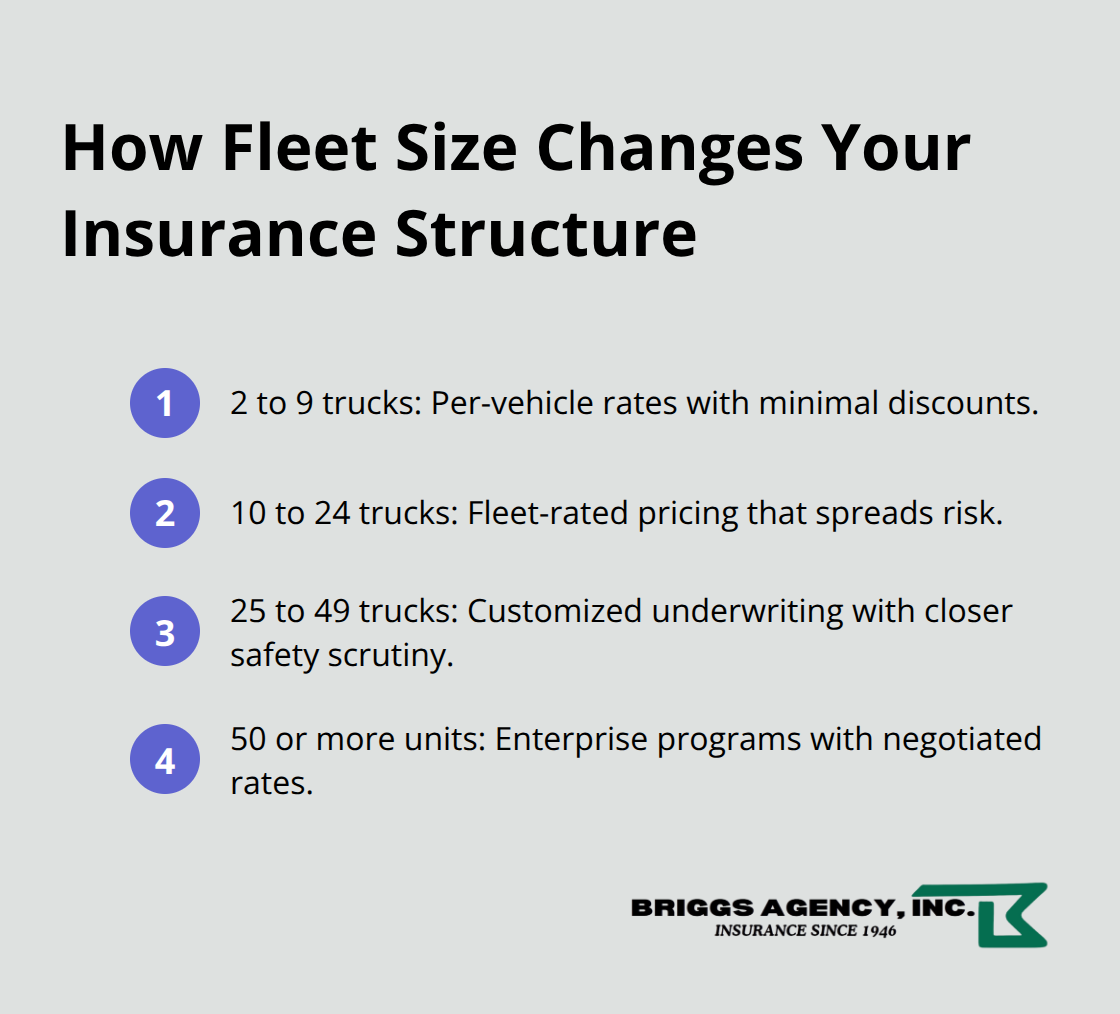
What Insurance Would Cover in a Zombie Apocalypse?

What Insurance Would Cover in a Zombie Apocalypse? (And What It Teaches Us About Real-Life Coverage)

When most people think about insurance, they picture paperwork, policies, and maybe a bill in the mail. But imagine something straight out of a movie — a zombie apocalypse.

While zombies (hopefully) aren’t real, thinking about extreme scenarios like this can actually be a fun and useful way to understand what different types of insurance coverage really protect you from.

Let’s break down what insurance might cover in a fictional zombie apocalypse and what that means for real-life risks that people face every day.


🏠 Homeowners Insurance: Protecting Your Home

Imagine this scenario:

You wake up to emergency alerts. Chaos spreads across the city. People are fleeing, infrastructure is failing, and buildings are getting damaged everywhere.

Your house gets damaged during the panic — maybe from:

  • A car crashing into your garage

  • A fire spreading from a neighboring property

  • Vandalism or looting during the crisis

What Would Insurance Cover?

A standard homeowners insurance policy may help cover:

✅ Fire damage
✅ Structural damage from accidents
✅ Vandalism or theft
✅ Damage caused by vehicles

So even though the zombie apocalypse itself isn’t a covered peril, many of the real events surrounding chaos or disaster could still be covered.

Real-Life Lesson

Insurance isn’t just about everyday problems. It also helps protect against unexpected disasters that damage your property.


🚗 Auto Insurance: Protecting Your Vehicle

In a zombie outbreak scenario, roads would likely be packed with people trying to escape. Accidents would be everywhere.

Imagine:

  • Someone crashes into your parked car

  • You hit debris while evacuating

  • Your vehicle gets stolen while you’re sheltering somewhere safe

What Would Cover It?

Depending on your policy:

Collision coverage

  • Pays for damage if your car hits another vehicle or object.

Comprehensive coverage

  • Covers theft, vandalism, falling objects, or disasters.

Real-Life Lesson

Even without zombies, these things happen every single day:

  • Car theft

  • Storm damage

  • Accidents

That’s why comprehensive and collision coverage are so important.


Liability Insurance: When Someone Gets Hurt

Let’s say your neighbor runs into your yard while trying to escape danger and trips over your broken fence.

Or your dog bites someone during the chaos.

Liability Coverage Could Help With

  • Medical expenses

  • Legal costs

  • Settlements or damages

This protection usually comes from your homeowners or renters insurance policy.

Real-Life Lesson

Most lawsuits don’t happen because of extreme disasters. They happen because of everyday accidents:

  • Someone slips on your icy driveway

  • A guest trips on your steps

  • A dog bite occurs

Liability coverage protects you financially in situations like these.


☂️ Umbrella Insurance: Extra Protection

In a zombie apocalypse, lawsuits and liability claims could quickly exceed normal policy limits.

That’s where umbrella insurance comes in.

Umbrella policies provide extra liability protection above your home and auto policies.

Example:

  • Your homeowners liability limit: $300,000

  • Lawsuit judgment: $900,000

Your umbrella policy could cover the remaining amount.

Real-Life Lesson

Umbrella insurance is surprisingly affordable and protects against major financial risks.


🏢 Business Insurance: When Disaster Shuts Things Down

Imagine you own a small business and suddenly:

  • You must close due to emergency conditions

  • Your property is damaged

  • Equipment is destroyed

Some commercial policies include business interruption coverage, which may help replace lost income during covered events.

Real-Life Lesson

Disasters don’t have to be fictional.

Real events like:

  • Severe storms

  • Fires

  • Power outages

  • Supply chain disruptions

can seriously impact businesses.

Insurance helps businesses survive these unexpected challenges.


🧠 What a Zombie Apocalypse Teaches Us About Insurance

The zombie scenario may be fictional, but the risks it represents are very real.

Insurance is designed to protect against unexpected events that disrupt life.

These include:

✔ Fires
✔ Car accidents
✔ Property damage
✔ Lawsuits
✔ Natural disasters
✔ Theft and vandalism

Without proper coverage, these events can create serious financial hardship.


🛡️ The Best Protection Is Being Prepared

You might never face a zombie apocalypse (thankfully), but unexpected events can happen at any time.

That’s why reviewing your coverage is important.

Ask yourself:

  • Do I have enough liability coverage?

  • Would my insurance rebuild my home if it were destroyed?

  • Am I protected against major lawsuits?

  • Does my business have interruption coverage?

If you’re not sure, it may be time to review your policies.


📞 Need Help Reviewing Your Coverage?

At Briggs Insurance Agency, we help individuals, families, and businesses make sure they have the right protection in place — whether it’s everyday risks or the unexpected.

Because while zombies may be fictional, financial disasters are not.

You can experience being a part of and full-serviced independent Insurance Agency today! Simply contact Briggs Agency Inc, if you are interested in an insurance review at 219-769-4840 or visit our website at www.BriggsAgency.com. We look forward to hearing from you!


Blog post written by: Zachary Pelke

Small Restaurant Insurance Indiana: A Practical Guide for Local Owners

Running a restaurant in Indiana means juggling dozens of moving parts, and insurance is one that can’t be overlooked. Most restaurant owners discover too late that standard business policies leave dangerous gaps in coverage.

At Briggs Agency, Inc., we’ve helped countless local restaurant owners find the right small restaurant insurance in Indiana to protect what they’ve built. This guide walks you through exactly what you need.

What You’re Actually Risking Without Restaurant-Specific Coverage

Why Generic Policies Fall Short for Food Service

Standard business insurance policies treat restaurants like any other operation, which is precisely the problem. A generic commercial general liability policy might cover slip-and-fall incidents, but it often excludes foodborne illness claims, liquor-related liability, and spoilage losses that can devastate a food service business. Indiana restaurants face distinct exposures that demand specialized protection, yet many owners discover critical gaps only after a loss occurs.

The Real Cost of Common Restaurant Disasters

The National Fire Protection Association reports that restaurants burn at roughly twice the rate of other commercial buildings, with cooking equipment the leading cause. Water damage from burst pipes, slip-and-fall accidents exceeding $500,000 in medical costs and settlements, and foodborne illness outbreaks that sicken patrons represent everyday risks in this industry. Food contamination alone costs around $1,800 per incident when inventory spoils, not counting the legal defense costs and lost business income that follow.

Indiana’s Legal Requirements Add Complexity

Indiana law requires workers’ compensation for any restaurant with employees, plus mandatory liquor liability insurance if you serve alcohol-a legal obligation tied directly to your liquor license through the Indiana Alcohol and Tobacco Commission. Health code violations carry fines up to $1,000 per violation and can trigger license suspension, transforming operational oversights into financial crises that insurance must address.

The CDC estimates that foodborne illnesses sicken about 48 million Americans annually, making robust protection non-negotiable for any food service operation.

Your Specific Exposure Determines Your Coverage Needs

Your restaurant’s actual exposure depends on your specific setup: whether you own or lease the building, how many employees you have, whether you offer delivery services, and what your claims history shows. A small fast-casual spot with five employees and no alcohol service faces entirely different risks than a fine-dining establishment with a full bar and delivery operations. Indiana’s location and local risk profiles also matter-flood-prone areas need riders that standard property policies exclude, and storm-prone considerations apply differently across the state.

Finding the Right Coverage Starts With Honest Assessment

Getting the right coverage starts with honest assessment of your operation’s details, not guessing based on what another restaurant carries. A local agent who understands Indiana’s specific legal landscape and restaurant risks spots gaps that online quotes miss, making the next step-identifying which coverage types actually protect your business-far more straightforward.

The Four Coverage Pillars Every Indiana Restaurant Needs

General Liability: Your First Line of Defense

General liability insurance forms the foundation of restaurant protection, covering the slip-and-fall incidents and food poisoning claims that plague this industry. Indiana restaurants typically need limits of $1 million per occurrence, with average costs around $73 per month and many policies offering $0 deductibles. This coverage pays for medical expenses, legal defense, and settlements when a customer is injured on your property or becomes ill from your food. A single slip-and-fall accident costing $500,000 in medical expenses and settlements wipes out most small restaurants’ operating capital without this protection.

Property Insurance: Protecting Your Physical Assets

Property insurance protects your building, kitchen equipment, and inventory from fire, theft, storms, and vandalism on a replacement-cost basis. The National Fire Protection Association reports restaurants burn at roughly twice the rate of other commercial buildings, with a single fire potentially destroying $50,000–$100,000 of equipment and inventory. Property coverage averages about $106 per month with a typical $1,000 deductible, and it becomes non-negotiable if your landlord holds the lease-most require proof of coverage before you open.

Workers’ Compensation: A Legal Mandate

Workers’ compensation is legally mandatory in Indiana the moment you hire your first employee, covering medical costs and lost wages for injured staff members. Indiana Workers’ Compensation Board data shows median costs around $139 per month, calculated as roughly $2.25 per $100 of payroll, with claims typically filed within two years of the incident. Noncompliance triggers penalties that dwarf the insurance premium itself, making this coverage non-negotiable from both a legal and financial standpoint.

Liquor Liability: Required if You Serve Alcohol

Liquor liability insurance is essential if you serve alcohol-not optional-because Indiana law ties it directly to your liquor license through the Indiana Alcohol and Tobacco Commission. This coverage pays legal defense costs, medical expenses, and settlements when an intoxicated patron causes harm to themselves or others, and violations of liquor service laws create exposure that standard general liability policies explicitly exclude.

Additional Protections That Fill Critical Gaps

Food contamination coverage reimburses spoiled or contaminated inventory after power outages or refrigeration failures, averaging about $1,800 per incident and protecting against losses that standard property policies often exclude. Commercial auto insurance becomes mandatory if you offer delivery services, with typical costs ranging from $1,200 to $2,500 per year depending on vehicle type and driver history. A Business Owner’s Policy bundles property, general liability, and business interruption coverage at a discounted rate, simplifying management and reducing total premiums compared to purchasing separate policies. Indiana restaurants in flood-prone areas need flood insurance riders since standard property policies exclude water damage from rising water, though coverage varies by region across the state. Cyber liability insurance protects against data breaches and payment card compromises, increasingly important as online ordering becomes standard in the industry.

The total foundation coverage-general liability, property, and workers’ compensation-typically costs roughly $300–$500 per month for a small restaurant, with final pricing determined by your building ownership status, employee count, claims history, and whether you serve alcohol or offer delivery. Understanding these four pillars gives you a solid starting point, but the real work begins when you compare actual quotes and identify which optional coverages match your specific operation.

How to Actually Save Money on Restaurant Insurance

Compare Quotes From Multiple Carriers

Getting multiple quotes from different carriers is non-negotiable if you want competitive pricing, yet most Indiana restaurant owners stop after one online form and accept whatever rate appears first. When you request quotes from three or four A-rated carriers, you’ll often see premium differences of 30 to 50 percent for identical coverage limits-differences that compound to thousands of dollars annually. The process takes two hours max: document your building square footage, number of employees, annual sales projection, whether you own or lease, delivery services offered, and claims history from the past five years.

Contact independent agents who represent multiple carriers rather than relying on online quote tools that funnel you toward a single insurer. An independent agent can access pricing from companies like State Farm, Travelers, and Hartford simultaneously, showing you side-by-side comparisons that reveal which carrier values your specific risk profile. Don’t accept the first number-push back and ask agents to run quotes with different deductibles ($1,000 versus $2,500) and coverage limits ($500,000 versus $1,000,000 per occurrence) so you see the actual cost of upgrading protection.

Many restaurant owners discover that increasing general liability limits from $500,000 to $1,000,000 costs only $15 to $25 more per month, making the upgrade obvious once you see the numbers. This comparison process also exposes which carriers penalize you for specific exposures-some charge premiums 40 percent higher for delivery operations while others barely adjust the rate, so knowing these differences matters enormously.

Evaluate Bundled Policies Carefully

Bundling policies into a Business Owner’s Policy sounds convenient but demands scrutiny before you commit. A bundled BOP typically combines property, general liability, and business interruption coverage at a 10 to 20 percent discount compared to purchasing policies separately, which sounds attractive until you realize the bundled limits may not match your actual needs. An agent might bundle you into a $300,000 property limit to hit a lower premium, but if your kitchen equipment alone exceeds that value, you’re underinsured despite the discount.

Request separate quotes for each coverage type, then ask the agent to price a BOP, and compare total premiums rather than assuming bundling always wins. This approach reveals whether the discount actually saves you money or simply masks inadequate coverage.

Lower Premiums Through Operational Changes

Safety measures directly lower premiums across all carriers-maintaining clean floors prevents slip-and-fall claims, implementing documented food safety procedures reduces contamination exposure, and offering employee benefits cuts turnover and associated workers’ compensation costs. Installing fire suppression systems in your kitchen can reduce property insurance costs by 5 to 10 percent, while updating your employee manual and conducting regular safety training demonstrates risk management that insurers reward with lower rates.

Percentage impacts from common savings strategies - Small restaurant insurance Indiana

The question to ask your local agent isn’t what coverage costs, but rather what specific operational changes would reduce your premium-some agents identify quick wins like installing a commercial hood cleaning service contract or upgrading lighting that immediately lower your rate. These conversations often reveal $2,000 to $4,000 in annual savings simply through restructuring deductibles and eliminating duplicate or unnecessary coverage, so a conversation with an agent who understands your operation pays for itself immediately.

Final Thoughts

Restaurant insurance in Indiana protects everything you’ve built, from your equipment and inventory to your employees and customers. Small restaurant insurance Indiana owners face real financial exposure that compounds every day without proper protection, and the coverage gaps we’ve outlined throughout this guide represent genuine risks that generic policies fail to address. Your restaurant’s specific setup determines what you actually need, which is why tailored coverage that matches your actual exposure beats one-size-fits-all approaches that leave critical gaps.

Start by documenting your operation’s details: building square footage, employee count, annual revenue projection, whether you own or lease, and any delivery or alcohol service you offer. Request quotes from multiple carriers using identical coverage specifications so you see real pricing differences, then evaluate whether bundling saves money or masks inadequate limits. Ask your agent which operational changes would lower your premium immediately, since this process takes a few hours but saves thousands annually and prevents the financial devastation that follows an uninsured loss.

A local independent agent who represents multiple carriers and understands Indiana’s specific legal requirements spots gaps that online tools miss, turning insurance from a cost center into genuine risk management. Contact Briggs Agency, Inc. to discuss your specific situation and receive quotes that reflect your real exposure rather than guessing based on what competitors carry.

The information provided in this blog is for general informational purposes only and does not constitute legal, financial, or insurance advice. Coverage options, terms, and availability may vary. Please consult with a licensed professional for advice specific to your situation.
Artificial intelligence may have been used to generate text and images in some blog articles.