
Truckers Liability Insurance: Protecting Your Driving Team
One accident can devastate a trucking business financially. At Briggs Agency, Inc., we’ve seen how quickly a single liability claim can threaten operations and drain resources.
Truckers liability insurance isn’t optional-it’s the foundation of responsible fleet management. This guide walks you through what coverage actually protects you, why it matters legally, and how to select the right policy for your operation.
What Truckers Liability Insurance Actually Covers
Truckers liability insurance protects you when someone else gets hurt or their property gets damaged because of your trucking operations. This coverage pays for medical bills, lost wages, and property repairs when a third party files a claim against you. If you haul freight for a customer and your truck damages their loading dock, or if a passenger gets injured at a truck stop while you work, liability insurance covers those costs. The coverage includes bodily injury claims, which handle medical expenses and ongoing care, and property damage claims, which reimburse for damaged vehicles, buildings, equipment, or other assets. Without this protection, a single accident costs you tens of thousands of dollars out of pocket. Federal Motor Carrier Safety Administration requirements mandate that interstate truckers carry liability coverage, with minimums varying based on cargo type and vehicle weight. Even local operators face state-level requirements, so compliance isn’t optional.
Who Pays When Accidents Happen
When an accident occurs, your liability policy covers legal defense costs and settlement payments on your behalf. If someone sues you for injuries or property damage, the insurance company provides an attorney and handles court proceedings, which typically cost $10,000 to $50,000 or more depending on case complexity. You avoid paying these expenses directly from your business account. The policy also covers settlements and judgments up to your coverage limits. For example, if a truck accident injures three people and damages property, your bodily injury coverage pays medical costs while property damage coverage handles vehicle and building repairs.
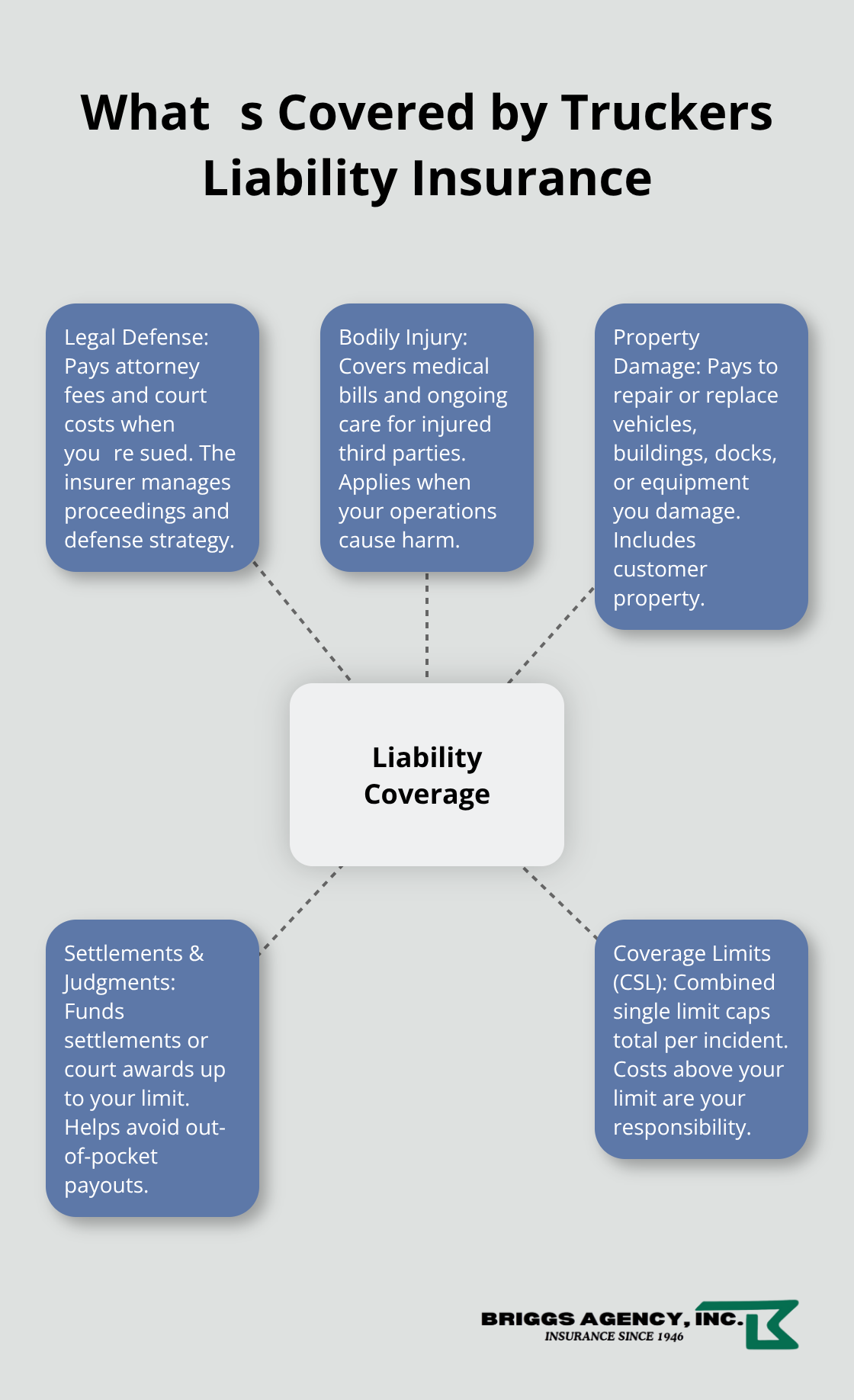
Your coverage limits matter enormously here. A combined single limit sets the maximum payout per incident, so if you carry $1,000,000 in coverage and damages exceed that amount, you pay the difference. Selecting adequate limits based on your cargo value and route density protects your business from catastrophic exposure.
Third-Party Injury Claims Create Real Exposure
Third-party injury claims arise from accidents where your truck causes harm to someone else’s body or property. If your truck collides with another vehicle, the other driver’s medical bills and vehicle repairs fall under your liability coverage. If you make a delivery and someone slips on wet pavement at a customer’s loading dock, that person’s injury claim becomes your responsibility. Cargo-related incidents create additional exposure. If your truck’s cargo shifts during transit and damages a customer’s production equipment, your liability coverage protects you. These scenarios occur regularly in trucking. Heavy truck accidents cause significantly greater damage than standard vehicle crashes due to weight and size differences, making liability claims more expensive and more likely to exceed basic coverage limits. Operating in congested areas, making frequent stops, or hauling high-value cargo increases your exposure to third-party claims. This is why many shippers, including major carriers like FedEx and Amazon, require drivers to carry specific liability minimums before accepting loads. Understanding your actual risk exposure based on your routes, cargo types, and customer requirements helps you select coverage limits that actually protect your business. The right policy prevents gaps that could leave you financially vulnerable when an accident happens.
Why Truckers Need Liability Insurance
Federal law mandates that interstate truckers carry liability coverage, with minimums set by the Federal Motor Carrier Safety Administration based on cargo type and vehicle weight. In-state operations face their own state-level requirements, and many major shippers including FedEx and Amazon require carriers to maintain specific liability minimums before accepting loads. Operating without mandated coverage means fines, loss of operating authority, and personal liability exposure. Beyond legal compliance, a single accident exposes your business to financial devastation that no owner-operator can absorb alone.
A moderate truck accident involving two vehicles and three injured people easily generates $500,000 to $2 million in combined medical costs, lost wages, vehicle repairs, and property damage. Without liability insurance, you pay these costs directly from business revenue or personal assets. Courts can garnish future earnings and freeze business accounts to satisfy judgments, effectively shutting down operations. Progressive’s 2025 analysis shows national average monthly premiums for commercial truck insurance range from $734 for specialty truckers to $926 for transport truckers, making the cost of coverage modest compared to the financial exposure of a single claim.
Cargo Claims Create Substantial Exposure
Cargo-related liability incidents represent a distinct category of exposure that many owner-operators underestimate. If your truck’s cargo shifts during transit and damages a customer’s production equipment, your liability coverage pays the claim. If you make a delivery and your cargo damages the customer’s loading dock or storage facility, that damage falls under your policy. Shippers frequently require proof of liability coverage specifically because cargo incidents happen regularly and costs mount quickly.
A damaged manufacturing line can cost tens of thousands per hour in lost production, and your liability policy must cover that exposure. Heavy truck accidents cause substantially greater damage than standard vehicle crashes due to weight and size, making cargo-related claims more expensive. Your operating radius and cargo type directly affect your actual exposure level.
How Your Routes and Cargo Mix Determine Coverage Needs
Regional and interstate routes with high-value cargo carry significantly higher liability risk than local operations with standard freight. Assessing your specific cargo mix, delivery locations, and customer requirements reveals your true exposure and helps determine appropriate coverage limits. The right coverage limit protects your business when accidents happen; inadequate limits leave you financially vulnerable despite carrying a policy.
Understanding these exposure factors positions you to select coverage that actually matches your operation. The next section walks you through how to evaluate your specific needs and choose a policy that protects your driving team and business.
How to Choose the Right Coverage Limits for Your Operation
Selecting adequate coverage limits starts with calculating your actual financial exposure based on cargo value, vehicle weight, and operating geography. If you haul high-value equipment or operate in densely populated areas with frequent stops, your exposure climbs significantly compared to long-haul dry freight on interstate highways. Progressive’s 2025 analysis shows monthly premiums range from $734 for specialty truckers to $926 for transport truckers, reflecting how cargo mix and routes drive risk assessment.
Start with Shipper Requirements and Industry Standards
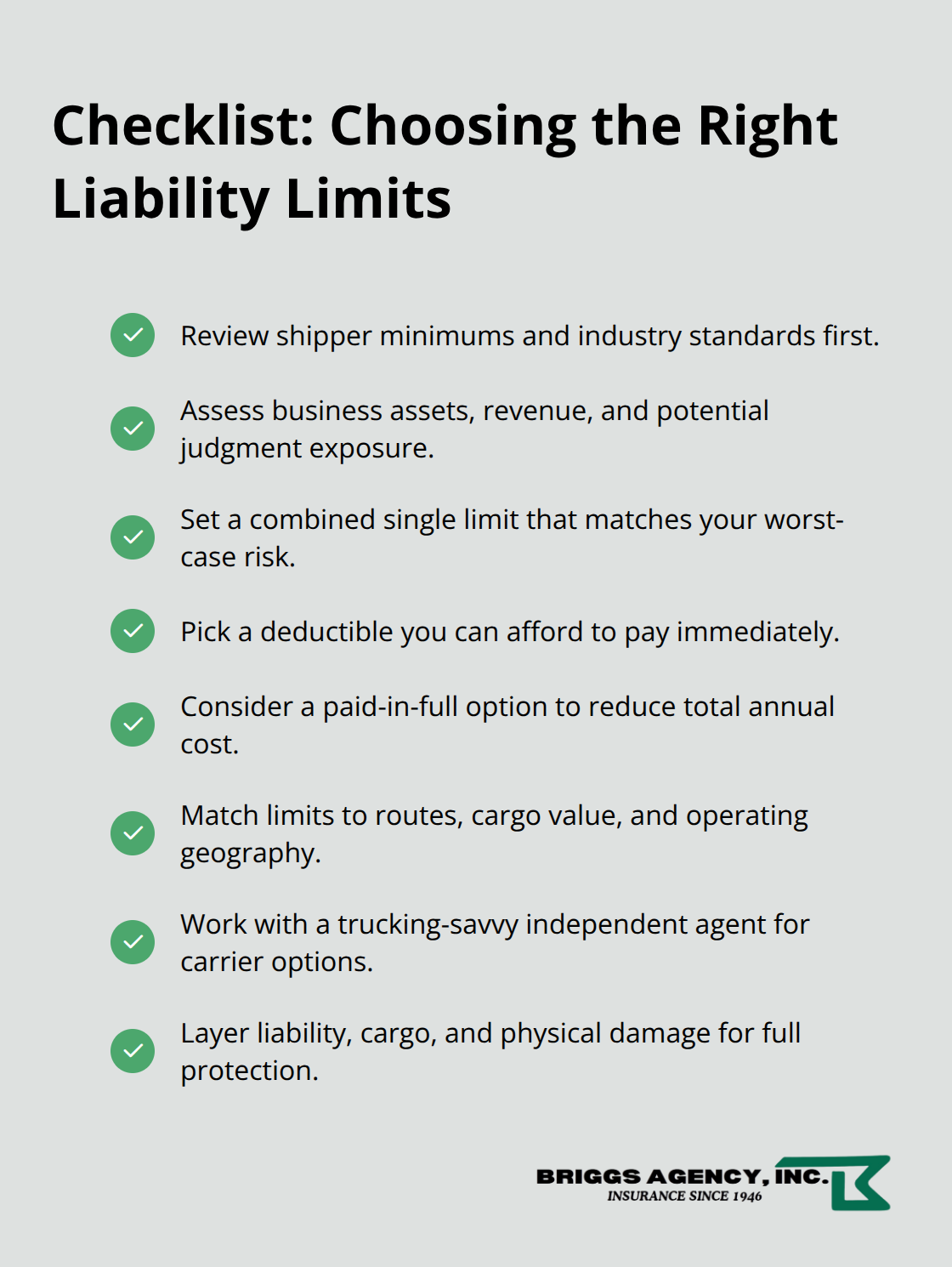
Review shipper requirements first-major carriers like FedEx and Amazon specify minimum liability limits before accepting loads, and those requirements reveal what the industry considers adequate protection for your cargo category. These minimums exist because shippers understand the real costs of cargo incidents and third-party claims. Your shipper’s requirements provide a practical baseline for coverage selection rather than guessing at appropriate limits.
Calculate Your Assets and Financial Exposure
Examine your assets and revenue next. If a judgment exceeds your coverage limit, courts can garnish future earnings and freeze business accounts. A combined single limit sets the maximum payout per incident, so if you carry $500,000 or $1,000,000 in coverage and damages exceed that amount, you absorb the difference. Most owner-operators carrying high-value cargo need minimums between $1,000,000 and $2,000,000 in combined single limit coverage to avoid catastrophic exposure.
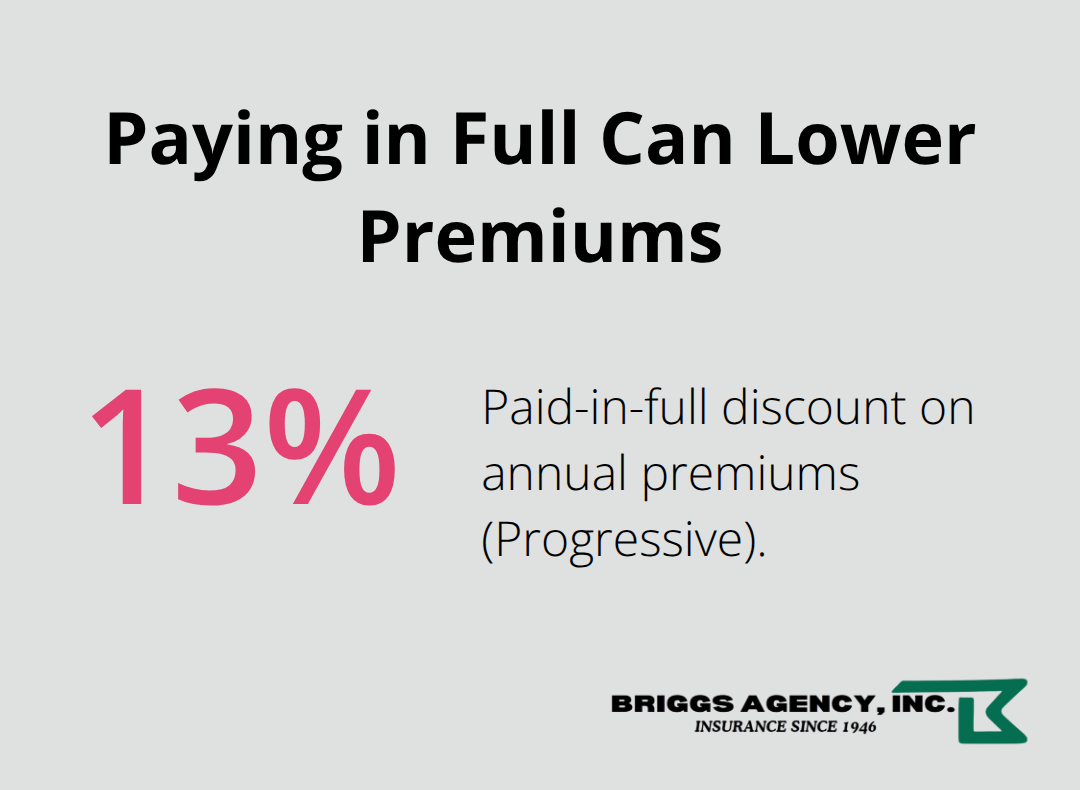
Your deductible directly affects your monthly premium-increasing it from $500 to $2,500 can reduce costs substantially, but only if you can actually pay that amount out of pocket when a claim occurs. Calculate your cash reserves realistically. If an accident happens and you cannot cover the deductible, you cannot file a claim, defeating the purpose of carrying insurance. Paid-in-full discounts can save 13% or more on annual premiums according to Progressive, reducing total cost upfront and improving cash flow management.
Match Coverage to Your Routes and Equipment
Route density and vehicle age influence coverage selection significantly. Regional operators making frequent stops face higher per-mile accident risk than long-haul drivers on interstate routes, justifying higher limits. Newer trucks with advanced safety features lower accident risk and insurance costs, while older equipment carries higher premiums and may require physical damage coverage if financed. State location matters-commercial truck insurance varies by jurisdiction due to traffic patterns, road conditions, and accident prevalence.
Work with an Agent Who Understands Trucking Operations
An agent who understands trucking operations can access multiple carriers and identify which insurers offer the best rates for your specific configuration. Rather than accepting a generic quote, work with an agent who asks detailed questions about your cargo mix, delivery locations, customer requirements, and fleet composition. This conversation reveals gaps in coverage you might miss alone. For example, if you operate outside dispatched routes or haul loads during non-working hours, bobtail or non-trucking liability coverage fills that gap when you are not actively moving cargo.
Layer Your Coverage for Complete Protection
Cargo insurance protects the goods themselves from damage or loss during transit, complementing liability coverage that protects against third-party claims. A comprehensive program combines liability, cargo, and physical damage coverage tailored to your operation rather than relying on a one-size-fits-all policy. This layered approach addresses the full range of exposures your trucking business faces.
Final Thoughts
Truckers liability insurance protects your driving team and business from the financial devastation that follows an accident. A single claim involving injuries or property damage can cost hundreds of thousands of dollars, and without adequate coverage, that expense comes directly from your business account or personal assets. Federal law requires interstate truckers to carry liability coverage, and major shippers like FedEx and Amazon mandate specific minimums before accepting loads.
Selecting the right policy means matching your coverage limits to your actual exposure based on cargo value, routes, and operating geography. A combined single limit between $1,000,000 and $2,000,000 protects most owner-operators carrying high-value cargo from catastrophic exposure. Your deductible affects your monthly premium significantly, and paying in full can save 13% or more on annual costs.
We at Briggs Agency, Inc. have served individuals and businesses in Crown Point, Indiana since 1946, helping trucking operations select comprehensive coverage that reduces risk and protects what matters most. Our independent agents represent multiple top-rated carriers and compare options to deliver competitive pricing and hands-on service tailored to your fleet. Contact us to discuss your trucking insurance needs and secure the protection your driving team deserves.
The information provided in this blog is for general informational purposes only and does not constitute legal, financial, or insurance advice. Coverage options, terms, and availability may vary. Please consult with a licensed professional for advice specific to your situation.
Artificial intelligence may have been used to generate text and images in some blog articles.

