

Business Property Insurance: Safeguarding Your Company’s Assets
Your company’s physical assets represent years of investment and hard work. From your building to your equipment and inventory, these assets keep your business running-but they’re also vulnerable to damage, theft, and disasters.
Business property insurance protects what you’ve built by covering the costs of repairs or replacement when the unexpected happens. At Briggs Agency, Inc., we help local business owners understand their coverage options so they can focus on what matters most: running their operation with confidence.
What Your Business Property Insurance Actually Covers
Your building, equipment, and inventory each face different risks-and your insurance needs to reflect that reality. Commercial property insurance protects the physical structures your business occupies, whether you own or rent the space. This includes the building itself, attached structures like loading docks or storage sheds, and permanent fixtures such as built-in shelving or HVAC systems. If you operate from a leased space, your landlord’s policy covers the building structure, but your policy protects your tenant improvements and the assets inside. The Hartford reports an average annual cost of around $1,605 for commercial property insurance, though this varies significantly based on your property’s age, construction materials, and location. Older buildings or those in higher-risk areas typically cost more to insure, while fire-resistant construction materials can lower your premiums.
Equipment and Tools Represent Real Value
Machinery, tools, computers, furniture, and specialized equipment all fall under your coverage. Business owners often underestimate how quickly equipment replacement costs accumulate-a restaurant’s kitchen equipment, a contractor’s power tools, or a salon’s styling stations represent substantial investments. If your business relies on specialized or high-value equipment, equipment breakdown insurance becomes particularly important. This coverage helps protect businesses from financial losses caused by mechanical, electrical or pressure system failures that standard property policies don’t cover. The Hartford includes equipment breakdown as an add-on endorsement, giving you flexibility to protect only what your business genuinely needs.
Inventory and Stock Demand Specific Attention
Your inventory-whether it’s retail products, raw materials, or perishable goods-needs separate consideration from your building and equipment. Standard property policies cover inventory against fire, theft, and vandalism, but gaps exist. If you stock perishable items like bakery ingredients or meat products, spoilage coverage becomes essential; without it, a refrigeration failure wipes out your inventory at your own expense. You need an accurate, current inventory list with replacement costs to determine appropriate coverage limits. Underinsuring your inventory means you absorb losses out of pocket; overinsuring wastes premium dollars. Getting your asset valuation right from the start matters significantly-this is where an experienced agent identifies exactly what needs protection and at what level.
Determining Your Coverage Limits
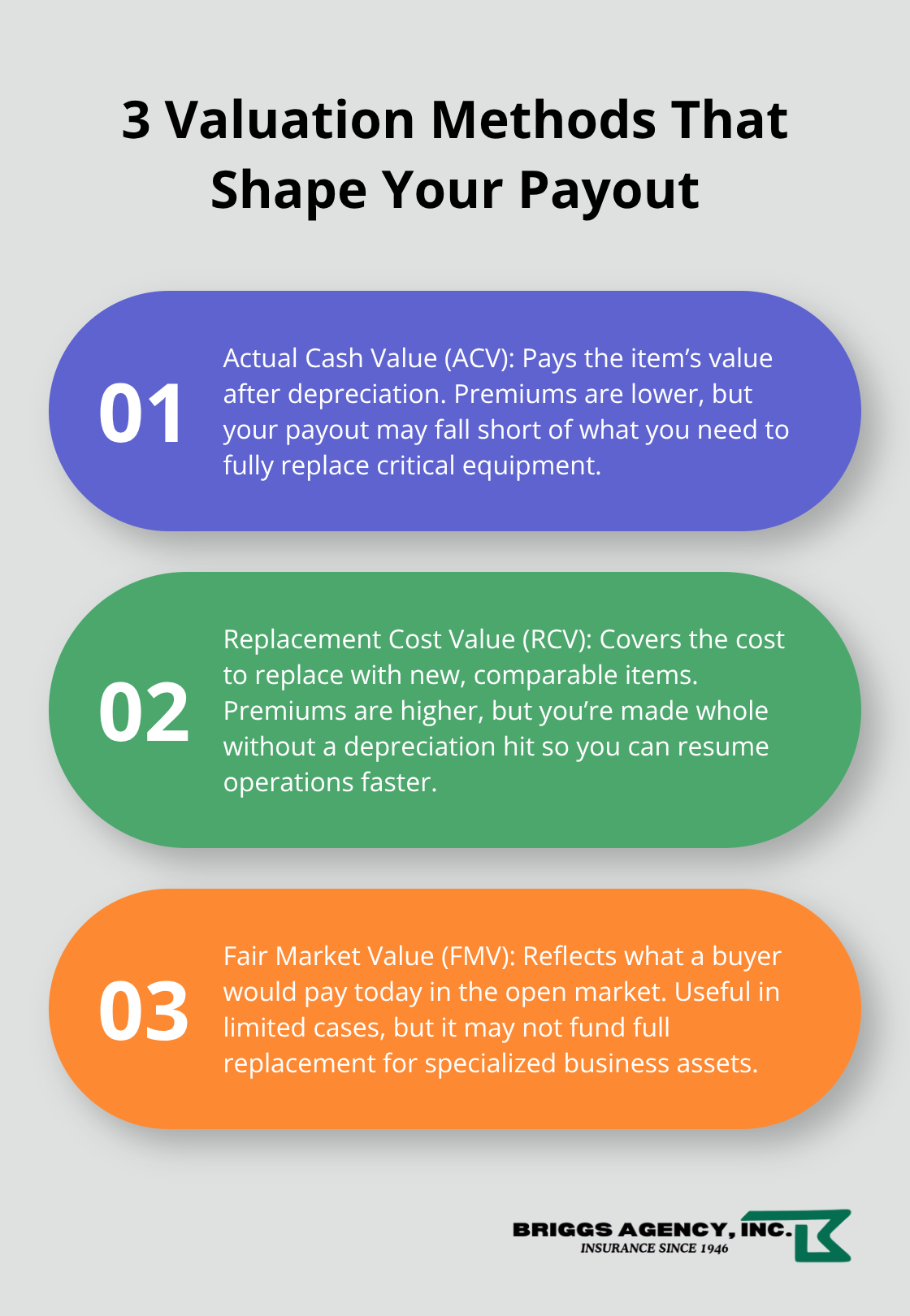
The three main valuation methods shape your coverage decisions: actual cash value (replacement cost minus depreciation), replacement cost value (cost to replace with similar items), and fair market value (current market price). Each method produces different coverage amounts and premium costs. Your choice affects how much you receive after a loss and how much you pay in premiums.
Higher deductibles generally lower your premium, but they also mean you pay more out of pocket when a loss occurs. Selecting the right balance between deductible and coverage limit requires understanding your financial capacity to absorb losses and your asset replacement timeline.
Building the Right Protection Strategy
Your specific risks determine which coverages you actually need. A retail store faces different exposures than a manufacturing facility or a professional services office. Location matters too-businesses in flood-prone areas need separate flood coverage through the National Flood Insurance Program, as standard policies exclude water damage. Construction materials, safety features (alarms, sprinklers, detectors), and the number of people on-site all influence both your risk profile and your premium. Once you understand what your business owns and what risks threaten those assets, you can work with an agent to build a protection strategy that fits your operation and budget. This assessment forms the foundation for choosing appropriate coverage limits and identifying any gaps that additional endorsements should fill.
Why Business Property Insurance Protects Your Bottom Line
A single fire, theft, or storm wipes out years of investment in equipment, inventory, and your physical space. Without property insurance, you absorb the full replacement cost yourself-and that’s money most businesses simply don’t have sitting in reserve. The Hartford reports an average annual cost of around $1,605 for commercial property insurance, which sounds substantial until you consider what happens without it. A restaurant owner whose kitchen equipment burns in a fire faces $50,000 to $100,000 in replacement costs plus weeks or months of lost revenue while rebuilding. A retail store robbed of its entire inventory loses not just the products but the cash flow those sales would have generated. Property insurance transforms a catastrophic loss into a manageable claim payout.
Lenders and Landlords Require Coverage
Beyond the direct financial protection, lenders and landlords won’t let you operate without it. If you financed your building, your mortgage lender requires proof of coverage-they’re protecting their investment in your property. Landlords writing commercial leases demand the same assurance. Many service contracts and customer agreements also stipulate that you maintain adequate property coverage. Without it, you violate those agreements and expose yourself to legal liability. The Hartford’s experience serving 1.3 million small business customers shows that most owners start with a Business Owner’s Policy bundling general liability, commercial property, and business income insurance.
Business Interruption Fills the Hidden Gap
Business interruption coverage, often included in property policies or available as an add-on, addresses the hidden cost of disasters. When a covered loss forces you to temporarily close, this coverage replaces lost income and covers ongoing expenses like payroll, rent, and utilities while you rebuild. A contractor with a fully equipped office and fleet loses more than the physical property if forced to shut down-they lose every job they can’t complete, every client they can’t service, and every dollar of revenue that stops flowing.
Location and Risk Profile Shape Your Costs
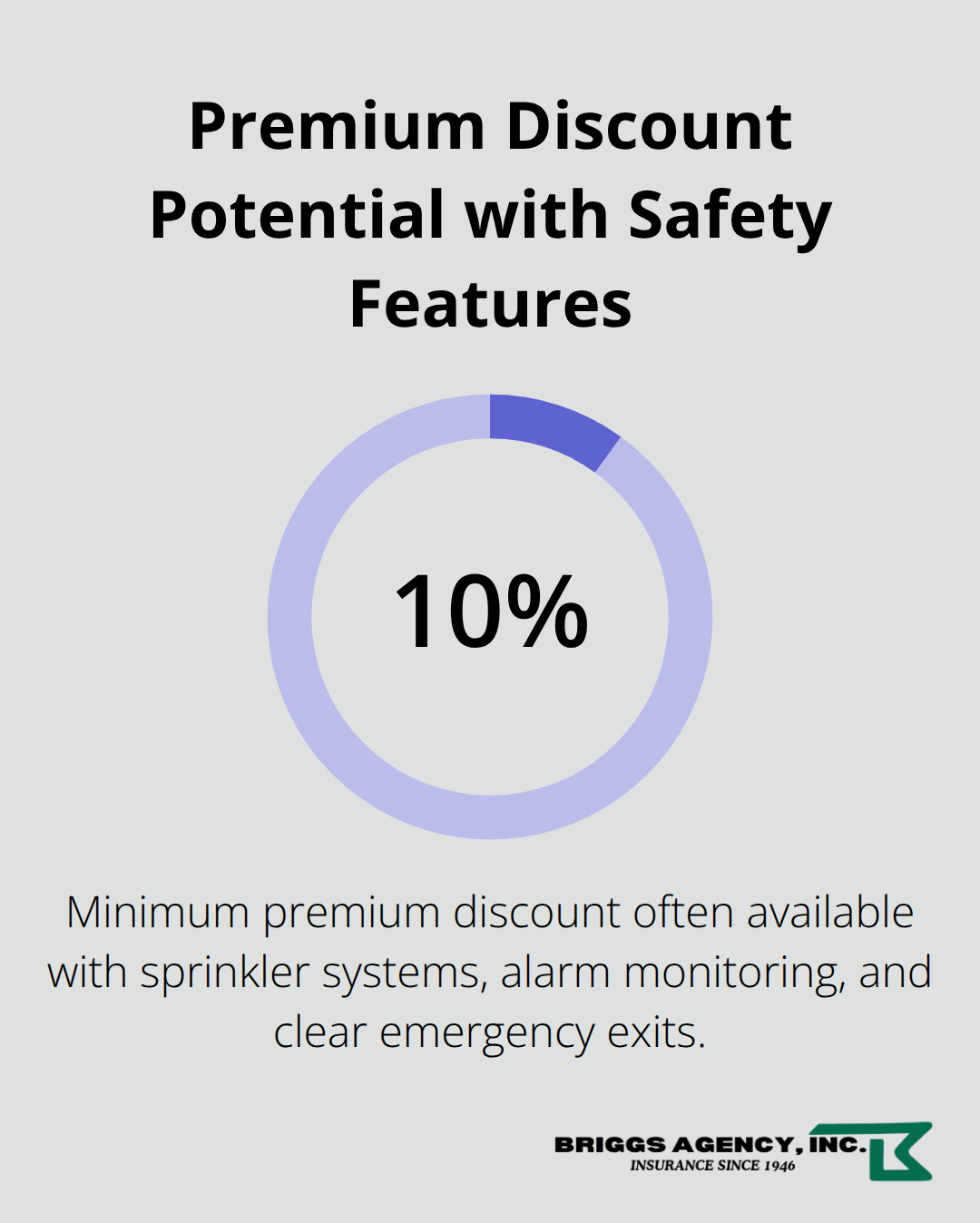
Location-specific risks matter enormously. A business in a high-crime area faces different theft exposures than one in a secure commercial park. Older buildings with outdated electrical systems carry higher fire risk than newer construction. Businesses with safety features like sprinkler systems, alarm monitoring, and clearly marked emergency exits often qualify for premium discounts of 10% or more, according to Hartford’s pricing structure. This means your risk management efforts directly reduce your insurance costs.
The National Flood Insurance Program exists as a separate requirement because standard policies exclude flood damage; if your business sits in a flood-prone area, this gap becomes expensive fast.
Understanding Your True Exposure
Property insurance isn’t an optional expense or a regulatory checkbox-it’s the difference between a manageable setback and a business-ending catastrophe. The right coverage protects your operation from financial ruin, but only if you’ve identified what you actually own and what risks threaten those assets. This assessment determines which coverages you need and at what limits, which is exactly what we’ll explore in the next section.
How to Match Your Coverage to What You Actually Own
Create a Complete Asset Inventory
Start with an inventory of every asset your business owns or leases. Walk through your building and list everything: the structure itself, HVAC systems, electrical panels, built-in fixtures, computers, machinery, furniture, signage, outdoor equipment, and inventory. Assign replacement costs to each category-not what you paid five years ago, but what it costs today to replace that item new. Business owners typically underestimate replacement costs, which means they end up underinsured.
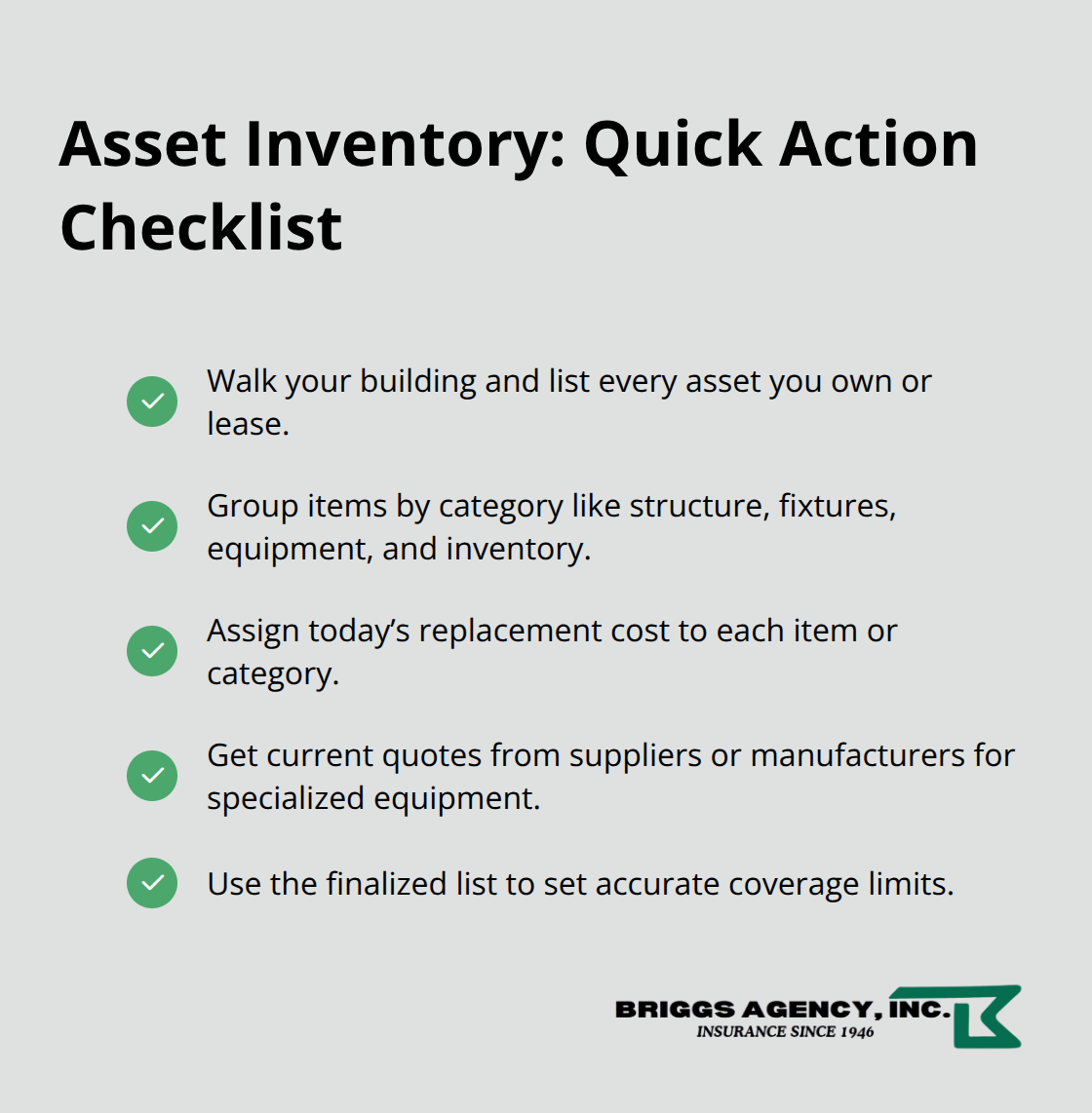
If you own a restaurant, contact equipment suppliers for replacement kitchen gear quotes. If you operate a retail store, calculate what it would cost to restock your entire inventory from scratch. For specialized equipment, manufacturers provide current pricing directly. This exercise takes time, but it forms the foundation for every coverage decision that follows. Once you know what you own and what it costs to replace, you can match your coverage limits to reality instead of guessing.
Choose the Right Valuation Method
The valuation method you select determines how much you actually receive after a loss. Replacement cost value pays to replace damaged items with new equivalents-a five-year-old computer gets replaced with a new computer of similar capability, not depreciated down to $200. Actual cash value subtracts depreciation, so that same computer might only yield $300 after accounting for age and wear.
Most business owners should choose replacement cost because it covers what you genuinely need to spend to get back to work. Actual cash value costs less in premiums but leaves you short when you need to replace equipment. Your deductible choice directly affects your monthly premium: a $500 deductible costs more than a $2,500 deductible, but that higher deductible means you pay $2,500 out of pocket before your policy kicks in.
Balance Your Deductible and Cash Flow
Analyze your business’s cash flow to determine the right deductible. Can you comfortably cover a $2,500 loss without disrupting operations, or would a $500 deductible better match your financial reality? Different combinations of deductibles and coverage limits affect both your premium and your out-of-pocket exposure when a loss occurs.
An experienced local agent walks through these decisions with you, showing exactly how each option impacts your costs. They identify coverage gaps that endorsements should fill, like spoilage coverage for refrigerated inventory or equipment breakdown for machinery your operation depends on.
Final Thoughts
Business property insurance protects what you’ve built, but only when your coverage matches what you actually own. The steps we’ve outlined-inventorying your assets, understanding valuation methods, and selecting appropriate deductibles-form the foundation of real protection. Without this groundwork, you risk being underinsured when you need coverage most, or paying for protection you don’t actually need.
Your next move is straightforward: gather your asset list and current policy documents, then schedule a conversation with an agent who understands your specific operation. Review what you’re currently covered for and identify any gaps. Ask whether your deductibles align with your cash flow, whether your coverage limits match today’s replacement costs, and whether endorsements like spoilage or equipment breakdown would protect your business better.
We at Briggs Agency, Inc. have been helping local business owners in Crown Point and beyond protect their operations since 1946. Our independent agency represents multiple top-rated carriers, which means we compare options and tailor business property insurance to your actual needs rather than pushing a single product. Contact us today to review your current coverage and discover how the right protection can safeguard your company’s assets with confidence.
The information provided in this blog is for general informational purposes only and does not constitute legal, financial, or insurance advice. Coverage options, terms, and availability may vary. Please consult with a licensed professional for advice specific to your situation.
Artificial intelligence may have been used to generate text and images in some blog articles.

