

Fleet Trucking Insurance: Coverage That Scales With Your Operations
Running a trucking fleet means managing more than just routes and schedules. Your vehicles, drivers, and cargo face real risks every day on the road.
Fleet trucking insurance protects your business from the financial impact of accidents, damage, and liability claims. At Briggs Agency, Inc., we help fleet operators find coverage that grows with their operations, whether you’re managing five trucks or fifty.
What Your Fleet Actually Needs to Be Protected
Primary Auto Liability: Your Biggest Cost Driver
Primary auto liability covers you when your drivers cause injury or property damage to third parties, and it accounts for 50 to 65 percent of your total fleet insurance costs, typically running $5,000 to $10,500 per truck annually. The reason it dominates your budget is straightforward: jury verdicts in trucking cases have exploded. Between mid-2020 and early 2023, average nuclear verdicts reached $27.5 million, which means carriers price in catastrophic risk. If you operate in states like New Jersey, Louisiana, Delaware, New York, or Connecticut, your liability premiums will be substantially higher due to dense urban corridors and active plaintiff litigation. A single truck in New Jersey costs around $20,763 annually in premiums compared to Mississippi at roughly $3,552, according to 2026 rate data. This geographic spread forces many operators to rethink their service territories entirely.
Physical Damage and Cargo Protection
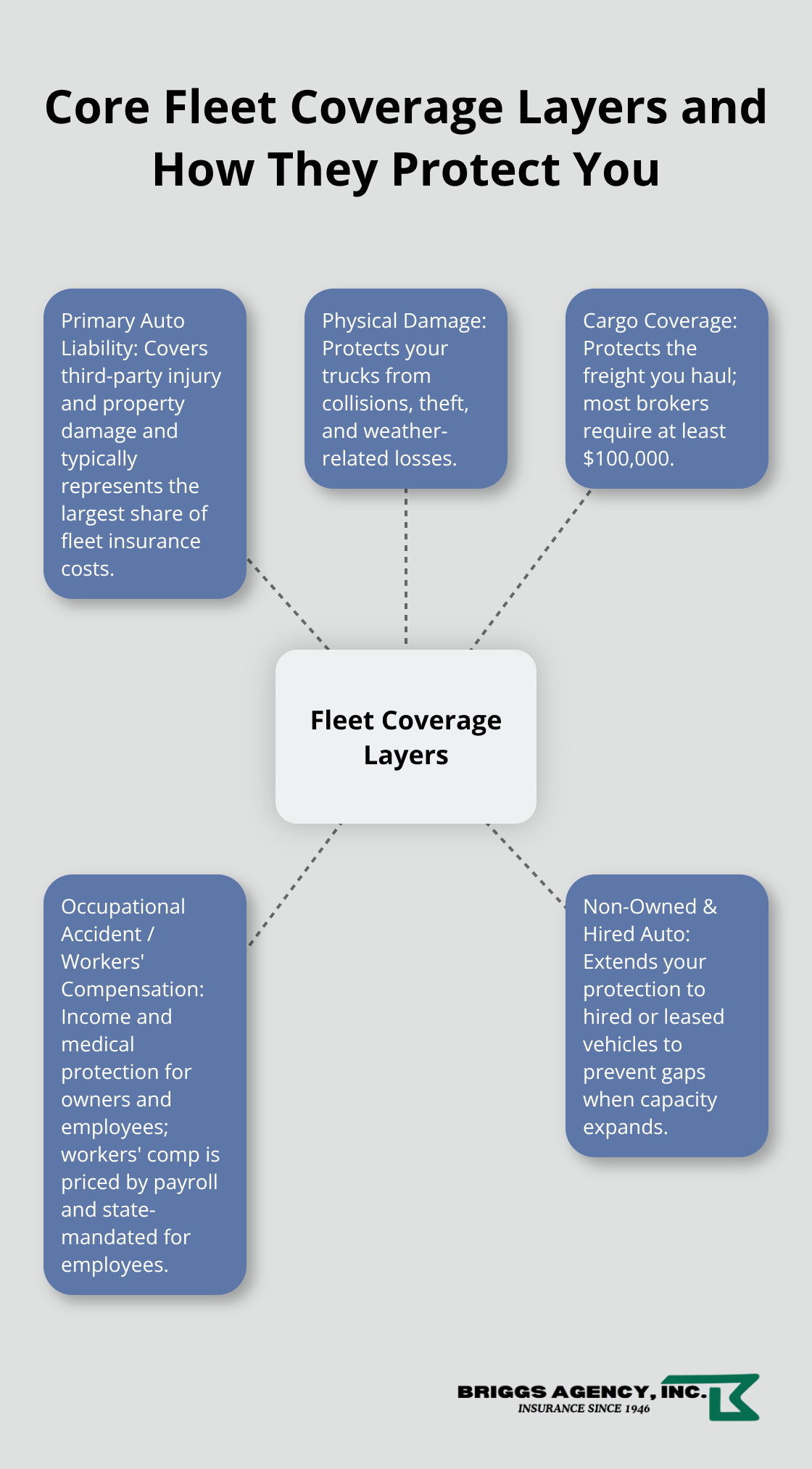
Physical damage coverage protects your trucks from collisions, theft, and weather, while cargo coverage protects the freight you haul. Most freight brokers require a minimum of $100,000 in cargo coverage, so this becomes non-negotiable if you want to secure loads. Cargo theft reached record levels in 2024 and stayed elevated into 2025, concentrated in food, metals, and electronics, which means underwriters tighten terms and demand stronger verification protocols. Your coverage structure must match your actual operational model-whether you own all equipment, lease some, or hire drivers with their own rigs.
Additional Coverage Layers for Your Operation
For owner-operators leasing to carriers, occupational accident coverage runs about $1,600 to $2,200 per year and protects you if injury prevents you from working. Workers’ compensation is priced on your payroll rather than truck count and is state-mandated for employee drivers. If you hire or lease vehicles from other operators, non-owned and hired vehicle coverage extends your protection to those trucks, preventing gaps when you temporarily expand capacity. These layers work together to address the specific risks your fleet faces based on how you actually operate.
The coverage you select today shapes how easily you can scale tomorrow. As your fleet grows, your insurance structure either supports that expansion or creates friction. Understanding what each layer protects-and why you need it-positions you to make decisions that align with your growth plans rather than fighting against them.
Matching Your Fleet Profile to the Right Coverage Structure
Fleet Size Shapes Your Pricing and Structure
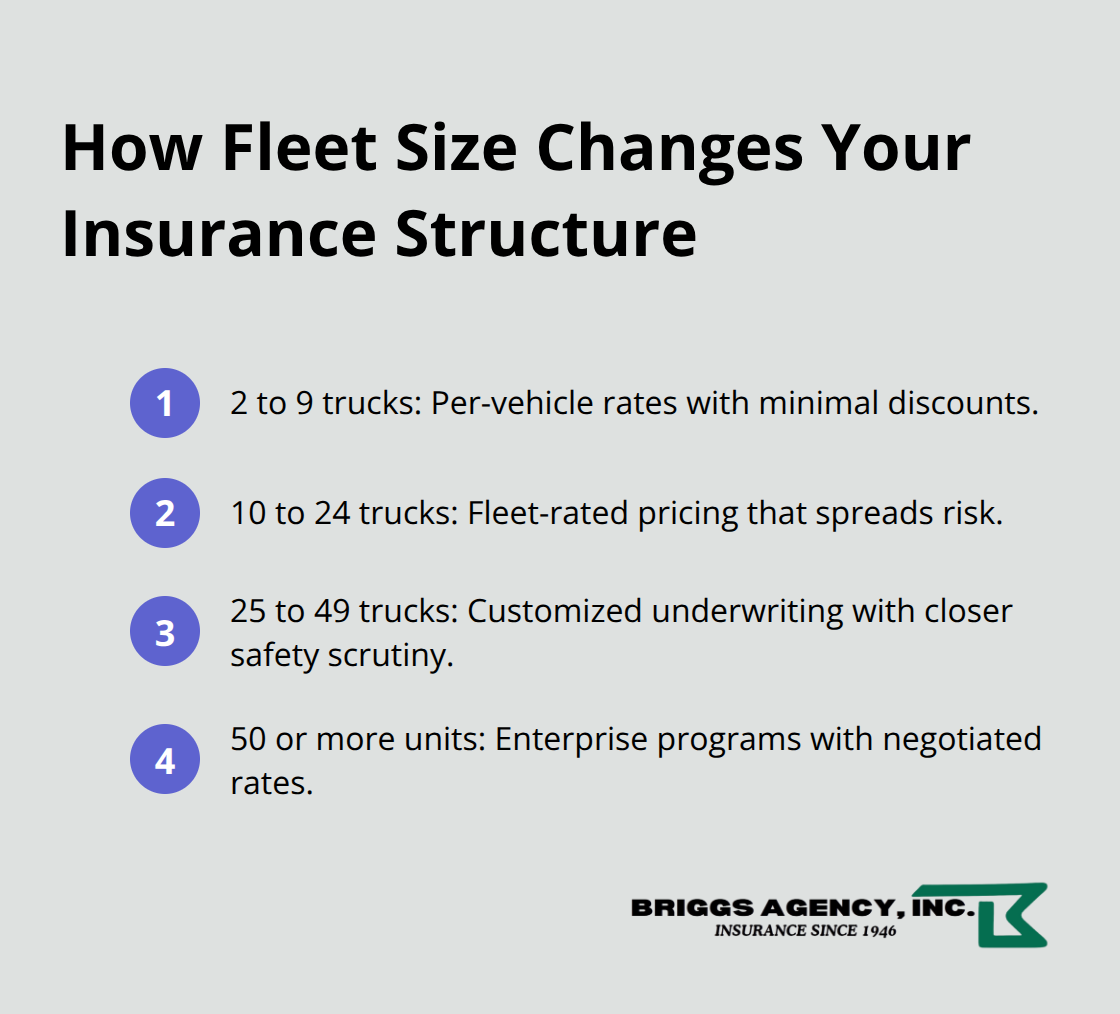
Fleet size determines everything about how your insurance gets priced and structured, so start there before comparing carriers. A fleet of five trucks operates under completely different economics than a fleet of 50, and insurers price accordingly. Small fleets with two to nine trucks pay per-vehicle rates with minimal discounts, while mid-size carriers running 10 to 24 trucks qualify for fleet-rated pricing that spreads risk across multiple units. Large carriers with 25 to 49 trucks and enterprise programs with 50 or more units receive customized underwriting and negotiated rates, but face much closer scrutiny of safety programs and loss history. Enterprise fleets pay roughly 38% less per unit than non-fleet operators.
Your vehicle types matter equally because a fleet of light-duty pickups presents different risk than heavy-haul rigs or refrigerated trailers. Insurers evaluate not just the number of vehicles but their value, age, and how you use them. A 20-truck fleet at midpoint rates costs approximately $252,000 annually, while a 40-truck fleet at the same midpoint runs about $432,000. These numbers shift dramatically based on your operating territory and route patterns.
Geographic Location Overwhelms Other Pricing Factors
Geographic location overwhelms most other pricing factors, so evaluate where you actually operate before selecting a carrier. The most expensive states like New Jersey, Louisiana, Delaware, New York, and Connecticut share dense urban corridors and aggressive litigation environments, while the Midwest offers the most affordable rates with six of the top 15 lowest-cost states located there. Operating in multiple states requires carriers with broad appetite across those regions, not just local players. A single truck in New Jersey costs around $20,763 annually compared to Mississippi at roughly $3,552, a spread that forces many operators to rethink their service territories entirely.
Coverage Limits, Deductibles, and Carrier Comparison
When comparing coverage limits and deductibles, avoid the trap of matching your competitor’s structure or accepting whatever the first quote shows. Instead, break out your costs by coverage layer: auto liability typically runs $5,000 to $10,500 per truck annually, cargo coverage depends on your freight requirements, and workers’ compensation scales with payroll. Higher deductibles directly reduce premiums, and many fleets benefit from structured excess arrangements rather than single-layer coverage. Match your deductible to your cash flow situation, not the lowest number available, and consider how your financial reserves align with your risk tolerance.
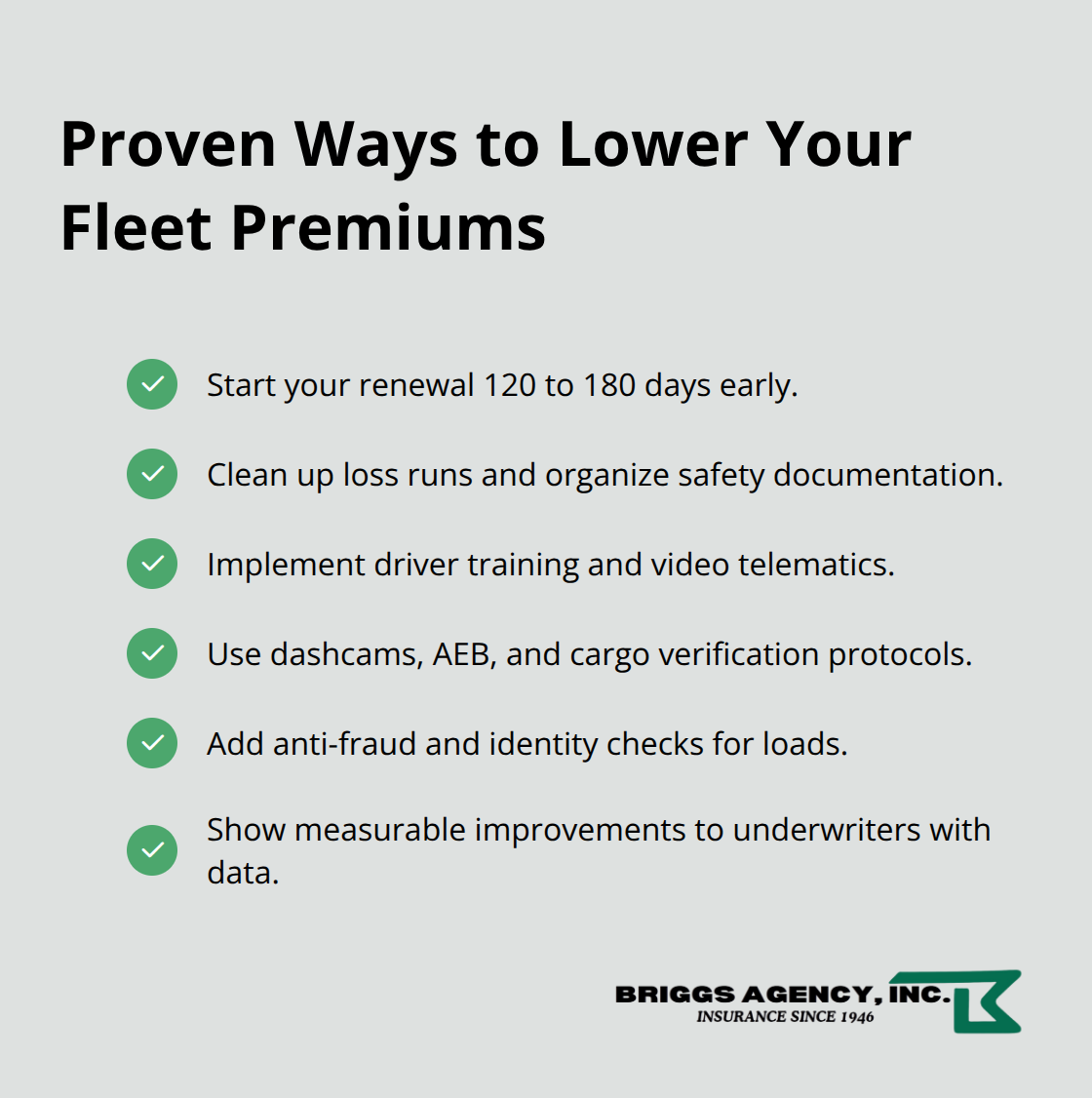
Start your carrier comparison 120 to 180 days before renewal, not 30 days out when your options narrow. Provide clean loss runs, current safety data, and evidence of driver training or telematics adoption. Carriers reward proactive safety with credits for video dashcams paired with driver coaching, automatic emergency braking systems, and strict cargo verification protocols. Request quotes from at least three carriers because rate variation for identical coverage often exceeds 20 percent based on how each underwriter evaluates your specific risk profile.
Your fleet’s operational structure-whether you own all equipment, lease some, or hire drivers with their own rigs-directly influences which coverage layers you need and how carriers will price them. Understanding this connection between your actual operations and your insurance structure positions you to make decisions that align with your growth plans rather than fighting against them.
What Actually Reduces Your Fleet Insurance Costs
Driver Safety Records and Training Programs
Driver safety records form the foundation of your premium because insurers treat each driver as a risk multiplier across your entire fleet. A single driver with multiple violations or at-fault accidents can push your rates up 15 to 25 percent or more, which means one bad hire costs you thousands annually across your whole operation. Formal driver training programs directly reduce this risk, and carriers reward them with measurable credits. Video telematics paired with driver coaching creates a documented safety culture that underwriters want to insure, often lowering premiums by 10 to 30 percent compared to fleets without these systems.
Dashcams specifically help exonerate drivers after claims, reducing liability exposure and protecting your loss history from inflated settlements. The data matters more than the equipment alone, so implement a system where drivers understand they are monitored for coaching, not punishment. Fleets that adopt this approach see improved retention and lower incident frequency because drivers know their performance directly affects the company’s bottom line.
Vehicle Maintenance and Equipment Standards
Vehicle maintenance and equipment standards separate fleets that control costs from those that chase claims. Newer trucks with automatic emergency braking systems reduce crash frequency, though repair costs for ADAS-equipped vehicles run higher when damage occurs, creating a tradeoff that carriers are still pricing into underwriting. Underwriters examine maintenance records closely because a fleet with documented preventive maintenance demonstrates operational discipline and reduces mechanical failure claims.
Equipment age matters significantly, with older trucks facing steeper premiums due to higher failure risk and increased repair costs. Your claims history then determines whether carriers view you as a reliable risk or a problem account. Fleets with frequent small claims often pay more than those with one major claim because frequency signals systemic operational issues, while severity can sometimes be dismissed as bad luck.
Timing Your Renewal and Managing Claims History
Start your renewal process 120 to 180 days early and give yourself time to clean up your loss runs, gather safety documentation, and demonstrate improvements before presenting to carriers. Carriers tighten terms when they see cargo theft, identity fraud, or repeated similar claims, so implement cargo verification protocols and anti-fraud measures now to prevent premium increases later. This proactive approach (combined with strong documentation) positions your fleet as a lower-risk account that carriers compete to insure rather than one they reluctantly accept.
Final Thoughts
Fleet trucking insurance works best when it scales alongside your operations rather than forcing you to rebuild coverage every time you add trucks or expand into new territories. The structure you build today-your coverage layers, deductible strategy, and carrier relationships-either supports that expansion or creates obstacles. Starting with the right foundation means understanding your fleet size, geographic footprint, and operational model so you can select limits and deductibles that match your actual risk.
Your driver safety programs, maintenance discipline, and claims management directly influence what carriers will offer you at renewal. Fleets that invest in telematics, driver training, and documented loss control don’t just reduce accidents; they build underwriting credibility that translates into competitive rates and flexible terms as you scale. The difference between a fleet that manages risk proactively and one that reacts to claims often exceeds 20 to 30 percent in annual premiums.
Starting your renewal process 120 to 180 days early gives you leverage to shop multiple carriers, present your safety improvements, and negotiate terms before capacity tightens. Contact Briggs Agency, Inc. to discuss your fleet’s specific needs and get customized quotes that reflect your actual operations and safety performance.
The information provided in this blog is for general informational purposes only and does not constitute legal, financial, or insurance advice. Coverage options, terms, and availability may vary. Please consult with a licensed professional for advice specific to your situation.
Artificial intelligence may have been used to generate text and images in some blog articles.

