
Auto Shop Garage Insurance: Protecting Your Mechanics’ Business
Running an auto shop means managing countless moving parts-literally and figuratively. One wrong move during a repair, an employee injury, or a customer dispute can drain your finances fast.
At Briggs Agency, Inc., we’ve seen how the right auto shop garage insurance protects mechanics’ businesses from these real threats. This guide walks you through the coverage types that matter, the risks you face, and what actually affects your premiums.
What Your Auto Shop Insurance Actually Covers
Liability coverage protects your shop when a customer suffers an injury on your premises or claims your work caused damage to their vehicle. A baseline of $1 million per occurrence and $2 million aggregate is standard, but this only addresses bodily injury and property damage claims-not damage to the customer’s car while it sits in your bay. That’s where garage liability comes in, and it’s a separate animal that many shop owners overlook. General liability excludes business operations, so you need garage liability to close that gap. If you road-test vehicles or have multiple technicians driving customer cars, you should push your umbrella coverage to at least $2 million, possibly higher if you handle exotic or high-value vehicles. The cost difference between $1 million and $2 million umbrella coverage is typically $300–$600 annually, which is negligible compared to what a single serious injury claim could cost.
Protecting Customer Vehicles in Your Care
Garagekeepers coverage protects customer vehicles from fire, theft, vandalism, or collision while the car remains under your care, custody, and control. Most policies cap per-occurrence limits around $2,500, with a typical per-vehicle deductible of $500, but that’s often too low if you service high-value cars. Calculate your exposure by multiplying the maximum number of vehicles on-site at any time by the average vehicle value, then add 20–30% as a cushion. If you typically have 25 vehicles in your shop averaging $28,000 each, you’re looking at roughly $700,000 in exposure, so a $900,000 to $1 million limit makes sense.
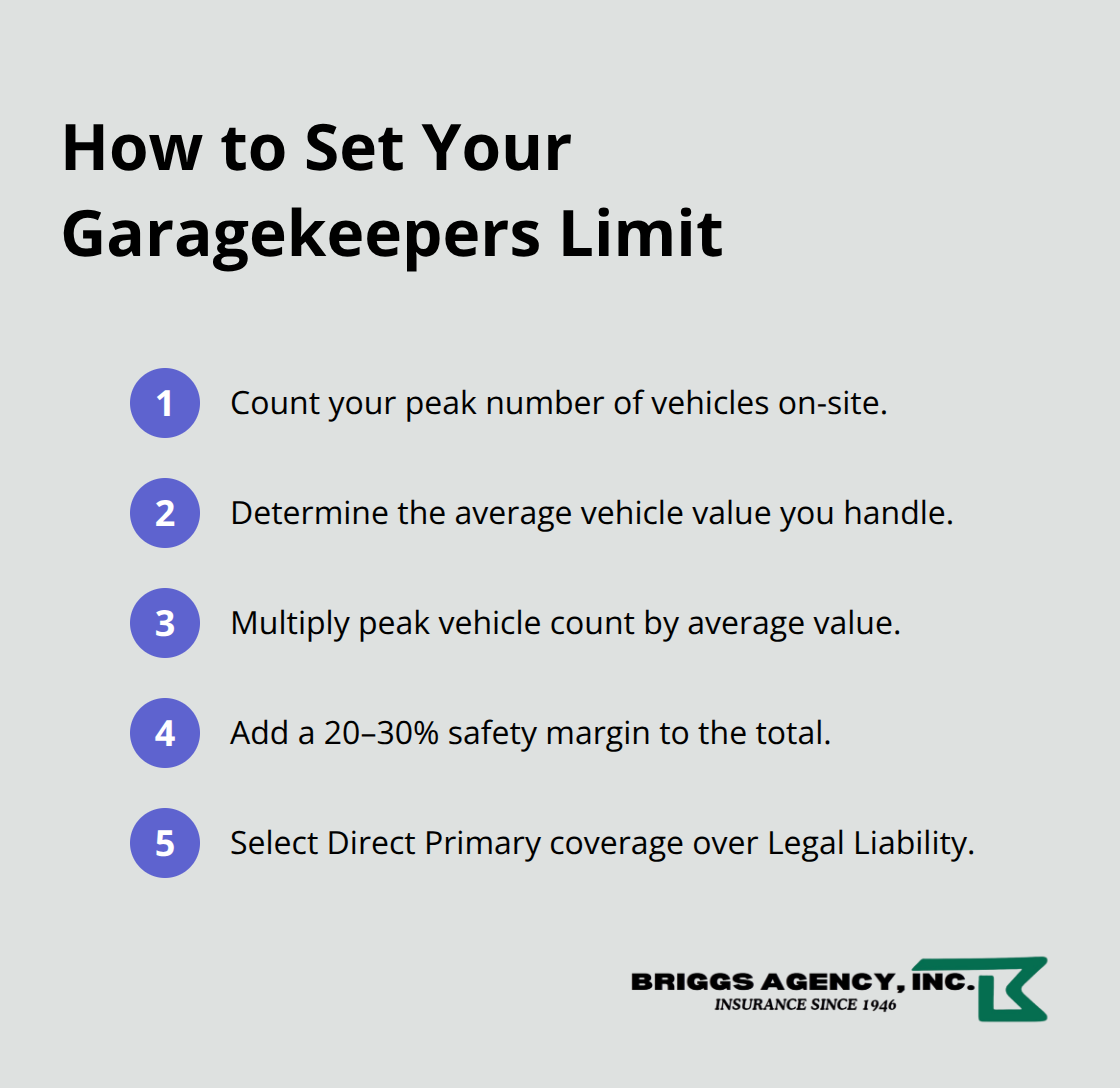
Choose Direct Primary coverage over Legal Liability-Direct Primary pays claims immediately without requiring you to prove negligence, while Legal Liability requires proof and creates delays that frustrate customers and damage your reputation.
Tools, Equipment, and Shop Assets
Inland Marine coverage protects your diagnostic equipment, lifts, and specialty tools against theft, damage, or loss both on-site and in transit. This coverage matters because a stolen $8,000 diagnostic scanner or damaged lift can halt operations for weeks. Equipment breakdown coverage also protects your lifts and diagnostic tools from mechanical failure, which standard property policies exclude. Your shop’s tools and equipment represent significant capital investment, so verify that your Inland Marine policy covers the full replacement cost of your highest-value items.
Workers’ Compensation and Employee Protection
Workers’ compensation is legally required in most states and covers medical expenses and lost wages if an employee suffers an injury on the job. Your workers’ comp cost depends on your state’s classification codes, payroll breakdown, and experience modifier. Separate your clerical and sales payroll from your shop payroll to avoid misclassification, which can spike your rates unnecessarily. If your experience modifier sits above 1.0, request a detailed breakdown from your carrier to understand which claims or exposures drove the increase-sometimes errors in classification or reserve assumptions inflate your mod unfairly.
Moving Forward with Your Coverage Strategy
The right combination of liability, garagekeepers, inland marine, and workers’ compensation forms the foundation of your shop’s protection. However, your specific exposure depends on the services you offer and how you operate. Understanding these gaps now positions you to address the real risks that could disrupt your business.
Real Risks That Stop Auto Shops Cold
Vehicle Damage Claims Expose Hidden Gaps
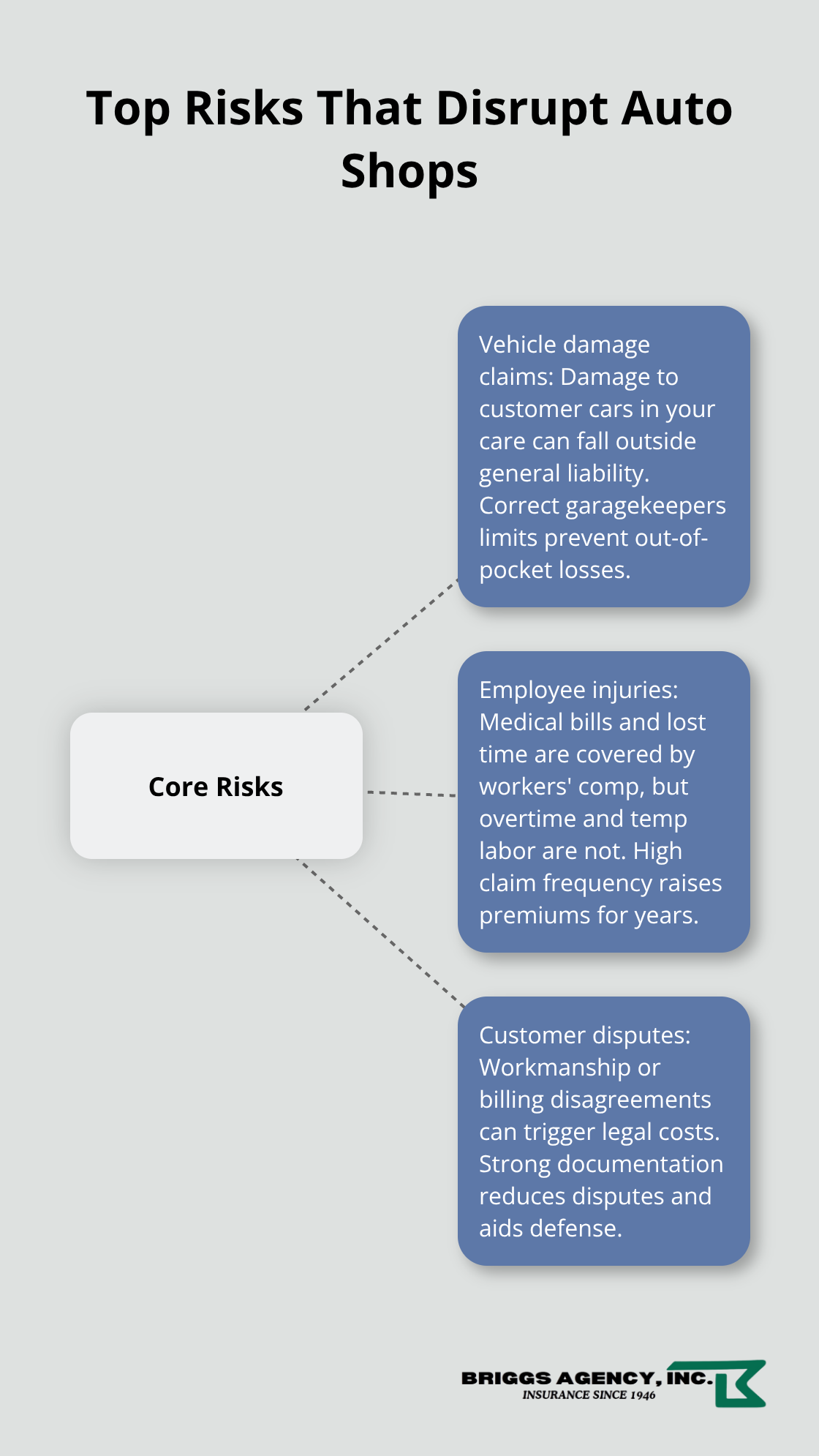
Vehicle damage claims happen constantly in auto shops, and most owners dramatically underestimate their exposure. A customer’s $45,000 BMW sits in your bay while you perform brake service, and a technician accidentally backs into it with a lift. That $8,000 in damage falls outside your general liability policy because the vehicle was in your care. Garagekeepers coverage handles vehicles in your care, custody, or control that you don’t own while they’re being repaired, serviced, or stored at your business, but only if you’ve set your limits correctly. If you cap your coverage at $2,500 per occurrence, you absorb the remaining $5,500 personally. Shop owners often discover this gap the hard way, assuming garagekeepers would cover any vehicle damage, only to find their limits were insufficient. The solution is straightforward: calculate the total value of vehicles typically in your shop and set your garagekeepers limit to match that exposure plus a 20–30% buffer. If you service high-value or exotic vehicles, request per-vehicle sublimits that reflect their actual value rather than a blanket cap that leaves you exposed.
Employee Injuries Create Compounding Financial Pressure
Employee injuries create a different kind of financial trap. A technician suffers a back injury while removing a transmission, and your workers’ compensation covers his medical bills and partial wages during recovery. That baseline protection masks the real cost that emerges when the injury causes him to miss eight weeks of work and you need to hire a temporary replacement at $25 per hour. Your workers’ comp doesn’t reimburse that overtime or temp labor expense, so your profit margin absorbs the hit. Additionally, if your experience modifier sits above 1.0, each claim pushes your rates higher for three years, compounding the financial damage. Invest in loss prevention now: proper lifting techniques, ergonomic workstations, and regular safety briefings reduce claims significantly. Separate your shop payroll from clerical payroll when reporting to your carrier, because misclassification inflates your rates unnecessarily. A single preventable injury can cost you thousands in direct expenses plus years of elevated premiums.
Customer Disputes Over Workmanship Quality
Customer disputes over repair quality or billing often escalate into legal claims that drain both time and money. A customer claims your shop installed a faulty alternator that failed two months after service, and now they demand $1,200 in damages plus rental car costs. Your garage liability covers bodily injury and property damage from your operations, but disputes over workmanship quality sit in a gray area that can trigger litigation costs regardless of whether you’re ultimately liable. Documentation becomes your strongest defense: photograph vehicles before and after service, provide written estimates that detail exactly what work will be performed, and maintain detailed service records that prove you followed proper procedures. Most customers won’t pursue legal action if your documentation clearly shows what was done and why. When disputes do occur, your liability coverage at least covers legal defense costs, which can easily exceed $5,000 before the case is resolved. These three risk categories-vehicle damage, employee injuries, and customer disputes-represent the most common threats to your shop’s financial stability, yet each one responds to specific coverage choices and operational practices that you control directly.
What Actually Drives Your Auto Shop Insurance Costs
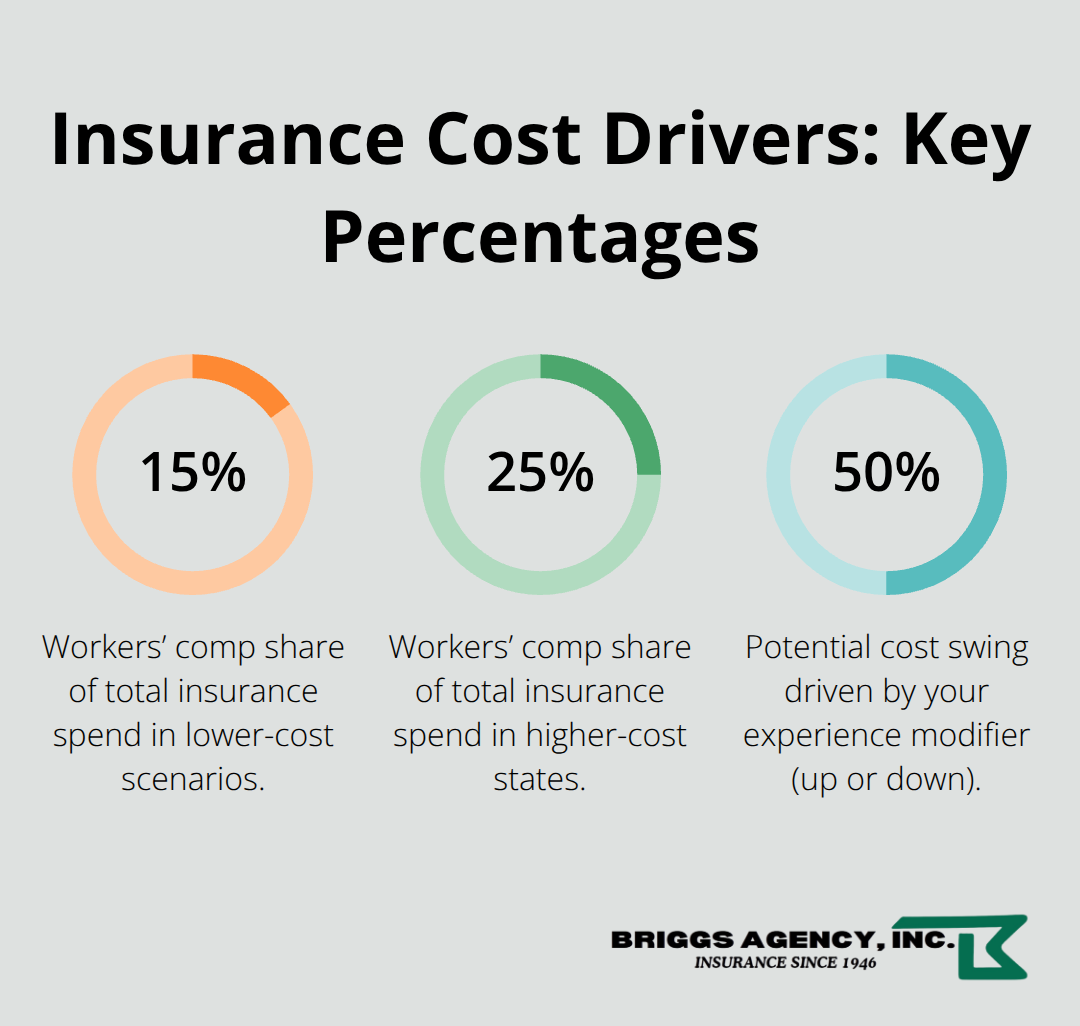
Your premiums reflect concrete operational factors that you control far more than most shop owners realize. The number of technicians on your payroll directly impacts your workers’ compensation costs, which typically represent 15–25% of your total insurance spend depending on your state. If you have five technicians earning $50,000 annually, your total payroll sits at $250,000, and your workers’ comp premium might run $8,000–$12,000 per year based on your state’s classification codes and experience modifier.
How Your Claims History Multiplies Costs
Your experience modifier-a multiplier that reflects your claims history-can swing that cost up or down by 30–50%. A modifier above 1.0 means you pay more than the standard rate because your shop filed more claims than the average shop in your classification. Request a detailed breakdown from your carrier showing which claims contributed to your modifier and what assumptions they used for reserves. Sometimes errors in classification inflate your mod unfairly, and correcting them saves thousands annually.
Separate your shop payroll from clerical work when reporting to your carrier, because mixing classifications artificially spikes your rates. A shop with three technicians, two office staff, and one owner reporting everything under one classification pays significantly more than a shop that properly separates $150,000 in shop payroll from $80,000 in clerical payroll.
Service Types Create Different Risk Profiles
The services you offer create vastly different risk profiles and premiums. A shop that only performs routine maintenance like oil changes and tire rotations pays substantially less than a shop performing transmission rebuilds or welding. Road-testing vehicles adds major exposure-if your technicians test-drive customer cars regularly, your umbrella coverage should start at $2 million rather than $1 million. That upgrade costs roughly $300–$600 annually but protects you from catastrophic liability.
Body work and painting introduce solvent and chemical exposures that standard garages don’t face, justifying higher pollution liability premiums. Garagekeepers coverage also scales directly with the vehicles you handle: a shop servicing mostly used Honda Civics and Toyota Corollas faces lower exposure than a shop handling luxury vehicles or exotic cars.
Location and Vehicle Value Shape Your Exposure
Calculate your garagekeepers limit by multiplying your peak on-site vehicle count by average vehicle value, then add 25% as a safety margin. If you typically have 15 vehicles averaging $35,000 each, you need roughly $650,000 in coverage, not the $2,500 default limit most policies offer. Your location matters significantly because state regulations, local labor costs, and litigation patterns all affect premiums. Indiana shops pay different rates than California shops, and urban locations typically cost more than rural areas due to higher medical costs and settlement values.
Claims History Determines Your Options
Your claims history over the past three years directly influences what carriers will quote and at what price. A shop with zero claims in three years qualifies for better rates and may access carriers that avoid shops with frequent small claims. Conversely, a shop with three claims in two years faces limited carrier options and higher premiums across all coverages. This is why loss prevention investments pay immediate dividends: reducing claims not only saves the direct cost of the claim but also lowers your baseline premium for years afterward, compounding the savings substantially.
Final Thoughts
Your auto shop garage insurance foundation rests on three essential coverage types working together: liability coverage protects you from customer injury claims, garagekeepers coverage protects the vehicles in your care from damage, and workers’ compensation protects your employees and your business from injury-related financial collapse. The specific limits you choose for each coverage type matter far more than the coverage names themselves-a $2,500 garagekeepers limit sounds reasonable until a customer’s $40,000 vehicle gets damaged in your bay and you’re writing a check for $37,500 out of pocket. Equipment breakdown and inland marine coverage round out your protection by safeguarding the tools and diagnostic equipment that keep your shop running.
We at Briggs Agency, Inc. represent multiple top-rated carriers, which means we compare options across different insurers rather than steering you toward one company’s standard package. Our experienced local agents in Crown Point, Indiana have served businesses since 1946, and we’ve seen firsthand how the right auto shop garage insurance tailored to your specific operation saves money while protecting what you’ve built. We’ll review your claims history, calculate your actual vehicle exposure, and identify gaps in your current coverage that could blindside you later.
Contact Briggs Agency, Inc. for a policy review and bring your current declarations page along with a list of the services you offer, the number of vehicles you typically have on-site, and your employee count. We’ll compare your current limits against your actual exposure, identify any coverage gaps, and show you what competitive rates look like from carriers that specialize in auto shop protection. The conversation takes 15 minutes and could save you thousands annually while closing the gaps that keep shop owners awake at night.
The information provided in this blog is for general informational purposes only and does not constitute legal, financial, or insurance advice. Coverage options, terms, and availability may vary. Please consult with a licensed professional for advice specific to your situation.
Artificial intelligence may have been used to generate text and images in some blog articles.

