
Restaurant Workers Compensation: Keeping Your Team Covered
Running a restaurant means managing countless moving parts, and your team’s safety should always be at the top of that list. Restaurant workers compensation isn’t just a legal requirement-it’s your safety net when injuries happen.
At Briggs Agency, Inc., we’ve seen firsthand how the right coverage protects both your employees and your business. This guide walks you through what you need to know to keep your team properly covered.
What Workers Compensation Actually Covers in Your Restaurant
Workers compensation in food service covers medical expenses, lost wages, and rehabilitation for job-related injuries and illnesses. If a cook suffers a burn from fryer oil, workers comp pays for emergency care, follow-up treatment, and medications. If a server injures their back lifting a heavy tray and can’t work for six weeks, the policy covers a portion of their lost wages during recovery. The coverage also extends to disability benefits if an injury causes permanent partial or total disability, and death benefits for families if a workplace injury proves fatal.
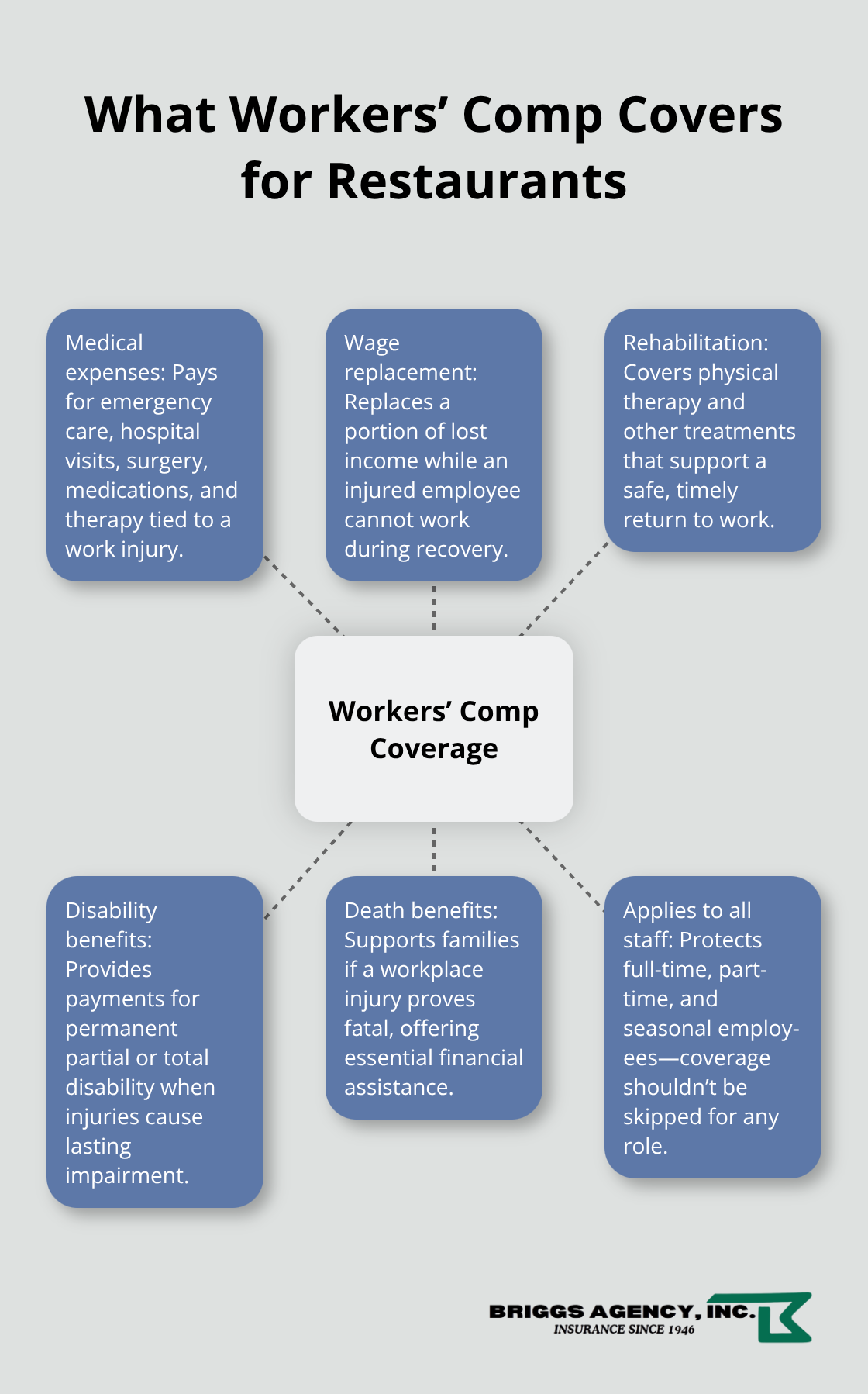
This protection applies regardless of whether your employee works full-time, part-time, or seasonally-a misconception that costs many restaurant owners money when they skip coverage for staff they assume don’t need it.
The Real Cost of Kitchen Injuries
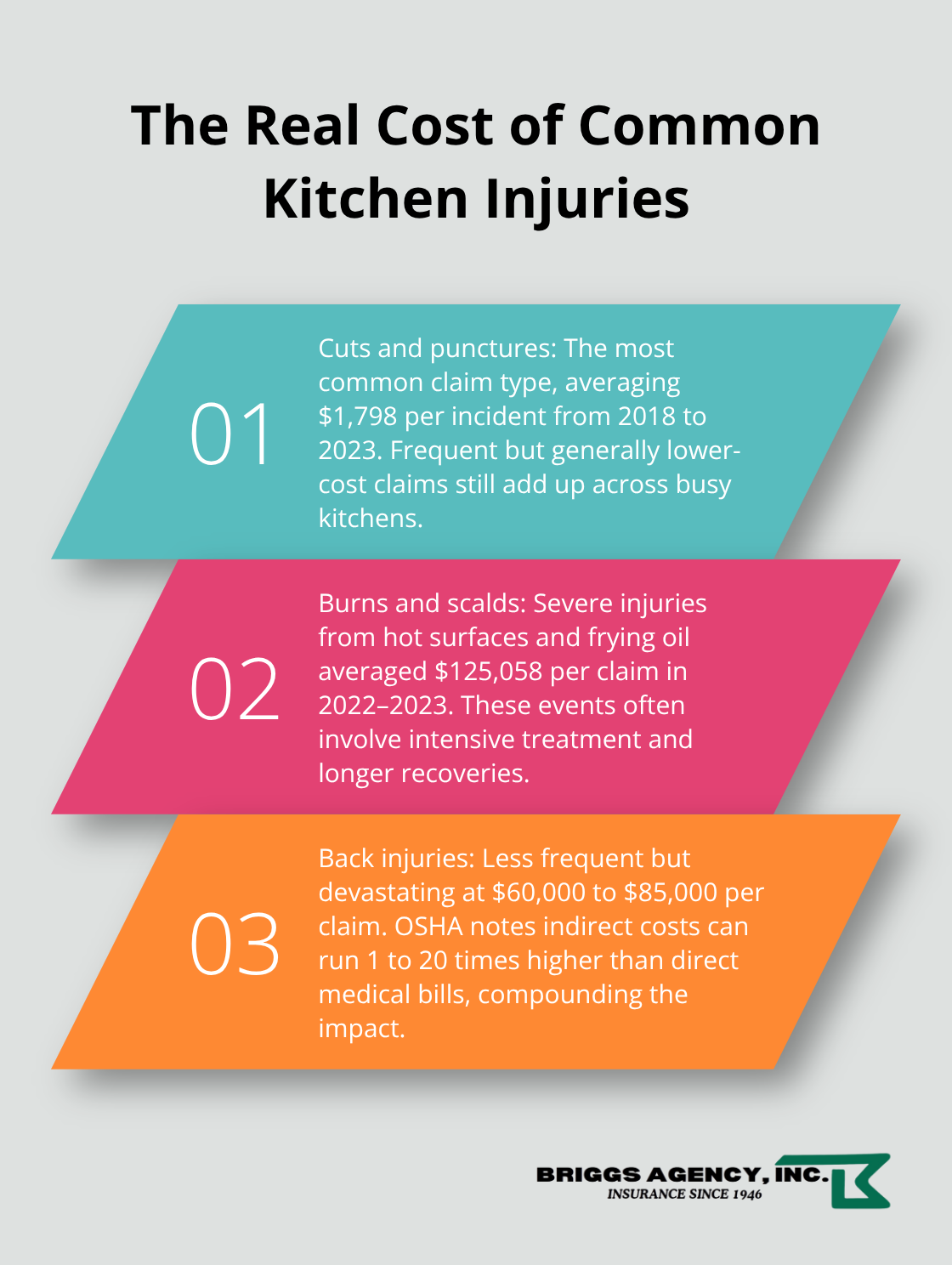
Restaurant injuries carry steep price tags, and the numbers reveal why this coverage matters. According to AmTrust’s analysis of roughly 130,000 workers compensation claims from 2018 to 2023, cuts and punctures from kitchen tools or broken glass represent the most common claim type, averaging $1,798 per incident. Burns and scalds from hot surfaces and frying oil averaged $125,058 per workers’ compensation claim in 2022 and 2023. Muscle strains and sprains from wet floors or heavy lifting run $9,966 to $10,672 per claim. Back injuries are rare but devastating-they typically cost $60,000 to $85,000 per claim due to heavy lifting and repetitive motions. Beyond direct medical costs, OSHA estimates indirect costs from workplace injuries run one to twenty times higher than direct costs, including lost productivity, temporary staff coverage, training replacements, and potential reputational damage when injuries become public.
Why This Protection Protects Your Business Too
Workers compensation isn’t just about employee welfare-it protects your restaurant from financial collapse. Without proper coverage, a serious injury exposes you to lawsuits, legal defense costs, and settlements that can devastate a small operation. The policy includes employer’s liability coverage, which defends against claims that you were negligent and covers attorney fees, court costs, and settlements. Most states require coverage if you have employees, and the penalties for operating without it include fines, license suspension, and personal liability.
Moving Forward With the Right Coverage
Understanding what workers compensation covers is only half the battle. The next step involves identifying which specific coverage types matter most for your restaurant’s unique operation and risk profile.
What Each Coverage Type Means for Your Restaurant
Medical Expense Coverage: The Foundation of Protection
General liability insurance forms the backbone of workers compensation, paying for all medical care tied to a work injury-from the ambulance ride to months of physical therapy. When a line cook suffers a severe burn from a fryer, medical coverage picks up emergency room costs, surgical procedures, ongoing wound care, and medications needed during healing. This applies whether the injury requires a single urgent care visit or extended hospitalization and rehabilitation. The coverage removes the burden of your employee choosing between medical care and financial hardship, which matters because untreated injuries often lead to complications, longer recovery times, and higher indirect costs for your business.
Wage Replacement Benefits: Keeping Your Team Stable
Wage replacement benefits function differently than medical coverage-they replace a portion of lost income while an injured employee recovers and cannot work. If a server with a shoulder injury takes eight weeks off, the policy typically covers 66 2/3 percent of their average weekly wage during that period, depending on your state’s rules. This partial wage replacement keeps your injured team member financially stable and reduces the likelihood they’ll return to work too soon and worsen their injury. The AmTrust analysis of 130,000 workers compensation claims from 2018 to 2023 shows that muscle strains and sprains average $9,966 to $10,672 per claim, and many of those injuries require weeks away from work-wage replacement ensures your employee isn’t forced into debt while healing.
Disability and Vocational Rehabilitation: Supporting Long-Term Recovery
Disability and vocational rehabilitation services address longer-term consequences when an injury causes permanent damage. If a back injury from repetitive lifting leaves an employee unable to return to their kitchen role, vocational rehabilitation helps them retrain for a different position within or outside your restaurant. Some policies also cover permanent partial disability payments if an injury results in lasting functional loss, such as reduced grip strength or chronic pain that prevents full duty work. These services matter because back injuries-the most expensive restaurant workers compensation claims at $60,000 to $85,000 per incident according to AmTrust data-often create situations where employees cannot safely perform their original duties. Without rehabilitation support, you lose experienced staff and face hiring and training costs for replacements.
Choosing the Right Coverage Limits for Your Operation
Different restaurants face different physical demands, and your coverage should reflect that reality. A high-volume kitchen with heavy lifting demands requires different protection than a fast-casual establishment with lighter physical work. The right coverage limits depend on your staff size, the types of roles you employ (line cooks carry higher risk than hosts), and your restaurant’s specific hazards. Understanding these distinctions helps you avoid both underinsurance and unnecessary overpayment, positioning your operation for financial stability when injuries occur.
How to Stop Restaurant Injuries Before They Happen
The most effective way to reduce workers compensation claims is to prevent injuries in the first place. Restaurant injuries follow predictable patterns, and AmTrust’s analysis of 130,000 claims from 2018 to 2023 shows exactly where your prevention efforts should focus. Cuts and punctures top the list as the most common claim type, followed by burns from hot surfaces and frying oil, then muscle strains from wet floors and heavy lifting. Back injuries, while less frequent, cost $60,000 to $85,000 per claim, making them the most expensive to treat. This data tells you something critical: prevention in kitchens isn’t about vague safety culture-it’s about addressing specific hazards with targeted action.
Eliminate Wet Floors and Slip Hazards
Wet floor hazards cause both cuts when employees slip into sharp objects and strains when they overextend to catch themselves. Require slip-resistant footwear for all kitchen and prep staff, not as a suggestion but as a non-negotiable uniform requirement. Clean spills immediately, not within five minutes or when someone notices-immediately. Assign a staff member during each shift to walk the kitchen every thirty minutes specifically to look for water, grease, or debris. Mark hot surfaces and high-risk equipment with clear warning labels and reflective tape so new hires and tired closing-shift staff instantly recognize danger zones. These aren’t expensive changes-they’re operational fixes that cost almost nothing but save tens of thousands in claim costs.
Organize Sharp Tools and Prevent Cuts
For cuts, implement a knife storage system where blades point downward in a designated rack rather than scattered in soapy dishwater. Train employees to pass knives handle-first and never hand them across the counter. Organize your prep station so sharp tools have designated homes and staff don’t dig through drawers searching for equipment. This simple reorganization removes one of the most common injury sources in your kitchen.
Structure Onboarding and Safety Training
High staff turnover in restaurants makes it tempting to skip formal training, but that turnover is exactly why structured onboarding and safety training saves money. New employees should receive hands-on instruction during their first shift on proper lifting technique-feet shoulder-width apart, bend at the knees not the back, keep loads close to the body. Show them how to operate equipment they’ll use daily and require them to demonstrate competency before working unsupervised. Create a simple written checklist of kitchen hazards and have each new hire sign it after walking through the space with a manager. Document these training sessions because safety documentation reduces premiums over time and protects you legally if an injury occurs and questions arise about whether proper instruction happened.
Maintain Consistent Safety Communication
Many insurance carriers offer free or low-cost safety resources including handbooks, posters, and on-site assessments-use them. Hold brief five-minute safety huddles before busy shifts where you highlight one specific hazard or near-miss from the previous week. If someone nearly slipped on a grease spot, talk about it. If a knife dropped near someone’s foot, discuss how to handle sharp tools safely. These quick touchpoints cost nothing and keep safety front-of-mind when staff might otherwise operate on autopilot during chaotic service.
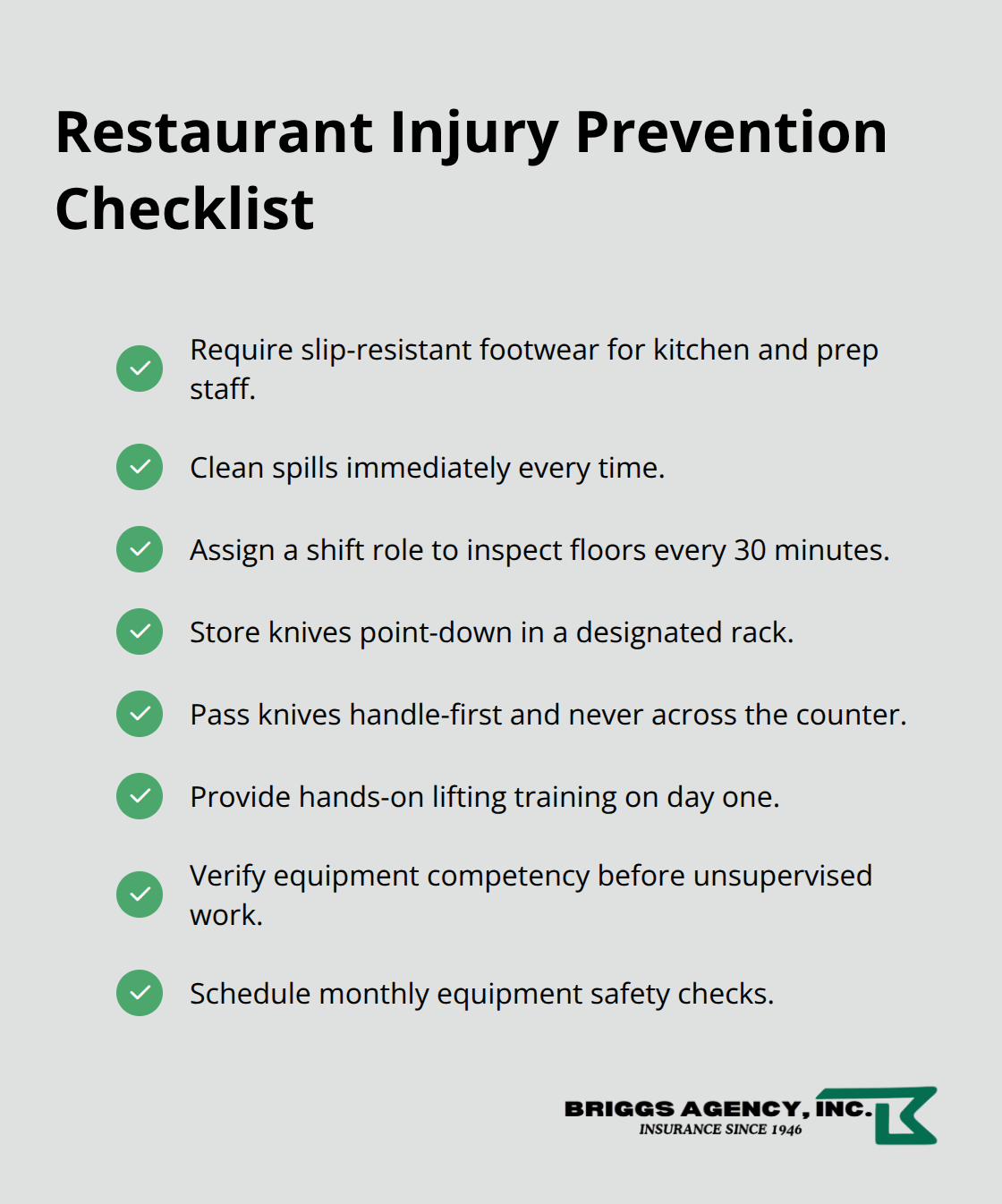
Inspect equipment regularly-fryers, grills, and slicers should have a monthly maintenance check where you verify safety guards are in place and functioning. Equipment failures cause injuries, and preventive maintenance stops failures before they happen.
Final Thoughts
Restaurant workers compensation protects your team and your business from financial devastation when injuries occur. You now understand what coverage actually pays for, which claim types cost the most, and exactly which prevention steps reduce injuries before they happen. The data shows that cuts and burns happen frequently but cost less per claim, while back injuries are rare but catastrophic at $60,000 to $85,000 each.
Prevention through slip-resistant footwear, immediate spill cleanup, structured safety training, and regular equipment maintenance directly reduces these costs and keeps your staff healthy. Review your current workers compensation coverage to confirm it matches your restaurant’s actual risk profile. If you employ line cooks, prep staff, and servers, your coverage needs differ from a fast-casual operation with lighter physical demands.
At Briggs Agency, Inc., we represent multiple top-rated carriers and compare options to find restaurant workers compensation that fits your operation and budget. Our local agents understand the specific risks restaurants face in Indiana and can tailor coverage to your staff size, job classifications, and hazard exposure. Contact us to review your current coverage or get a quote that reflects your restaurant’s actual needs.
The information provided in this blog is for general informational purposes only and does not constitute legal, financial, or insurance advice. Coverage options, terms, and availability may vary. Please consult with a licensed professional for advice specific to your situation.
Artificial intelligence may have been used to generate text and images in some blog articles.

