

Protect Your Business With E&O insurance coverage and Strong Risk Management
One mistake or missed deadline can cost your business thousands in legal fees and settlements. At Briggs Agency, Inc., we’ve seen how quickly a client claim can threaten a professional services firm.
E&O insurance coverage protects you when things go wrong, but insurance alone isn’t enough. The businesses that survive claims strongest combine solid coverage with strong risk management practices.
What E&O Insurance Actually Pays For
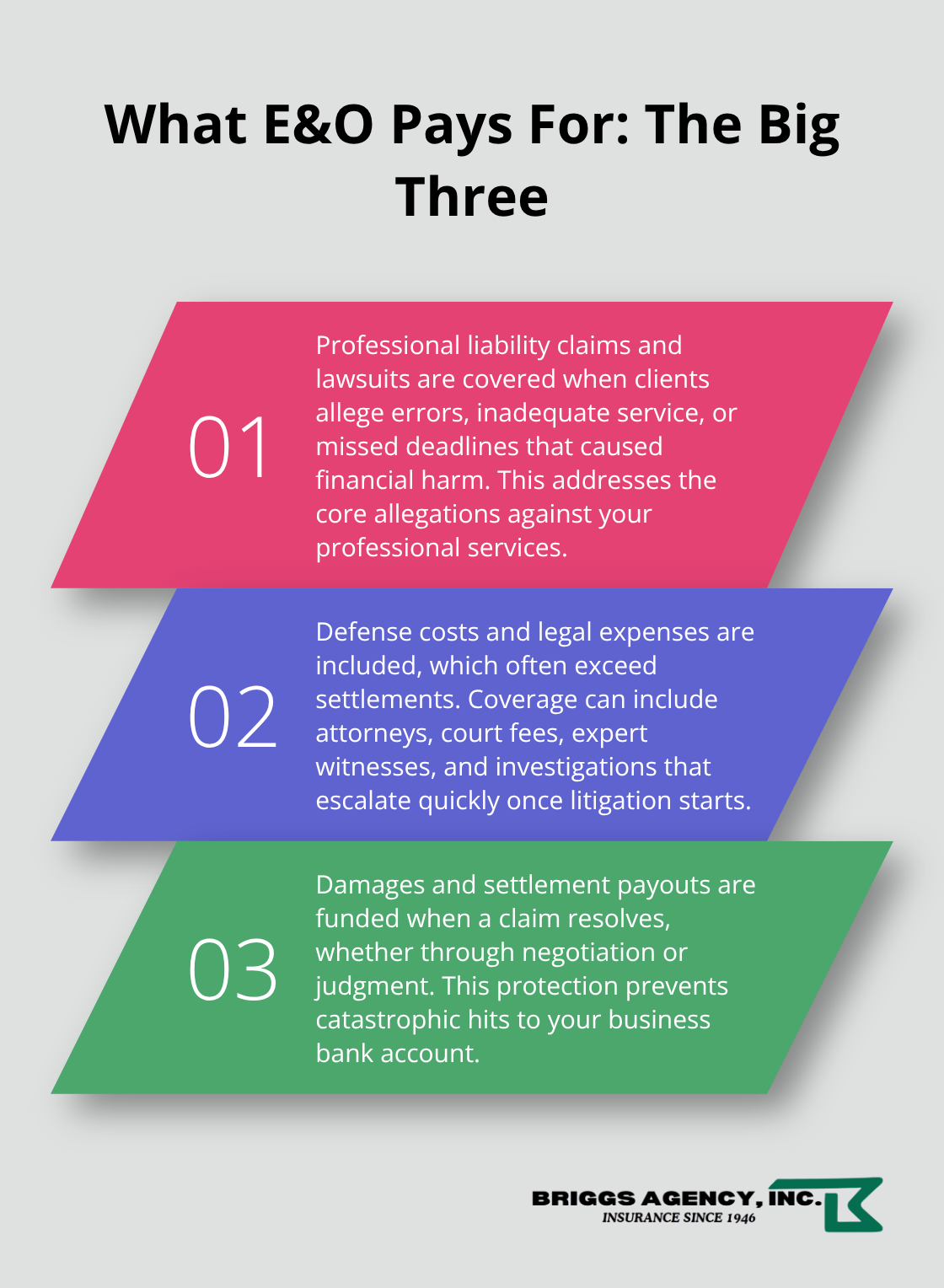
E&O insurance covers three distinct categories of expenses when a client claim emerges, and understanding what falls under your policy matters far more than most business owners realize. First, your policy covers professional liability claims and lawsuits themselves-the actual allegations that you failed to deliver adequate service, made a critical error, or missed a deadline that harmed your client financially. This isn’t theoretical protection; professional services claims can involve significant costs depending on your industry.
Second, E&O policies cover defense costs and legal expenses, which often exceed the actual settlement amount. Defense costs include attorney fees, court filings, expert witness testimony, and investigation expenses that accumulate rapidly once litigation begins. Many business owners don’t realize that these legal expenses typically come out of pocket first, then get reimbursed by your insurer-which means you need liquid capital or a policy with defense cost coverage outside your policy limits.
Third, your policy covers damages and settlement payouts when a claim resolves, whether through settlement negotiation or court judgment. This protection shields your business bank account from catastrophic loss.
Coverage Limits Determine Your Real Protection
Your policy limit sets your maximum protection, and choosing too low a limit creates dangerous exposure. A contractor facing a delayed project claim might face $200,000 in damages, but a software developer or consultant could face claims exceeding $500,000 when a system failure costs a client significant revenue. Most client contracts now require minimum coverage of $1 million or higher, so review your actual agreements to see what liability limits your clients demand you carry.
What Most Policies Exclude
E&O policies specifically exclude fraud, criminal activity, and intentional misconduct, which means dishonest business practices won’t receive coverage regardless of your premium payments. Policies also typically exclude prior acts, meaning claims arising from work completed before your policy start date fall outside coverage. This prior acts exclusion creates real problems when you switch insurers (timing matters significantly when you purchase or renew coverage).
Understanding these coverage gaps and limits sets the foundation for stronger protection. The next step involves pairing your E&O policy with active risk management strategies that actually prevent claims from happening in the first place.
Why E&O Insurance Protects Your Bottom Line
The Real Cost of Claims Without Coverage
A single professional liability lawsuit costs more than $27,000 to defend on average, according to research on medical malpractice claims. Without E&O coverage, those expenses come straight from your operating account, forcing you to choose between paying lawyers and paying employees. Service professionals often watch their business savings evaporate within months of a claim. The financial protection E&O insurance provides keeps your business operational while you fight a claim rather than simply covering damages after the fact.
How Long Claims Actually Disrupt Your Cash Flow
Professional services firms face claims that take 18 to 24 months to resolve, meaning your cash flow stays disrupted for nearly two years without proper coverage. Your policy covers legal fees upfront, investigation costs, expert witnesses, and settlement amounts, which means your business continues functioning instead of grinding to a halt. This extended timeline makes advance preparation critical-you cannot afford to scramble for funds while litigation proceeds.
Contract Requirements Drive Your Coverage Decisions
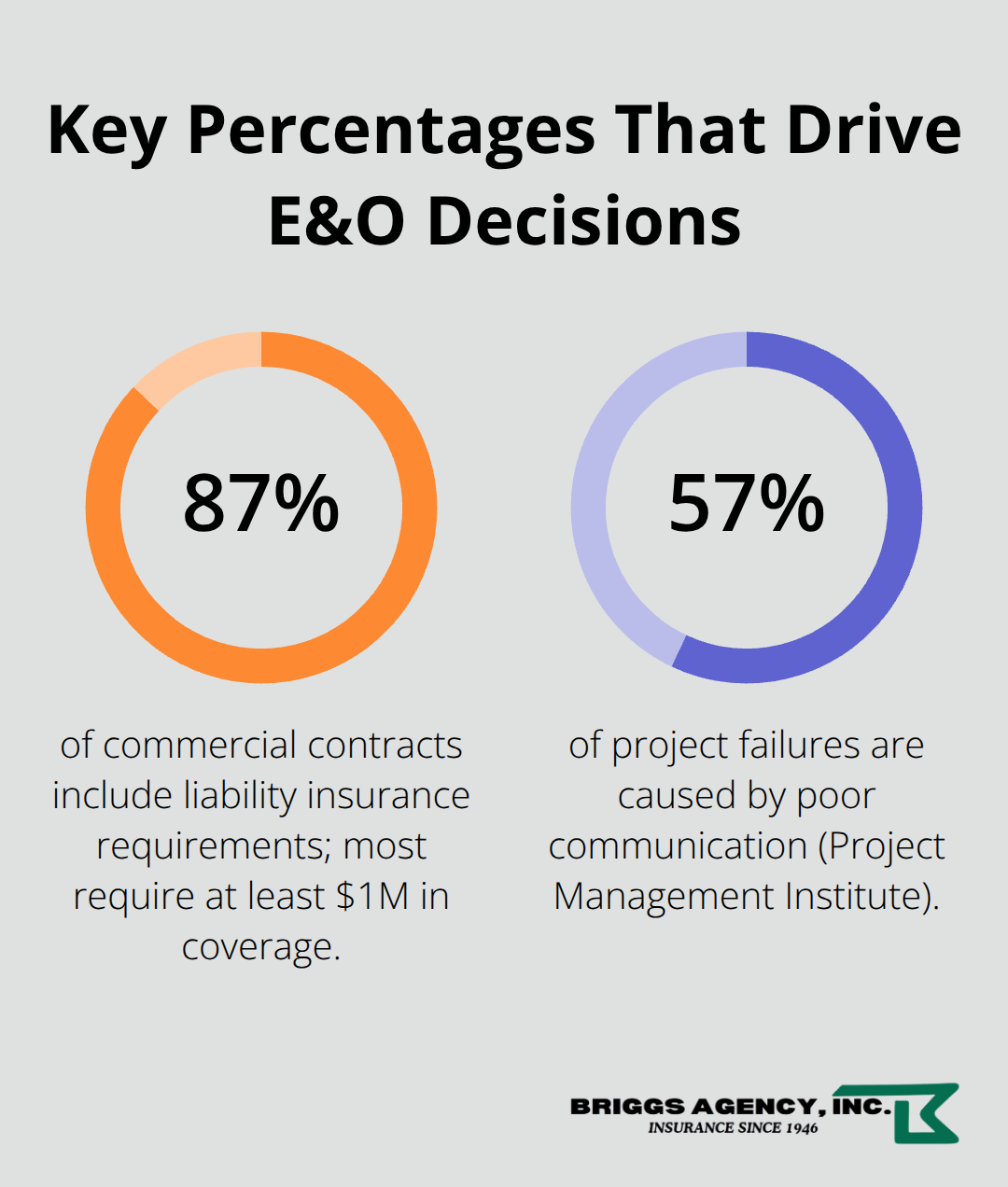
Client contracts now demand proof of coverage as standard practice. Over 87% of commercial contracts reviewed by risk management consultants include specific liability insurance requirements, and most specify minimum coverage of $1 million.
Without documented E&O insurance, you simply cannot bid on larger projects or contracts with established companies. Clients view your E&O policy as proof you take professional responsibility seriously, which builds their confidence in your ability to deliver quality work and handle problems professionally.
Industry Standards Vary by Your Profession
Architects typically carry $2 million to $5 million in coverage, while consultants operate effectively with $1 million to $2 million. Your contract requirements should drive your coverage decisions rather than industry averages alone. Meeting these contractual obligations isn’t optional-it’s the price of entry for professional services work.
With your E&O policy protecting your finances, the next step involves pairing that coverage with active risk management strategies that actually prevent claims from happening in the first place.
How to Prevent Claims Before They Happen
Insurance pays for mistakes, but preventing mistakes costs far less and protects your reputation. E&O coverage becomes infinitely more valuable when combined with operational practices that actually reduce the likelihood of claims occurring in the first place. The businesses that handle claims best aren’t the ones with the highest coverage limits-they’re the ones that rarely need to file claims at all because their internal processes catch problems before clients do.
Documentation Creates Your Defense
Every project decision, client conversation, and work milestone needs documented proof. When a claim emerges, your documentation either proves you delivered appropriate service or it proves you cut corners-there’s no middle ground. Create written project scopes that specify exactly what you will and won’t deliver, what the client must provide, and timeline expectations. Have clients sign these scopes before work starts. When disputes arise months later, that signed document becomes your strongest protection because it shows you explicitly communicated boundaries and deliverables upfront.
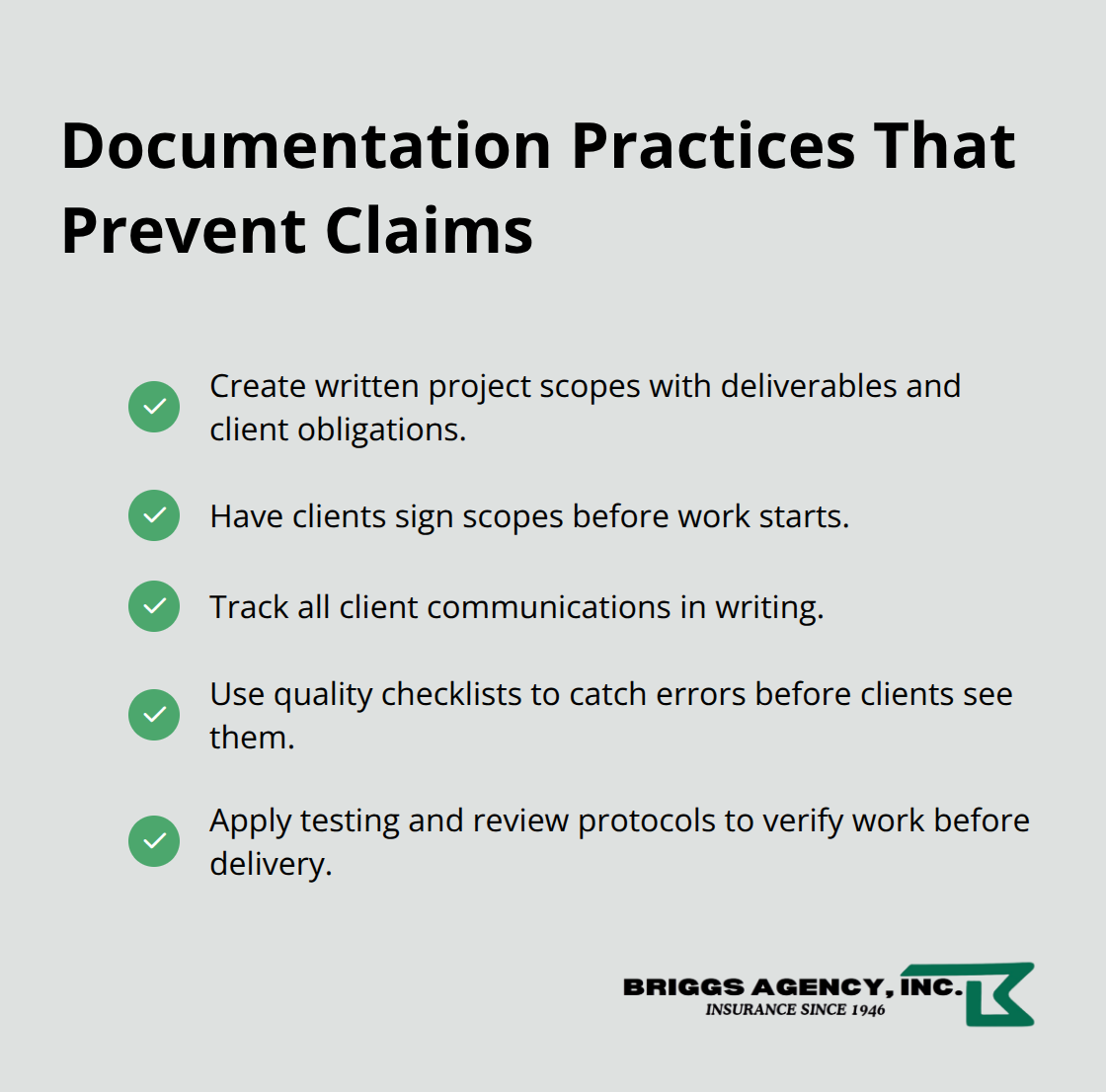
Track all client communications in writing through email, project management platforms, or client portals rather than relying on phone calls or casual conversations. If a disagreement surfaces later, you’ll have a complete record proving what you promised and what you delivered. Quality checklists catch errors before they reach clients-architects use construction checklists to verify specifications, software developers use testing protocols to identify bugs, and consultants use review processes to verify recommendations. These internal checkpoints prevent the mistakes that create claims in the first place.
Training Prevents the Most Expensive Mistakes
Your team members make decisions daily that either protect you from claims or expose you to them. Invest in specific, measurable training focused on your actual work processes rather than generic compliance videos. A consultant might train staff on client interview techniques to ensure thorough information collection before recommendations. A contractor might train crews on measurement verification to prevent costly estimation errors. A designer might train staff on version control and approval workflows to prevent delivering outdated designs.
Training should address the specific mistakes that have actually cost your industry money. Poor communication causes 57% of project failures according to the Project Management Institute, which means communication training directly prevents claims. Test your team’s understanding through practical scenarios or case reviews rather than just checking attendance boxes. When your team understands why clear documentation matters and how sloppy processes create liability, they become your first line of defense against claims.
Regular Reviews Catch Policy Gaps Before Claims Expose Them
Schedule a formal review of your coverage and risk management practices annually, not just when your policy renews. Contract requirements change as you take on new clients, and your coverage limits should reflect your actual exposure. If you’ve expanded into new service areas or taken larger projects, your current limits might no longer match your risk. A contractor who previously handled $500,000 projects but now regularly manages $2 million jobs needs higher coverage.
Review which claims your industry has actually faced in the past year and verify your policy covers them. Industry associations track common claims-your professional organization likely publishes this data. Adjust your internal processes based on real claims data rather than guessing what might go wrong. We at Briggs Agency, Inc. work with business owners to review coverage annually and identify gaps before they matter, helping your protection keep pace with your growing business.
Final Thoughts
E&O insurance coverage protects your business from financial devastation after a client claim, but insurance alone won’t shield you from every threat. The businesses that survive claims strongest combine solid coverage with operational practices that prevent claims from happening in the first place. Your documentation systems, team training, and regular policy reviews work together with your E&O insurance coverage to create comprehensive protection against the mistakes that threaten professional services firms.
Risk management and insurance work as partners, not competitors. When you implement clear processes, train your team on best practices, and catch errors before clients discover them, you reduce the likelihood of ever filing a claim. Your E&O policy then provides financial protection if something still goes wrong despite your best efforts, keeping your business operational and protecting your reputation while meeting the contract requirements your clients demand.
Evaluate whether your current coverage matches your actual exposure by reviewing your client contracts for specific liability limits they require and assessing whether your policy covers those amounts. We at Briggs Agency, Inc. help business owners throughout Crown Point and beyond compare E&O options and build protection strategies tailored to their specific risks. Contact us today to review your coverage and identify any gaps before they become expensive problems.
The information provided in this blog is for general informational purposes only and does not constitute legal, financial, or insurance advice. Coverage options, terms, and availability may vary. Please consult with a licensed professional for advice specific to your situation.
Artificial intelligence may have been used to generate text and images in some blog articles.

