

Business property protection: Safeguard Your Assets and Bottom Line
Your business property is one of your most valuable assets. Yet many business owners operate without fully understanding their exposure to damage, theft, or loss.
At Briggs Agency, Inc., we’ve seen firsthand how the right business property protection can mean the difference between a temporary setback and a financial crisis. This guide walks you through what you need to know to keep your assets-and your bottom line-secure.
What Property Damage Actually Costs Your Business
Property damage strikes businesses harder than most owners anticipate. The National Association of Insurance Commissioners reports that property losses cost U.S. businesses over $60 billion annually, yet many operations remain significantly underinsured. When fire, weather, theft, or equipment failure hits, the financial damage extends far beyond the immediate repair or replacement costs. Your business faces lost revenue, employee downtime, customer dissatisfaction, and potential long-term reputation damage that can take months or years to recover from.
The Real Price of Underestimating Risk
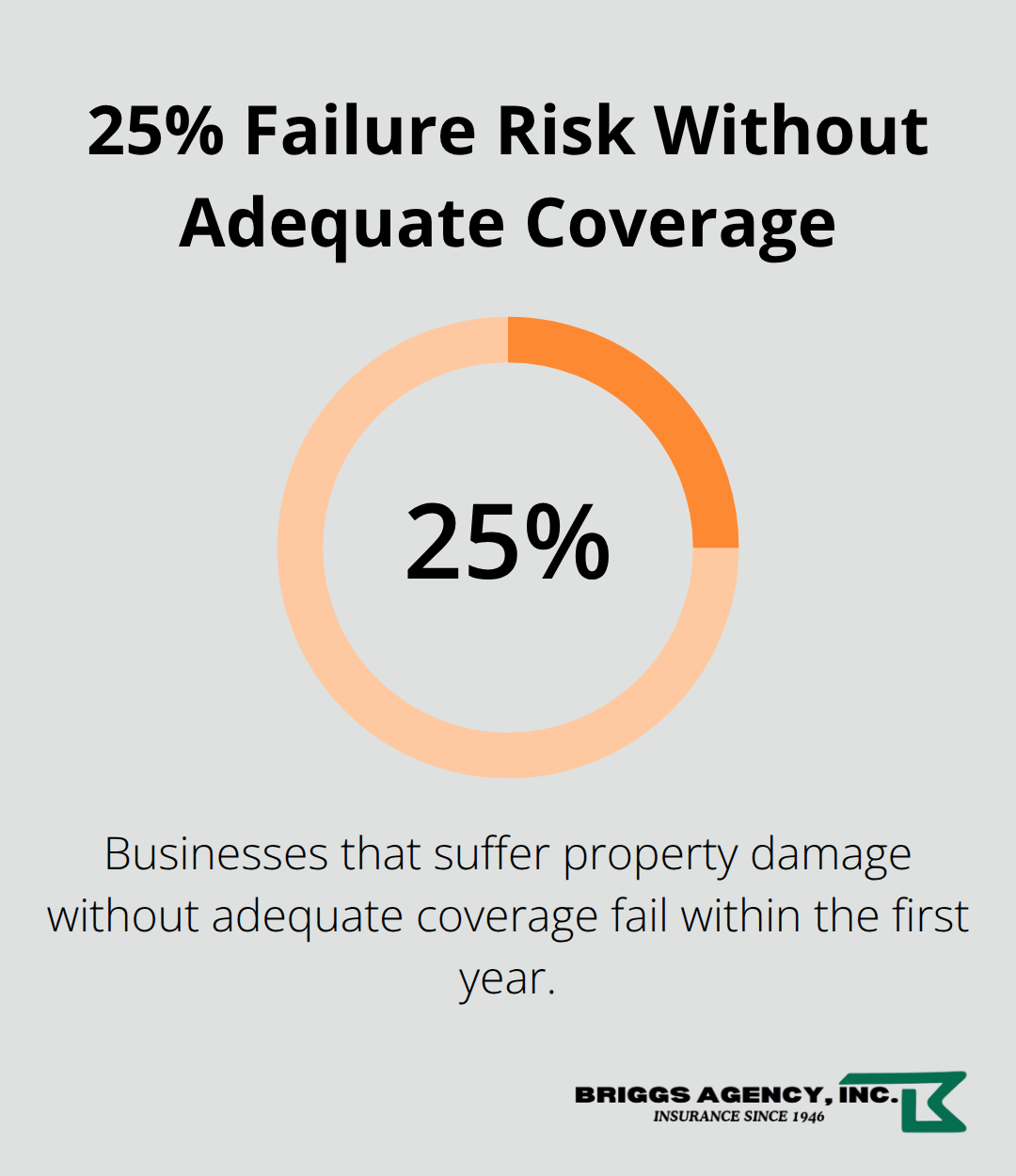
Most business owners focus only on replacing damaged property itself. They miss the cascading financial impact. A manufacturing facility damaged by fire doesn’t just lose equipment worth $500,000-it loses production capacity, customer orders, and employee wages for weeks or months. According to the U.S. Small Business Administration, businesses that experience property damage without adequate coverage face a 25% failure rate within the first year. The building or inventory sits idle while competitors fulfill your contracts.
Clients move to other vendors. Your cash flow stops while expenses continue. This operational collapse kills more businesses than the initial damage itself.
Weather Creates Growing Exposure
Weather represents an increasing threat to your assets. The Insurance Information Institute found that weather-related property claims have risen 40% over the past decade, with severe thunderstorms, hail, and flooding driving the majority of losses. A single hail event can damage roofs, HVAC systems, and exterior structures. Flood damage averages $25,000 per incident according to FEMA data, yet most standard policies exclude flood coverage entirely. Your business might carry basic property insurance that leaves you exposed to these exact scenarios.
Inventory and Equipment Losses Compound the Problem
Retail businesses, restaurants, and manufacturers hold significant assets in stock, machinery, and specialized tools. A break-in or fire destroys raw materials, finished goods, and production equipment that took years to acquire. The replacement timeline matters enormously. You cannot simply order new commercial equipment and have it installed tomorrow. Lead times for specialized machinery stretch weeks or months. During that period, your revenue drops to zero while you still pay rent, utilities, and payroll. Business interruption insurance bridges this gap (covering lost income and continuing operating expenses when you cannot operate). Without it, you bank on personal savings or loans to survive the shutdown period.
Why Standard Coverage Falls Short
Standard policies leave critical gaps that expose your operation to financial ruin. Most business owners don’t realize what their current coverage actually protects-and more importantly, what it doesn’t. Equipment breakdown, inventory spoilage, and temporary relocation costs often fall outside standard protection. The assets that matter most to your specific industry may not receive adequate limits. Your local agent at Briggs Agency, Inc. works with business owners to identify these exact coverage gaps before disaster strikes. Understanding your exposure and the threats your industry faces allows you to protect the assets that matter most.
What Coverage Types Protect Your Business Assets
Building Protection Forms Your Foundation
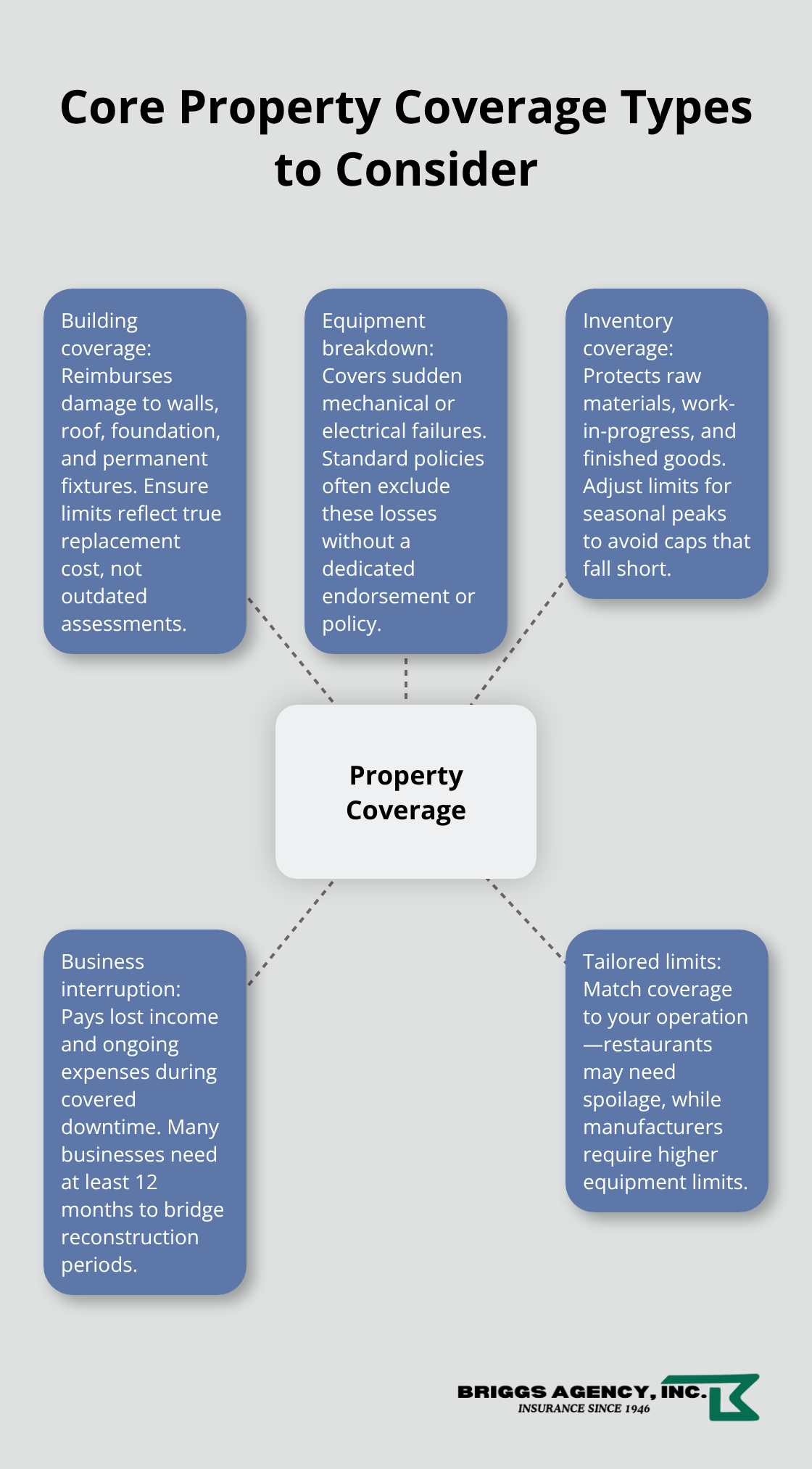
Building coverage reimburses you for structural damage to walls, roofs, foundation, and permanent fixtures, yet many owners purchase far too little. A commercial building valued at $800,000 with only $400,000 in coverage leaves you exposed to catastrophic loss. The Insurance Information Institute reports that the average commercial building replacement cost runs $313 to $378 per square foot for single-story buildings, meaning a 5,000-square-foot facility costs $1.565 million to $1.89 million to rebuild. Most owners underestimate this figure by 30% to 50%. You need coverage that reflects actual replacement costs, not outdated property tax assessments.
Equipment Breakdown Hits Your Bottom Line Instantly
Machinery failure creates immediate operational collapse. When an HVAC system fails in summer or a refrigeration unit stops working, you face production stoppage and revenue loss. Spoilage claims alone cost restaurants and food retailers an average of $8,000 per incident according to industry data, and that’s just one failure. Manufacturing equipment failures cost significantly more. Standard policies often exclude mechanical breakdown entirely, treating it as maintenance rather than loss. Specialized equipment breakdown policies cover the repair or replacement of machinery, electronics, and systems that your operation depends on daily.
Inventory Coverage Protects Your Stock
Inventory coverage protects the actual products you stock, whether raw materials, work-in-progress items, or finished goods. Retail businesses typically hold 40% to 60% of annual revenue in inventory at any given time, yet many policies cap inventory protection at unrealistic limits. A clothing retailer with $200,000 in seasonal stock faces total loss if a fire strikes during peak inventory season. Your policy should reflect your actual inventory levels throughout the year, accounting for seasonal fluctuations.
Business Interruption Insurance Bridges Critical Gaps
Business interruption insurance covers the gap that building and equipment coverage leaves open. When your facility becomes unusable, this coverage pays your lost net income and continues your operating expenses (rent, utilities, payroll, loan payments) while you cannot operate. The National Association of Insurance Commissioners found that businesses without interruption coverage face average losses of $250,000 to $500,000 per month of downtime. A single week of closure for a small business can eliminate months of profit. This coverage typically activates immediately when a covered peril forces closure and continues until you can resume normal operations or until the policy limit expires. The duration matters critically-most businesses need at least 12 months of coverage to survive extended reconstruction periods.
Matching Coverage to Your Specific Operation
Each coverage type addresses different exposures, and your actual needs depend on what your business does. A restaurant needs equipment breakdown and spoilage coverage that a service business might never use. A manufacturer needs higher equipment limits than a consulting firm. Your local agent can identify which coverage types address your actual exposures rather than selling generic packages that leave gaps.
The next step involves taking inventory of what you own and evaluating whether your current protection matches your real asset values.
How to Identify What You Actually Own and What Protection Gaps Exist
Most business owners operate with incomplete information about their own assets. You likely know your building’s approximate value and maybe your equipment costs, but few business owners maintain a detailed, current inventory that insurance companies actually need. This gap between what you think you’re covered for and what your policy actually protects creates serious exposure.
Start with a Complete Physical Inventory
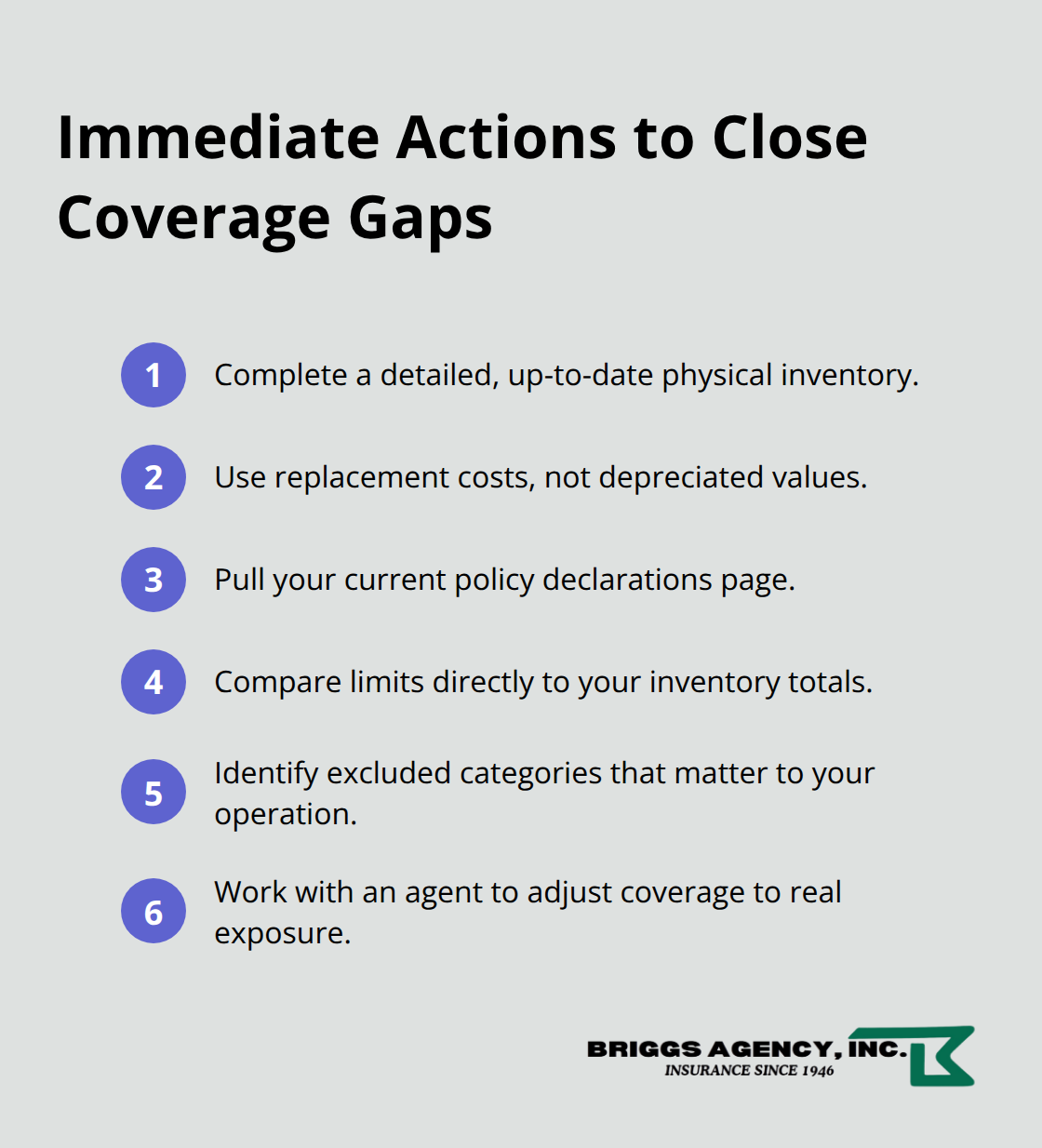
Walk through your facility and document every asset: machinery, computers, furniture, inventory, signage, tools, vehicles parked on-site, HVAC systems, security equipment, and specialized industry-specific items. Assign realistic replacement costs to each category, not depreciated values. The NFPA (National Fire Protection Association) recommends updating this inventory annually because businesses constantly acquire new equipment and inventory changes seasonally.
Compare Your Inventory to Your Policy Declarations
Once you complete this inventory, compare it directly to your current policy declarations. Most business owners discover their policy limits don’t match their actual asset values. A contractor with $150,000 in tools and equipment might have only $50,000 in coverage. A restaurant with $120,000 in kitchen equipment could be insured for half that amount.
The coverage gap isn’t a minor oversight-it’s a financial catastrophe waiting to happen. Your policy declarations page lists exactly what’s covered and the limits for each category. If your building is valued at $1.2 million but your policy shows $800,000 in building coverage, you’re underinsured by $400,000.
Identify Excluded Coverage Categories
Many policies also exclude entire categories of loss that matter to your operation: equipment breakdown, inventory spoilage, data loss, or temporary relocation costs. Your current agent may have simply sold you standard coverage without analyzing your actual needs. These exclusions create blind spots that expose your business to unexpected financial loss when a claim occurs.
Work with an Agent Who Understands Your Business
The solution requires working with someone who understands your specific business and takes time to identify these gaps before a loss occurs. Your local agent can review your inventory against your current declarations and recommend coverage adjustments that match your real exposure. This process prevents the devastating scenario where you discover after a loss that your insurance falls short of what you need to rebuild. The few hours spent on this assessment now saves your business from financial ruin later.
Final Thoughts
Underinsurance remains the norm, not the exception, among business owners. Most operations carry 30% to 50% less coverage than they actually need, and the gap between what you think protects you and what your policy actually covers creates real financial exposure. A single fire, flood, or equipment failure eliminates years of profit if your business property protection falls short.
Three concrete actions strengthen your protection immediately. Complete a detailed inventory of everything your business owns using replacement costs rather than depreciated values, pull your current policy declarations and compare them directly to that inventory, and identify what your policy excludes entirely.
Most business owners discover significant gaps during this process, with equipment breakdown, inventory spoilage, and business interruption coverage often revealing themselves as missing pieces that matter enormously to your specific operation.
We at Briggs Agency, Inc. have served Crown Point and surrounding communities since 1946, helping business owners identify coverage gaps and build protection that matches your real exposure. Our independent agency represents multiple top-rated carriers, which means we compare options rather than pushing one company’s products. Contact Briggs Agency, Inc. to review your current business property protection and identify what you’re missing.
The information provided in this blog is for general informational purposes only and does not constitute legal, financial, or insurance advice. Coverage options, terms, and availability may vary. Please consult with a licensed professional for advice specific to your situation.
Artificial intelligence may have been used to generate text and images in some blog articles.

