
Contractor bond requirements: What Builders Need to Know
Contractor bond requirements can feel overwhelming, but they’re a non-negotiable part of doing business in construction. Whether you’re bidding on a government project or landing a local job, understanding what bonds you need-and why-directly impacts your ability to win contracts and protect your business.
At Briggs Agency, Inc., we’ve helped countless builders navigate these requirements without overpaying or missing critical deadlines. This guide breaks down the three main bond types, explains what federal and state regulations demand, and shows you how to get bonded at competitive rates.
Types of Contractor Bonds and Their Purpose
Performance Bonds Protect Project Owners
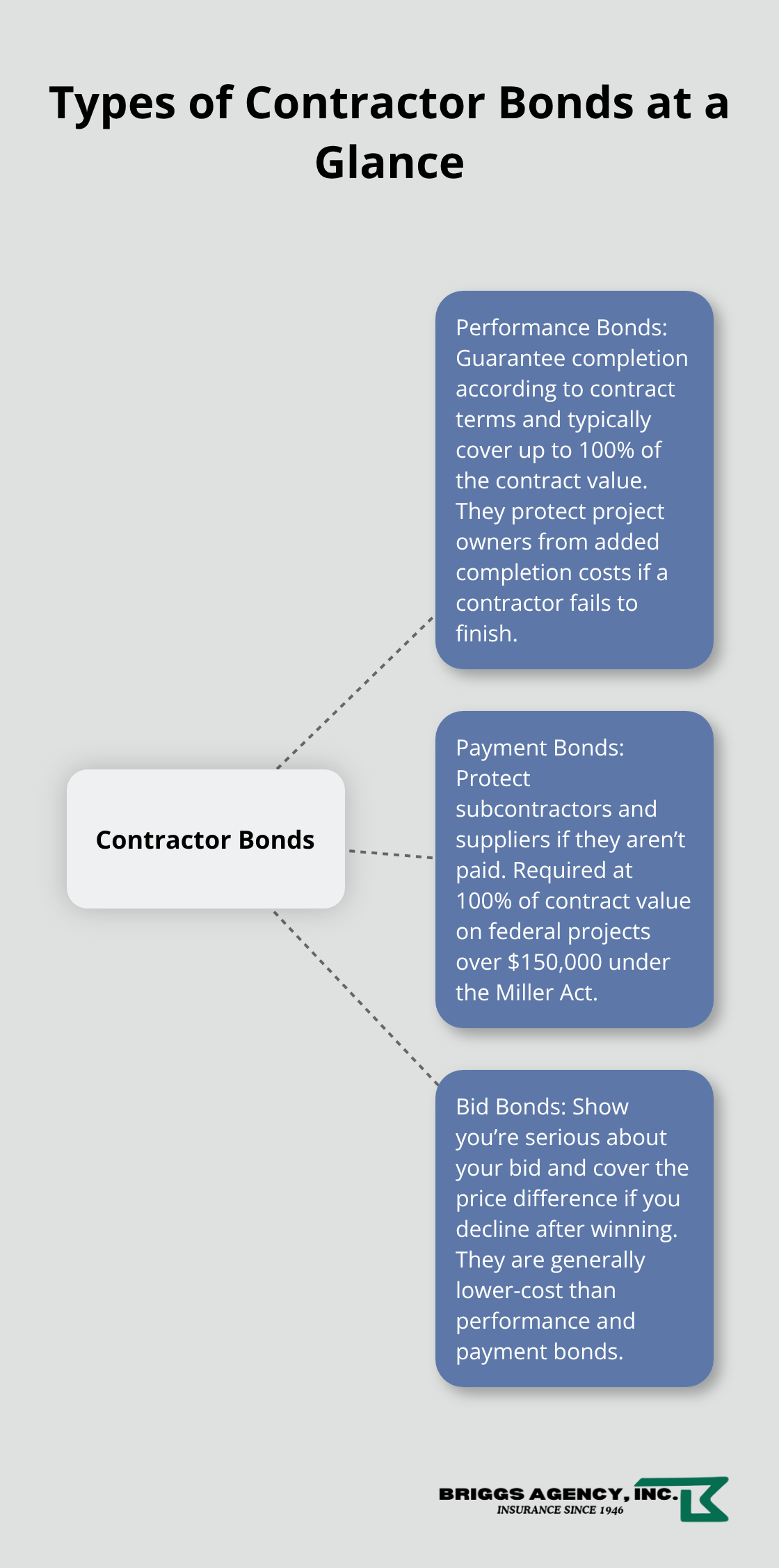
Performance bonds guarantee that you’ll complete a project according to the contract terms. If you fail to finish the work, the bond protects the project owner by covering completion costs, typically up to 100% of the contract value. This protection matters most on large projects where delays or incomplete work create significant financial exposure for the owner.
Payment Bonds Protect Subcontractors and Suppliers
Payment bonds work in the opposite direction from performance bonds. They protect subcontractors and material suppliers if you don’t pay them. On federal projects over $150,000, the Miller Act requires both performance and payment bonds at 100% of the contract value. Many state and local projects follow similar rules, though thresholds vary significantly-some states require bonds on projects as small as $25,000, while others don’t mandate them until $500,000.
Bid Bonds Demonstrate Contractor Credibility
Bid bonds prove you’re serious when submitting a bid. If you win and then refuse the job, the bid bond covers the difference between your bid and what the owner pays the next contractor. Most bid bonds cost 0.5% to 3% of the bid amount, making them relatively inexpensive compared to performance and payment bonds, which typically range from 1% to 5% annually depending on your credit, experience, and project risk.
Why Bonding Costs Add Up Quickly
Understanding these distinctions matters because bonding costs add up fast on larger projects. A $1 million commercial build might require $10,000 to $50,000 in annual bonding premiums. Contractors with strong financials, solid payment histories, and established track records typically qualify for the best rates. If your bonding costs seem high, the issue usually traces back to one of three factors: incomplete financial documentation, previous payment problems with suppliers or subs, or insufficient project experience in your category.
Getting Bonded Before You Need It
You should obtain bonding before you need it, since the underwriting process takes time and poor credit or limited experience can delay approvals or increase rates significantly. A local insurance agent who understands construction helps tremendously-they can identify which carriers offer the best rates for your specific situation and guide you through the application requirements before you face deadline pressure. This preparation becomes especially important when you’re ready to pursue larger contracts that demand bonding as a condition of bidding.
State and Federal Contractor Bond Requirements
Federal Bonding Mandates Apply Uniformly
Federal projects operate under strict bonding mandates that differ significantly from state and local work. The Miller Act, passed in 1935, requires performance and payment bonds on all federal construction projects exceeding $150,000. This threshold has remained unchanged for decades, which means most federal work demands bonding regardless of your company size or track record. If you bid on Department of Defense, General Services Administration, or any federally funded infrastructure project, you must post bonds at 100% of the contract value. The federal government verifies coverage before work begins and won’t award a contract without proof of bonding.
State Requirements Vary Dramatically
State bonding requirements diverge dramatically from federal rules and from each other. California requires bonds on public works projects over $25,000, while Texas doesn’t mandate them until $250,000. New York requires bonds on state projects over $50,000 but applies different thresholds for local municipal work. Florida applies bonding requirements to projects over $150,000, though some county governments impose lower limits. This variation means you cannot assume what worked for a project in one state applies elsewhere. You should check specific state bonding statutes before quoting any public work, since missing a requirement can disqualify your bid or expose you to liability if something goes wrong.
Local Jurisdictions Set Independent Thresholds
Local jurisdictions often impose their own thresholds independent of state law. Many cities and counties require bonds on projects as small as $50,000, even when their state doesn’t mandate bonding at that level. Some municipalities tie bonding requirements to project type rather than dollar amount-certain jurisdictions require bonds on all commercial work regardless of size but exempt residential projects. County road departments, school districts, and municipal authorities frequently set bonding requirements stricter than state minimums (sometimes requiring bonds on projects under $25,000 that state law wouldn’t touch).
How to Verify Local Requirements Before Bidding
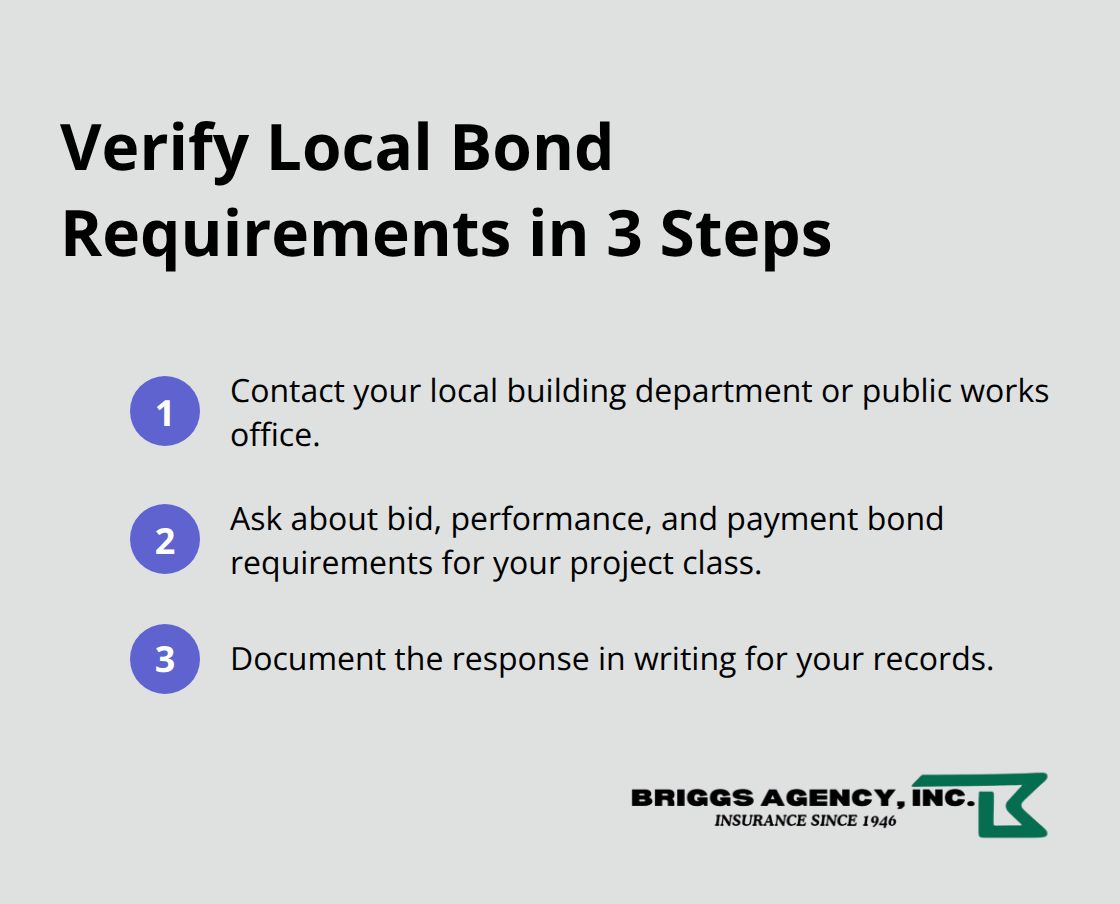
The safest approach involves contacting your local building department or public works office directly before bidding any public project over $25,000. Ask specifically about performance bond, payment bond, and bid bond requirements for your project classification. Document their answer in writing so you have proof of what was required if questions arise later.
This step takes minutes but prevents costly mistakes that could eliminate you from consideration or create compliance problems after you’ve won the work.
Understanding these layered requirements-federal, state, and local-positions you to bid confidently on public projects without surprises. Once you know what bonds you need, the next step involves finding the right carrier and securing competitive rates for your specific situation.
How to Obtain Contractor Bonds and Reduce Costs
Start the Bonding Conversation Early
Finding the right bonding carrier and securing favorable rates requires strategy, not just shopping around. Most contractors make a critical mistake by waiting until they’ve won a bid to contact a bonding agent, which eliminates negotiating power and creates time pressure that drives costs up. Instead, approach bonding like you’d approach financing for equipment-establish the relationship and get pre-qualified well before you need the coverage.
An independent insurance agent who works with multiple carriers holds significant advantage here because they can present your application to several underwriters simultaneously rather than relying on a single company’s appetite and pricing. This approach exposes your profile to carriers most likely to offer competitive rates for your trade, project type, and financial situation.
Understand What Underwriters Examine
The underwriting process examines three primary factors that directly impact your pricing: financial strength, payment history, and project experience. Underwriters pull your personal credit report, request three years of business tax returns, and verify that you’ve paid suppliers and subcontractors on time. If your credit score sits below 700 or you’ve had recent payment disputes, expect to pay 2 to 4 percentage points more than contractors with clean records.
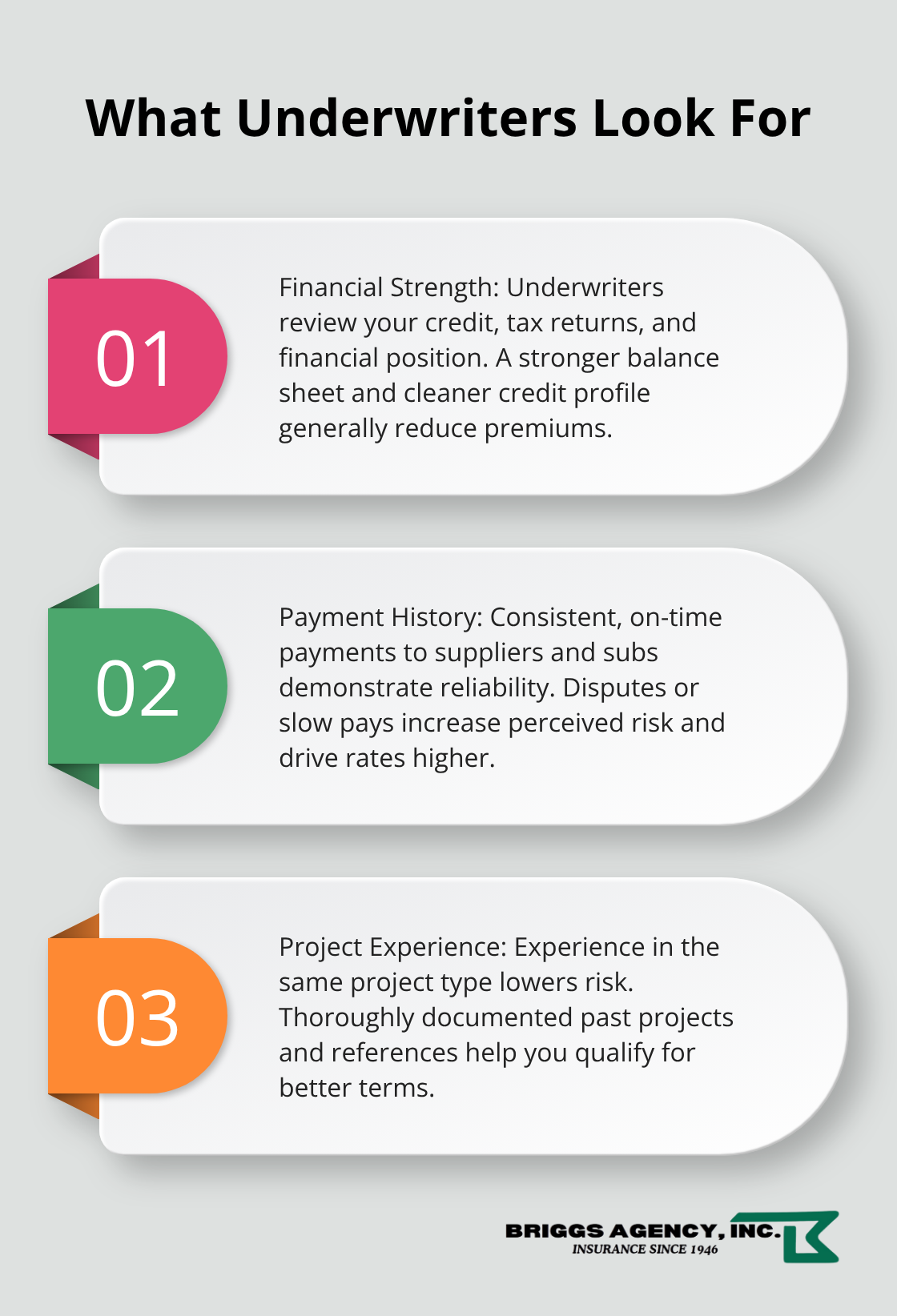
One practical step that moves the needle involves settling any outstanding supplier invoices before applying for bonds-this single action can lower your rates by 10 to 25 percent because it removes red flags from your payment history. Your experience level in specific categories matters equally; a contractor with ten years building commercial office buildings will qualify for better rates on office work than someone with only residential experience, even if both have identical credit scores. Document your project history thoroughly, including contract values, completion dates, and client references, because underwriters use this information to assess your competence and risk profile.
Prepare a Complete Application Package
The application itself demands accuracy and completeness because incomplete submissions get rejected or delayed, and resubmitting takes additional time. Prepare your application by gathering certified copies of your last three years of tax returns, proof of licensure, a current personal credit authorization form, and a detailed list of your last fifteen to twenty completed projects with values and dates.
Some underwriters require bank statements or proof of bonding capacity-essentially verification that you have sufficient assets or credit lines to handle the work you’re bidding. Many contractors submit partial applications, which triggers back-and-forth communication that stretches the underwriting timeline from five days to three weeks. Starting the bonding conversation early gives you breathing room to address underwriting questions without panic, and it signals to the carrier that you’re serious and organized, which subtly influences how they evaluate your application.
Work with Multiple Carriers Simultaneously
Presenting your profile to several underwriters at once (rather than one at a time) accelerates the approval process and creates competitive pressure that improves pricing. An independent agent coordinates this effort, handling the paperwork and follow-up while you focus on running your business. This coordination prevents the common scenario where you submit to one carrier, wait two weeks for a rejection, then start over with another carrier-a cycle that can consume a month or more.
Final Thoughts
Contractor bond requirements don’t have to derail your bidding strategy or drain your budget. Federal projects demand consistent bonding at 100% of contract value over $150,000, while state and local thresholds vary enough that you need to verify requirements before submitting any bid. Taking time to research your specific jurisdiction and project type prevents disqualifications and compliance headaches.
Establishing bonding relationships before you need coverage gives you a significant advantage over contractors who wait until the last minute. Your financial documentation, payment history, and project experience directly influence pricing, so addressing any red flags in your application before submission can save thousands in premiums. An independent agent representing multiple carriers compares options across underwriters to find the rates and terms that fit your situation.
Contact Briggs Agency, Inc. to discuss your bonding needs and get pre-qualified for competitive rates. Bring your financial documentation, project history, and specific questions about your jurisdiction’s requirements. This preparation positions you to bid confidently on public projects and protects your business from compliance surprises.
The information provided in this blog is for general informational purposes only and does not constitute legal, financial, or insurance advice. Coverage options, terms, and availability may vary. Please consult with a licensed professional for advice specific to your situation.
Artificial intelligence may have been used to generate text and images in some blog articles.

